Cape sand frog

Cape sand frog

Tomopterna delalandii

Silhouette: Dmitry Bogdanov (vectorized by T. Michael Keesey) · PhyloPic

LCLeast ConcernNTVUENCR
Daily sighting probability ~20% · Possible
at De Hoop Nature Reserve

In 3 days ~40% in a week ~80%

6 Verified sightings at De Hoop Nature Reserve From 2019 to 2026
100 In all 3 parks
April Best month
☀️🌙 Day & Night When it's spotted

About the Cape sand frog

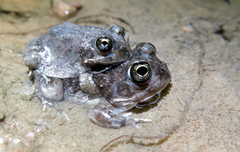
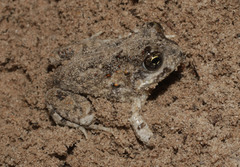
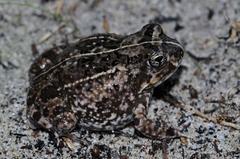
Delalande's sand frog (Tomopterna delalandii), also known as Delalande's frog, Cape sand frog, or striped pixie, is a species of frog in the family Pyxicephalidae. It is endemic to western and southern South Africa and occurs in the low-lying areas of Namaqualand, Western Cape, and Eastern Cape as far east as Cape St. Francis.

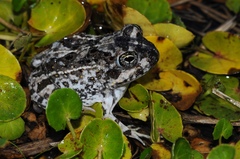
The specific name delalandii honours Pierre Antoine Delalande, a French explorer and naturalist who collected in the Cape area in 1818. Tomopterna delalandii is a robust-bodied species with toad-like appearance and gait. Females can reach 50 mm (2.0 in) in snout–vent length. The head is broad and the eyes are large and bulging. The legs are relatively short. There are no finger or toe discs but the toes have some webbing. The upper parts vary in colouration from light grey to dark brown, usually with a mottled appearance and a pale patch between the shoulders. There is also usually a pale vertebral stripe, and often a pale stripe on either side of the body. Males have a dark throat.

The male advertisement call is a series of short ringing notes, with about 6–8 notes per second. The species occurs... Wikipedia →

Sounds

Recording0:21

South Africa · 2024

© Nick Talbot · XC949376 · CC BY-NC-SA 4.0

Recording0:04

South Africa · 2018

© Alex Rebelo · iNaturalist · CC BY-NC 4.0

Recording0:07

South Africa · 2022

© Oliver Angus · iNaturalist · CC BY-NC 4.0

Global Distribution

Parks Where Found

# Park Country Daily sighting probability
1 De Hoop Nature Reserve 🇿🇦 South Africa
~20%
2 Table Mountain National Park 🇿🇦 South Africa
~10%
3 Addo Elephant National Park 🇿🇦 South Africa
~10%

Cities Where Found

# City Country Daily sighting probability
1 Cape Town 🇿🇦 South Africa
~10%

Before you go

What are the chances of seeing a Cape sand frog in De Hoop Nature Reserve?

Possible

About 20% of wildlife watchers report a Cape sand frog sighting in De Hoop Nature Reserve on a given day, based on 6 verified sightings from GBIF citizen-science data from 2019 to 2026. It is the 5th most-seen of the 6 amphibians we can rate there. Over three days the chance rises to about 40%, and over a week to about 80%, if each day is a fresh chance.

When is the best time to see a Cape sand frog in De Hoop Nature Reserve?

April

In that month about 50% of wildlife watchers report a Cape sand frog in De Hoop Nature Reserve on a given day, against under 5% in May, July–September and November–March, the lowest months.

What time of day is best to see a Cape sand frog?

Between 7 and 10 pm

Across all the parks we cover, that three-hour window holds the most Cape sand frog sightings with a recorded time, and about half of them come between 6 pm and 6 am: it is seen both by day and at night.

Is De Hoop Nature Reserve the best place to see a Cape sand frog?

Yes

Of the 3 parks where we can rate Cape sand frog sightings, De Hoop Nature Reserve has the highest daily chance: about 20%. Next come Table Mountain National Park (South Africa, about 10%) and Addo Elephant National Park (South Africa, about 10%).

Which relatives of the Cape sand frog live in De Hoop Nature Reserve?

Same family: Pyxicephalidae

The closest relatives of the Cape sand frog that you can see in De Hoop Nature Reserve (family Pyxicephalidae, African Box-headed Frogs) are Clicking Stream Frog (about 40%) and Cape River Frog (about 20%), with each one's daily chance of a sighting.

Where does the Cape sand frog sighting chance come from?

GBIF citizen-science records

It is estimated from how often the Cape sand frog is recorded against all the amphibians logged in De Hoop Nature Reserve (6 verified sightings from 2019 to 2026), calibrated against known sighting rates. Figures are rounded to the nearest 10% because citizen-science data supports honest approximations, not decimals, and months with records from fewer than five people show "—". How it works.

← Back to De Hoop Nature Reserve