Common Swee Waxbill

Common Swee Waxbill

Coccopygia melanotis

Silhouette: Sheatherius · PhyloPic

LCLeast ConcernNTVUENCR
Daily sighting probability <5% · Rare
at De Hoop Nature Reserve

In 3 days ~10%

10 Verified sightings at De Hoop Nature Reserve From 2019 to 2026
1,813 In all 4 parks
October Best month
☀️ Diurnal When it's spotted

About the Common Swee Waxbill

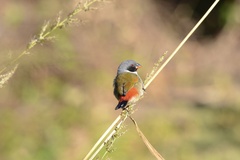
The swee waxbill (Coccopygia melanotis), is a common species of estrildid finch native to Southern Africa. The swee waxbill is 9–10 cm long with a grey head and breast, pale yellow belly, olive back and wings, red lower back and rump, and a black tail. The upper mandible is black and the lower red. The male has a black face, but the female's face is grey. Juveniles are much duller than the female and have an all-black bill.

The swee waxbill is typically found in uplands in dry shrubland and open forest habitats. Some subspecies also occur in lowlands, and may be seen in large gardens. This species is a common and tame bird typically seen in small parties, and does not form large flocks. The swee waxbill's call is typically considered a soft swee, swee.

BirdLife Species Factsheet Clement, Harris and Davis, Finches and Sparrows ISBN 0-7136-8017-2 Species text in The Atlas of Southern African Birds Swee waxbill Structured guide to the species in southern Africa Wikipedia →

Sounds

Call0:14

South Africa · 2019

© Frank Lambert · XC523714 · CC BY-NC-ND 4.0

Call0:37

South Africa · 2017

© Peter Boesman · XC392414 · CC BY-NC-ND 4.0

Call0:25

South Africa · 2019

© Lynette Rudman · XC489306 · CC BY-NC-SA 4.0

Global Distribution

Parks Where Found

# Park Country Daily sighting probability
1 Table Mountain National Park 🇿🇦 South Africa
~20%
2 Garden Route National Park 🇿🇦 South Africa
~10%
3 De Hoop Nature Reserve 🇿🇦 South Africa
<5%
4 Kruger National Park 🇿🇦 South Africa
<5%

Cities Where Found

# City Country Daily sighting probability
1 Cape Town 🇿🇦 South Africa
~10%

Before you go

What are the chances of seeing a Common Swee Waxbill in De Hoop Nature Reserve?

Rare

Under 5% of wildlife watchers report a Common Swee Waxbill sighting in De Hoop Nature Reserve on a given day, based on 10 verified sightings from GBIF citizen-science data from 2019 to 2026. It is the 176th most-seen of the 189 birds we can rate there. Over three days the chance rises to about 10%, if each day is a fresh chance.

When is the best time to see a Common Swee Waxbill in De Hoop Nature Reserve?

October

In that month about 10% of wildlife watchers report a Common Swee Waxbill in De Hoop Nature Reserve on a given day, against under 5% in July–September and November–May, the lowest months. June has too few records to rate.

What time of day is best to see a Common Swee Waxbill?

Between 9 am and noon

Across all the parks we cover, that three-hour window holds the most Common Swee Waxbill sightings with a recorded time, and nearly all of them come between 6 am and 6 pm: it is a daytime animal.

Is De Hoop Nature Reserve the best place to see a Common Swee Waxbill?

3rd of 4

Of the 4 parks where we can rate Common Swee Waxbill sightings, De Hoop Nature Reserve ranks 3rd at under 5%. The best odds are in Table Mountain National Park (South Africa, about 20%) and Garden Route National Park (South Africa, about 10%).

Which relatives of the Common Swee Waxbill live in De Hoop Nature Reserve?

Same order: Passeriformes

The closest relatives of the Common Swee Waxbill that you can see in De Hoop Nature Reserve (order Passeriformes, Perching Birds) are Southern Fiscal (about 70%), Cape Bulbul (about 70%) and Bokmakierie (about 70%), with each one's daily chance of a sighting.

Where does the Common Swee Waxbill sighting chance come from?

GBIF citizen-science records

It is estimated from how often the Common Swee Waxbill is recorded against all the birds logged in De Hoop Nature Reserve (10 verified sightings from 2019 to 2026), calibrated against known sighting rates. Figures are rounded to the nearest 10% because citizen-science data supports honest approximations, not decimals, and months with records from fewer than five people show "—". How it works.

← Back to De Hoop Nature Reserve