Crowned Cormorant

Crowned Cormorant

Microcarbo coronatus

Silhouette: L. Shyamal · PhyloPic

LCLeast ConcernNTVUENCR
Daily sighting probability ~10% · With luck
at De Hoop Nature Reserve

In 3 days ~20% in a week ~30%

33 Verified sightings at De Hoop Nature Reserve From 2019 to 2026
1,856 In all 3 parks
November Best month
☀️ Diurnal When it's spotted

About the Crowned Cormorant

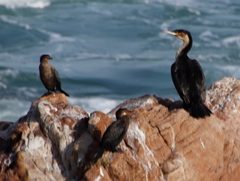
The crowned cormorant (Microcarbo coronatus) or kuifkopduiker, 'Fringe-head diver', is a small cormorant that is endemic to the waters of the cold Benguela Current of southern Africa. It is an exclusively coastal species and is not found more than 10 km (6 mi) away from land. This species is related to the reed cormorant, and was formerly considered to the same species.

It is found from Cape Agulhas north to Swakopmund along the coast of southern Africa. The population appears to be between 2500 and 2900 breeding pairs. It breeds in small groups, with fewer than 150 individuals per colony being typical. Ringing recoveries show that juveniles may disperse up to 277 km from their nests, and adults move between breeding sites over 500 km apart.

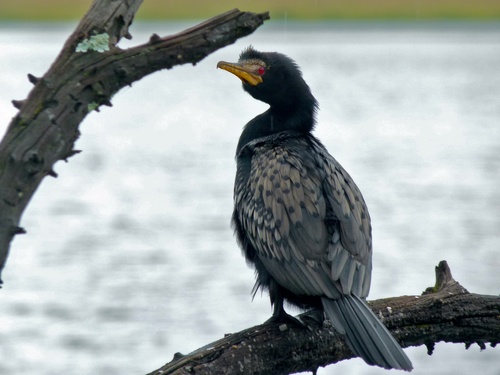
The crowned cormorant is 50–55 cm in length. Adults are black with a small crest on the head and a red face patch. Young birds are dark brown above, paler brown below, and lack the crest. They can be distinguished from immature reed cormorants by their darker underparts and shorter tail.

Crowned cormorants feed on slow-moving fish and invertebrates, which they forage for in shallow coastal waters... Wikipedia →

Global Distribution

Parks Where Found

# Park Country Daily sighting probability
1 West Coast National Park 🇿🇦 South Africa
~30%
2 Table Mountain National Park 🇿🇦 South Africa
~20%
3 De Hoop Nature Reserve 🇿🇦 South Africa
~10%

Cities Where Found

# City Country Daily sighting probability
1 Cape Town 🇿🇦 South Africa
<5%

Before you go

What are the chances of seeing a Crowned Cormorant in De Hoop Nature Reserve?

With luck

About 10% of wildlife watchers report a Crowned Cormorant sighting in De Hoop Nature Reserve on a given day, based on 33 verified sightings from GBIF citizen-science data from 2019 to 2026. It is the 138th most-seen of the 189 birds we can rate there. Over three days the chance rises to about 20%, and over a week to about 30%, if each day is a fresh chance.

When is the best time to see a Crowned Cormorant in De Hoop Nature Reserve?

April, September and November

In those months about 10% of wildlife watchers report a Crowned Cormorant in De Hoop Nature Reserve on a given day, against under 5% in May, July–August, October and December–March, the lowest months. June has too few records to rate.

What time of day is best to see a Crowned Cormorant?

Between 1 and 4 pm

Across all the parks we cover, that three-hour window holds the most Crowned Cormorant sightings with a recorded time, and about 9 in 10 of them come between 6 am and 6 pm: it is a daytime animal.

Is De Hoop Nature Reserve the best place to see a Crowned Cormorant?

3rd of 3

Of the 3 parks where we can rate Crowned Cormorant sightings, De Hoop Nature Reserve ranks 3rd at about 10%. The best odds are in West Coast National Park (South Africa, about 30%) and Table Mountain National Park (South Africa, about 20%).

Where does the Crowned Cormorant sighting chance come from?

GBIF citizen-science records

It is estimated from how often the Crowned Cormorant is recorded against all the birds logged in De Hoop Nature Reserve (33 verified sightings from 2019 to 2026), calibrated against known sighting rates. Figures are rounded to the nearest 10% because citizen-science data supports honest approximations, not decimals, and months with records from fewer than five people show "—". How it works.

← Back to De Hoop Nature Reserve