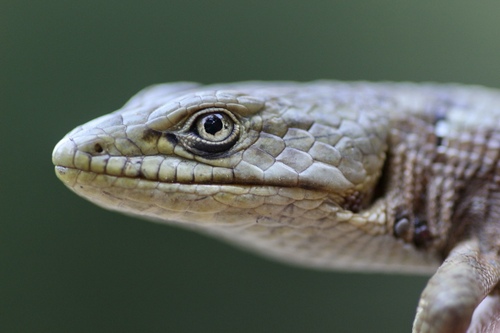
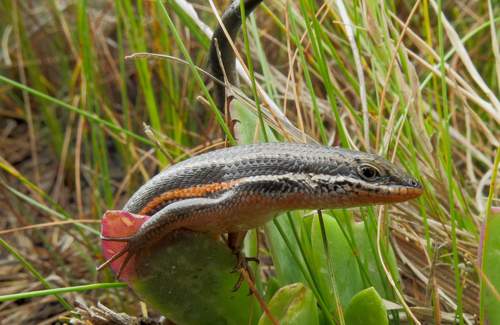
Robertson Dwarf Chameleon

Robertson Dwarf Chameleon

Bradypodion gutturale

LCLeast ConcernNTVUENCR
Daily sighting probability ~40% · Likely
at De Hoop Nature Reserve

In 3 days ~70% in a week >90%

23 Verified sightings at De Hoop Nature Reserve From 2019 to 2026
23 In 1 park
October Best month
☀️ Diurnal When it's spotted

About the Robertson Dwarf Chameleon

The Robertson dwarf chameleon, also known as the Little Karoo dwarf chameleon, (Bradypodion gutturale) is a chameleon in the genus Bradypodion. It is found in the dry Fynbos and Renosterveld shrub vegetation, in the centre of the Western Cape province, South Africa.

A medium-sized dwarf chameleon, with a relatively robust build and a long prehensile tail, it can grow up to 15 cm in length. It is generally grey-olive in colour, but individuals have been found that vary. This species occurs in the Little Karoo, and the surrounding mountain ranges, within the Western Cape, South Africa.

It is recorded as far west as the border of the Cederberg mountains, and as far east as Uniondale. In the south it occurs near the coast in the area of Robertson and on the Agulhas plain. It prefers the fynbos vegetation, unlike some other species of dwarf chameleons that are forest-dwellers. It is particularly adapted to dry fynbos, renosterveld and is even found in the transition zones to arid succulent Karoo vegetation. DNA evidence suggests the Robertson chameleon may have diverged from the forest-dwellers several million years ago, coinciding with... Wikipedia →

Global Distribution

Parks Where Found

# Park Country Daily sighting probability
1 De Hoop Nature Reserve 🇿🇦 South Africa
~40%

More parks will be added in future updates.

Closest Relatives at De Hoop Nature Reserve

No species of the same family or order lives in De Hoop Nature Reserve, so these are its closest relatives here: other reptiles.

Before you go

What are the chances of seeing a Robertson Dwarf Chameleon in De Hoop Nature Reserve?

Likely

About 40% of wildlife watchers report a Robertson Dwarf Chameleon sighting in De Hoop Nature Reserve on a given day, based on 23 verified sightings from GBIF citizen-science data from 2019 to 2026. It is the 5th most-seen of the 18 reptiles we can rate there. Over three days the chance rises to about 70%, and over a week to over 90%, if each day is a fresh chance.

When is the best time to see a Robertson Dwarf Chameleon in De Hoop Nature Reserve?

October

In that month about 60% of wildlife watchers report a Robertson Dwarf Chameleon in De Hoop Nature Reserve on a given day, against under 5% in February to June, the lowest months.

What time of day is best to see a Robertson Dwarf Chameleon?

Between 9 am and noon

Across all the parks we cover, that three-hour window holds the most Robertson Dwarf Chameleon sightings with a recorded time, and about 8 in 10 of them come between 6 am and 6 pm: it is a daytime animal.

Where else can you see a Robertson Dwarf Chameleon?

Only De Hoop Nature Reserve, in our data

De Hoop Nature Reserve is the only park on Wallace's Line with enough records to rate Robertson Dwarf Chameleon sightings: about 40% of wildlife watchers there report one on a given day.

Where does the Robertson Dwarf Chameleon sighting chance come from?

GBIF citizen-science records

It is estimated from how often the Robertson Dwarf Chameleon is recorded against all the reptiles logged in De Hoop Nature Reserve (23 verified sightings from 2019 to 2026), calibrated against known sighting rates. Figures are rounded to the nearest 10% because citizen-science data supports honest approximations, not decimals, and months with records from fewer than five people show "—". How it works.

← Back to De Hoop Nature Reserve