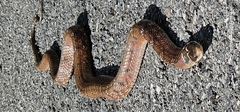
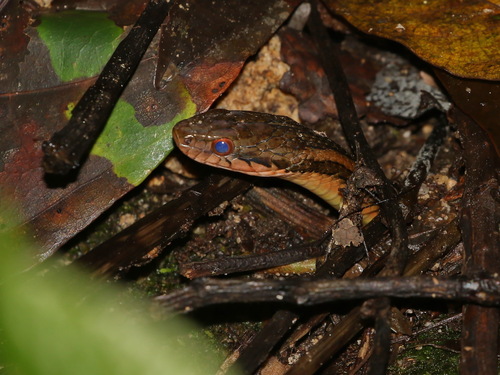
Big-eyed Bamboo Snake

Big-eyed Bamboo Snake

Pseudoxenodon macrops

Silhouette: Alex Slavenko · PhyloPic

LCLeast ConcernNTVUENCR
Daily sighting probability ~10% · With luck
at Doi Inthanon National Park

In 3 days ~40% in a week ~70%

8 Verified sightings at Doi Inthanon National Park From 2019 to 2026
8 In 1 park
September Best month
🌅 Crepuscular When it's spotted

About the Big-eyed Bamboo Snake

Pseudoxenodon macrops, commonly known as the large-eyed bamboo snake or the big-eyed bamboo snake, is a species of mildly venomous rear-fanged snake endemic to Asia. P. macrops is a fairly variable species with brownish and almost blackish shades with short crossbars.

P. macrops preys on frogs and lizards. P. macrops is a mildly venomous species. However, the potency of its venom is currently unknown. P. macrops is an oviparous species. An adult female may lay as many as 10 eggs. There are three known subspecies including, the nominotypical subspecies.

Pseudoxenodon macrops fukiensis Pope, 1928 Pseudoxenodon macrops macrops (Blyth, 1855) Pseudoxenodon macrops sinensis Boulenger, 1904 Nota bene: A binomial authority or a trinomial authority in parentheses indicates that the species or subspecies was originally described in a genus other than Pseodoxenodon.

P. macrops is found in Northeast India (Darjeeling, Assam, Arunachal Pradesh, Mizoram, Sikkim), Nepal, Bhutan, Myanmar, Thailand, West Malaysia, Vietnam, Laos, SW China (Yunnan, Guangxi, Guangdong, Fujian, Sichuan, Guizhou ?, Gansu... Wikipedia →

Global Distribution

Parks Where Found

# Park Country Daily sighting probability
1 Doi Inthanon National Park 🇹🇭 Thailand
~10%

More parks will be added in future updates.

Before you go

What are the chances of seeing a Big-eyed Bamboo Snake in Doi Inthanon National Park?

With luck

About 10% of wildlife watchers report a Big-eyed Bamboo Snake sighting in Doi Inthanon National Park on a given day, based on 8 verified sightings from GBIF citizen-science data from 2019 to 2026. It is the 15th most-seen of the 30 reptiles we can rate there. Over three days the chance rises to about 40%, and over a week to about 70%, if each day is a fresh chance.

When is the best time to see a Big-eyed Bamboo Snake in Doi Inthanon National Park?

September

In that month about 40% of wildlife watchers report a Big-eyed Bamboo Snake in Doi Inthanon National Park on a given day, against under 5% in April, July and December–February, the lowest months. That is one of Doi Inthanon National Park's wettest months, with about 330 mm of rain against 20 mm in February.

What time of day is best to see a Big-eyed Bamboo Snake?

Between 6 and 9 am

Across all the parks we cover, that three-hour window holds the most Big-eyed Bamboo Snake sightings with a recorded time, and about 7 in 10 of them come between 6 am and 6 pm: it is most active around dawn and dusk.

Where else can you see a Big-eyed Bamboo Snake?

Only Doi Inthanon National Park, in our data

Doi Inthanon National Park is the only park on Wallace's Line with enough records to rate Big-eyed Bamboo Snake sightings: about 10% of wildlife watchers there report one on a given day.

Which relatives of the Big-eyed Bamboo Snake live in Doi Inthanon National Park?

Same family: Colubridae

The closest relatives of the Big-eyed Bamboo Snake that you can see in Doi Inthanon National Park (family Colubridae, Colubrid Snakes) are Oriental Whipsnake (about 20%), Banded Keelback (about 20%) and Blue-eyed Bush Rat Snake (about 20%), with each one's daily chance of a sighting.

Where does the Big-eyed Bamboo Snake sighting chance come from?

GBIF citizen-science records

It is estimated from how often the Big-eyed Bamboo Snake is recorded against all the reptiles logged in Doi Inthanon National Park (8 verified sightings from 2019 to 2026), calibrated against known sighting rates. Figures are rounded to the nearest 10% because citizen-science data supports honest approximations, not decimals, and months with records from fewer than five people show "—". How it works.

← Back to Doi Inthanon National Park