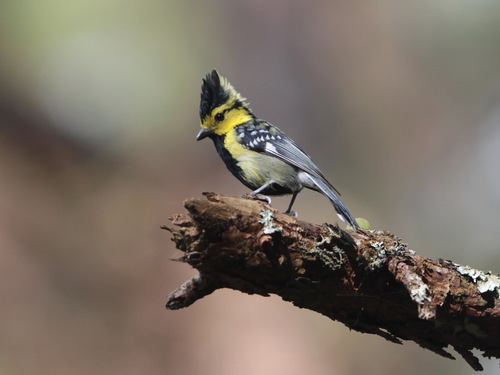
Fire-capped Tit

Fire-capped Tit

Cephalopyrus flammiceps

Silhouette: Sheatherius · PhyloPic

LCLeast ConcernNTVUENCR
Daily sighting probability <5% · Rare
at Doi Inthanon National Park

In 3 days <5%

13 Verified sightings at Doi Inthanon National Park From 2019 to 2026
13 In 1 park
March Best month
☀️ Diurnal When it's spotted

About the Fire-capped Tit

The fire-capped tit (Cephalopyrus flammiceps) is a small, 10 cm (3.9 in) long, weighing about 7 g (0.25 oz) bird species assigned to the family Paridae, that breeds in the temperate forest bordering the Himalayas to the south, in the Hengduan Shan and Nujiang Shan on the Myanmar-China border, the Micah Shan and Daba Shan on the Northern Sichuan border. It winters down hill and further south. Further to the east, birds tend to be smaller and the plumage becomes gradually darker.

The species was once considered to be a kinglet but is today treated as a tit. It is placed in a monotypic genus, Cephalopyrus. Its previous assignment to the family Remizidae was not entirely satisfactory, as this species nests in hollows in trees, as do the true tits and chickadees (Paridae), so it was placed there. It also lays blue eggs, like the verdin Auriparus flaviceps, and not white. Its small cone-shaped bill, and its song however are typical for a penduline tit.

Outside the breeding season (September–January), the crown is dark olive-brown, with a yellowish olive-green border. The upper parts are yellowish to olive-green. The rump yellowish to olive-golden... Wikipedia →

Sounds

Call0:30

China · 2006

© Nick Athanas · XC20019 · CC BY-NC-SA 3.0

Call0:32

China · 2024

© Peter Boesman · XC916126 · CC BY-NC-ND 4.0

Global Distribution

Parks Where Found

# Park Country Daily sighting probability
1 Doi Inthanon National Park 🇹🇭 Thailand
<5%

More parks will be added in future updates.

Before you go

What are the chances of seeing a Fire-capped Tit in Doi Inthanon National Park?

Rare

Under 5% of wildlife watchers report a Fire-capped Tit sighting in Doi Inthanon National Park on a given day, based on 13 verified sightings from GBIF citizen-science data from 2019 to 2026. It is the 320th most-seen of the 367 birds we can rate there. Over three days the chance rises to under 5%, if each day is a fresh chance.

When is the best time to see a Fire-capped Tit in Doi Inthanon National Park?

Any time of year

In every month with enough records, under 5% of wildlife watchers report a Fire-capped Tit in Doi Inthanon National Park on a given day, so our monthly data shows no clear season.

What time of day is best to see a Fire-capped Tit?

Between 8 and 11 am

Across all the parks we cover, that three-hour window holds the most Fire-capped Tit sightings with a recorded time, and about 9 in 10 of them come between 6 am and 6 pm: it is a daytime animal.

Where else can you see a Fire-capped Tit?

Only Doi Inthanon National Park, in our data

Doi Inthanon National Park is the only park on Wallace's Line with enough records to rate Fire-capped Tit sightings: under 5% of wildlife watchers there report one on a given day.

Which relatives of the Fire-capped Tit live in Doi Inthanon National Park?

Same order: Passeriformes

The closest relatives of the Fire-capped Tit that you can see in Doi Inthanon National Park (order Passeriformes, Perching Birds) are Black-backed Sibia (about 60%), Blue Whistling-Thrush (about 60%) and Black-crested Bulbul (about 50%), with each one's daily chance of a sighting.

Where does the Fire-capped Tit sighting chance come from?

GBIF citizen-science records

It is estimated from how often the Fire-capped Tit is recorded against all the birds logged in Doi Inthanon National Park (13 verified sightings from 2019 to 2026), calibrated against known sighting rates. Figures are rounded to the nearest 10% because citizen-science data supports honest approximations, not decimals, and months with records from fewer than five people show "—". How it works.

← Back to Doi Inthanon National Park