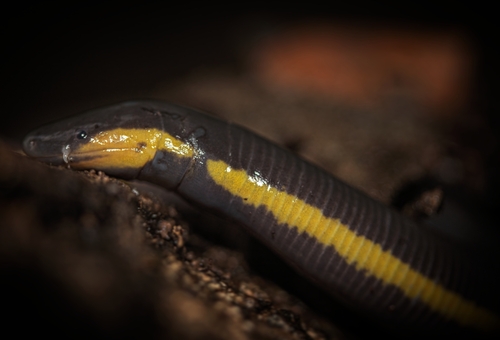
Koh Tao Caecilian

Koh Tao Caecilian

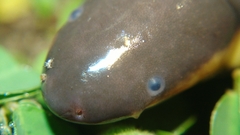
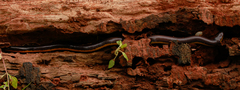
Ichthyophis kohtaoensis

Silhouette: Dmitry Bogdanov (vectorized by T. Michael Keesey) · PhyloPic

Daily sighting probability ~20% · Possible
at Doi Inthanon National Park

In 3 days ~50% in a week ~80%

16 Verified sightings at Doi Inthanon National Park From 2019 to 2026
22 In all 2 parks
August Best month
☀️ Diurnal When it's spotted

About the Koh Tao Caecilian

The Koh Tao Island caecilian (Ichthyophis kohtaoensis) is a species of amphibian in the family Ichthyophiidae found in Cambodia, Laos, Myanmar, Thailand, and Vietnam. Also known as the Ichthyophis bannanicus, the Banna caecilian, it is also found in southern China.

Its natural habitats are subtropical or tropical moist lowland forests, subtropical or tropical moist montane forests, rivers, intermittent rivers, swamps, freshwater marshes, intermittent freshwater marshes, plantations, rural gardens, urban areas, heavily degraded former forests, irrigated land, and seasonally flooded agricultural land. It is threatened by habitat loss.

The scientific name refers to Ko Tao Island in the Gulf of Siam, where the type specimen was collected. The mitotic karyotypes of both the female and male Koh Tao caecilians have 21 pairs of chromosomes, although in a study performed by Nussbaum and Treisman, it was found that there was an inconsistent report of chromosomes. While they all may have the 21 chromosome pairs, there was a study that found they have 18 metacentric, 4 submetacentric, and 20 telocentric chromosomes while another study had found 16 metacentric, 6 submetacentric... Wikipedia →
Global Distribution

Parks Where Found

# Park Country Daily sighting probability
1 Doi Inthanon National Park 🇹🇭 Thailand
~20%
2 Khao Sok National Park 🇹🇭 Thailand
~10%

Closest Relatives at Doi Inthanon National Park

No species of the same family or order lives in Doi Inthanon National Park, so these are its closest relatives here: other amphibians.

Before you go

What are the chances of seeing a Koh Tao Caecilian in Doi Inthanon National Park?

Possible

About 20% of wildlife watchers report a Koh Tao Caecilian sighting in Doi Inthanon National Park on a given day, based on 16 verified sightings from GBIF citizen-science data from 2019 to 2026. It is the 9th most-seen of the 17 amphibians we can rate there. Over three days the chance rises to about 50%, and over a week to about 80%, if each day is a fresh chance.

When is the best time to see a Koh Tao Caecilian in Doi Inthanon National Park?

August and September

In those months about 40% of wildlife watchers report a Koh Tao Caecilian in Doi Inthanon National Park on a given day, against under 5% in April and November–January, the lowest months. Those are among Doi Inthanon National Park's wettest months, with about 340 mm of rain a month against 20 mm in February.

What time of day is best to see a Koh Tao Caecilian?

Between 2 and 5 pm

Across all the parks we cover, that three-hour window holds the most Koh Tao Caecilian sightings with a recorded time, and about 8 in 10 of them come between 6 am and 6 pm: it is a daytime animal.

Is Doi Inthanon National Park the best place to see a Koh Tao Caecilian?

Yes

Of the 2 parks where we can rate Koh Tao Caecilian sightings, Doi Inthanon National Park has the highest daily chance: about 20%. Next come Khao Sok National Park (Thailand, about 10%).

Where does the Koh Tao Caecilian sighting chance come from?

GBIF citizen-science records

It is estimated from how often the Koh Tao Caecilian is recorded against all the amphibians logged in Doi Inthanon National Park (16 verified sightings from 2019 to 2026), calibrated against known sighting rates. Figures are rounded to the nearest 10% because citizen-science data supports honest approximations, not decimals, and months with records from fewer than five people show "—". How it works.

← Back to Doi Inthanon National Park