Orange-Legged Bumble Bee

Orange-Legged Bumble Bee

Bombus eximius

Daily sighting probability ~10% · With luck
at Doi Inthanon National Park

In 3 days ~30% in a week ~50%

7 Verified sightings at Doi Inthanon National Park From 2019 to 2026
14 In all 2 parks
December Best month
☀️ Diurnal When it's spotted

About the Orange-Legged Bumble Bee

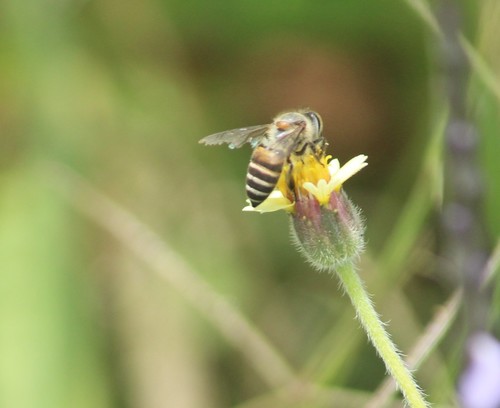
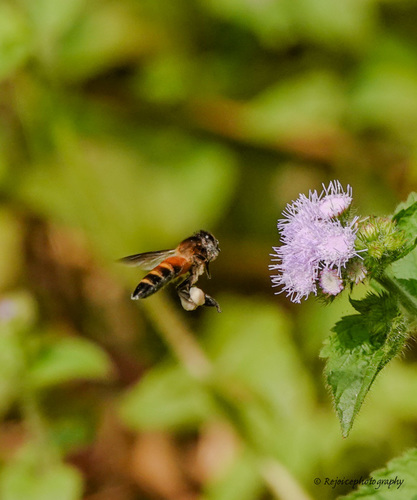
Bombus eximius is a species of bumblebee that belongs to the subgenus Melanobombus in the simplified subgeneric classification. It is found in the Southern, Eastern and Southeastern parts of the Asian continent. Bombus eximius is a very large species of bumblebee. The queens are 28–29 mm (1.1 in) long, while the female workers are 14–19 mm (0.55–0.75 in) and the male workers 18–19 mm (0.71–0.75 in). The color of the hair on the thorax is black, and that on the mid and hind tibiae and the basitarsus is orange. The bright coloration has also been described as "yellowish red" (via German: gelblichrot).

This species can easily be misidentified as Bombus flavescens. The close-up view of the face of Bombus eximius shows the oculomandibular distance (OMD), i.e., the distance between the compound eye and the mandible, to be 0.9–1.0 times the mandible breadth. The labrum, i.e., lips, have irregular lamella, but are mostly straight. The inner eye margin has scattered large punctures.

The species is relatively uncommon in low altitude areas between 450–1,200 m (1,480–3,940 ft) around the Sichuan basin area. It has been found in the Himalayan region, Myanmar... Wikipedia →
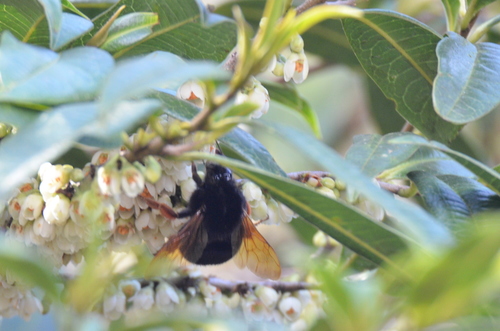
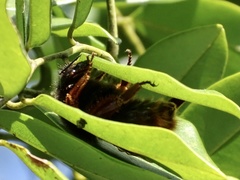
Global Distribution

Parks Where Found

# Park Country Daily sighting probability
1 Doi Inthanon National Park 🇹🇭 Thailand
~10%
2 Taroko National Park 🇹🇼 Taiwan
~10%

Cities Where Found

# City Country Daily sighting probability
1 Hong Kong 🇨🇳 China
~10%

Before you go

What are the chances of seeing an Orange-Legged Bumble Bee in Doi Inthanon National Park?

With luck

About 10% of wildlife watchers report an Orange-Legged Bumble Bee sighting in Doi Inthanon National Park on a given day, based on 7 verified sightings from GBIF citizen-science data from 2019 to 2026. It is the 105th most-seen of the 153 insects we can rate there. Over three days the chance rises to about 30%, and over a week to about 50%, if each day is a fresh chance.

When is the best time to see an Orange-Legged Bumble Bee in Doi Inthanon National Park?

April and December

In those months about 20% of wildlife watchers report an Orange-Legged Bumble Bee in Doi Inthanon National Park on a given day, against under 5% in January–February, May and July–October, the lowest months. Those are among Doi Inthanon National Park's driest months, with about 80 mm of rain a month against 340 mm in August.

What time of day is best to see an Orange-Legged Bumble Bee?

Between 7 and 10 am

Across all the parks we cover, that three-hour window holds the most Orange-Legged Bumble Bee sightings with a recorded time, and about 9 in 10 of them come between 6 am and 6 pm: it is a daytime animal.

Is Doi Inthanon National Park the best place to see an Orange-Legged Bumble Bee?

Yes

Of the 2 parks where we can rate Orange-Legged Bumble Bee sightings, Doi Inthanon National Park has the highest daily chance: about 10%. Next come Taroko National Park (Taiwan, about 10%).

Which relatives of the Orange-Legged Bumble Bee live in Doi Inthanon National Park?

Same family: Apidae

The closest relatives of the Orange-Legged Bumble Bee that you can see in Doi Inthanon National Park (family Apidae, Honey Bees, Bumble Bees, and Allies) are Asian Honey Bee (about 20%) and Giant Honey Bee (about 10%), with each one's daily chance of a sighting.

Where does the Orange-Legged Bumble Bee sighting chance come from?

GBIF citizen-science records

It is estimated from how often the Orange-Legged Bumble Bee is recorded against all the insects logged in Doi Inthanon National Park (7 verified sightings from 2019 to 2026), calibrated against known sighting rates. Figures are rounded to the nearest 10% because citizen-science data supports honest approximations, not decimals, and months with records from fewer than five people show "—". How it works.

← Back to Doi Inthanon National Park