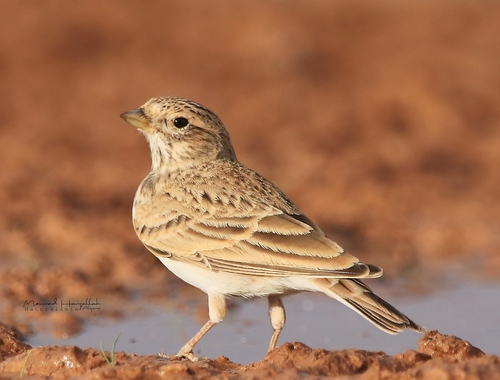

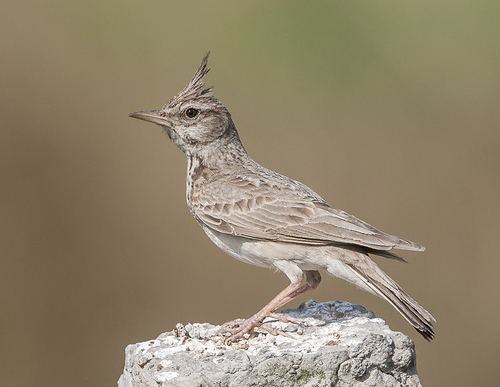
Mediterranean Short-toed Lark

Mediterranean Short-toed Lark

Calandrella rufescens

Silhouette: Gossipguy and T. Michael Keesey · PhyloPic

Daily sighting probability ~10% · With luck
at Doñana National Park

In 3 days ~30% in a week ~60%

374 Verified sightings at Doñana National Park From 2019 to 2026
374 In 1 park
July Best month
☀️ Diurnal When it's spotted

About the Mediterranean Short-toed Lark

The Mediterranean short-toed lark (Alaudala rufescens) is a small passerine bird found in and around the Mediterranean Basin. It is a common bird with a very wide range from Canary Islands north to the Iberian Peninsula and east throughout North Africa to parts of the Middle East. The International Union for Conservation of Nature has rated its conservation status as being of "least concern".

Its range was also previously thought to include parts of Central Asia, and with the Mediterranean and Central Asian clades combined the species was referred to as the lesser short-toed lark. However, a 2020 study split these two populations into distinct species, with A. rufescens being the Mediterranean clade and A. heinei being the Central Asian clade. Confusingly, Hume's short-toed lark is also sometimes called the lesser short-toed lark.

The Mediterranean short-toed lark was originally described as belonging to the genus Alauda. The genus name Alaudala is a diminutive of Alauda, and the specific rufescens is Latin for "reddish", from rufus "red". Alternate names for the lesser short-toed lark include the common short-toed lark, grey lark, rufous short-toed lark... Wikipedia →

Sounds

Recording0:11

Türkiye · 2025

© Mehmet Baran · iNaturalist · CC BY-NC-ND 4.0

Recording0:28

Spain · 2022

© dbeadle · iNaturalist · CC BY-NC 4.0

Recording0:04

Spain · 2025

© Jens Bokelaar · iNaturalist · CC BY 4.0

Global Distribution

Parks Where Found

# Park Country Daily sighting probability
1 Doñana National Park 🇪🇸 Spain
~10%

More parks will be added in future updates.

Before you go

What are the chances of seeing a Mediterranean Short-toed Lark in Doñana National Park?

With luck

About 10% of wildlife watchers report a Mediterranean Short-toed Lark sighting in Doñana National Park on a given day, based on 374 verified sightings from GBIF citizen-science data from 2019 to 2026. It is the 98th most-seen of the 234 birds we can rate there. Over three days the chance rises to about 30%, and over a week to about 60%, if each day is a fresh chance.

When is the best time to see a Mediterranean Short-toed Lark in Doñana National Park?

July

In that month about 30% of wildlife watchers report a Mediterranean Short-toed Lark in Doñana National Park on a given day, against about 10% in January–June and August–November, the lowest months. That is one of Doñana National Park's driest months, with almost no rain against 90 mm in October.

What time of day is best to see a Mediterranean Short-toed Lark?

Between 10 am and 1 pm

Across all the parks we cover, that three-hour window holds the most Mediterranean Short-toed Lark sightings with a recorded time, and about 9 in 10 of them come between 6 am and 6 pm: it is a daytime animal.

Where else can you see a Mediterranean Short-toed Lark?

Only Doñana National Park, in our data

Doñana National Park is the only park on Wallace's Line with enough records to rate Mediterranean Short-toed Lark sightings: about 10% of wildlife watchers there report one on a given day.

Where does the Mediterranean Short-toed Lark sighting chance come from?

GBIF citizen-science records

It is estimated from how often the Mediterranean Short-toed Lark is recorded against all the birds logged in Doñana National Park (374 verified sightings from 2019 to 2026), calibrated against known sighting rates. Figures are rounded to the nearest 10% because citizen-science data supports honest approximations, not decimals, and months with records from fewer than five people show "—". How it works.

← Back to Doñana National Park