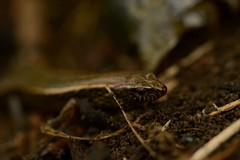

Copper Skink

Copper Skink

Oligosoma aeneum

Silhouette: David Orr · PhyloPic

LCLeast ConcernNTVUENCR Endemic
Daily sighting probability ~10% · With luck
at Egmont National Park

In 3 days ~40% in a week ~70%

6 Verified sightings at Egmont National Park From 2019 to 2026
6 In 1 park
May Best month
☀️ Diurnal When it's spotted

About the Copper Skink

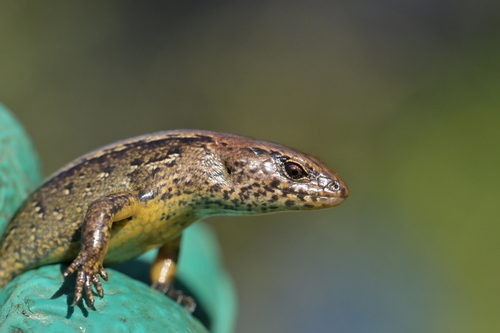
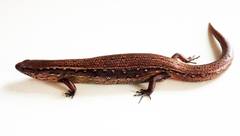
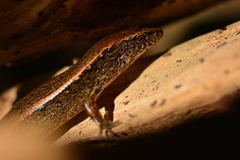
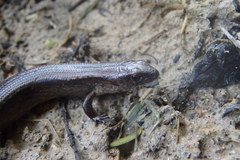
The copper skink (Oligosoma aeneum) is a skink of the family Scincidae that is endemic to the North Island of New Zealand. The number of skink species endemic to New Zealand is not yet known, as advancing molecular studies indicate genetic divergence amongst many groups previously considered a single species. At present, there is estimated to be between 50 and 60 species, all of the family Scincidae. Following a taxonomic revision of the species complex in 2008, the copper skink was assigned the scientific name of Cyclodina aenea, and found to be both genetically and morphologically diverged from two other skink species that were previously considered synonymic.

The initial arrival of the copper skink (and indeed any other skink species) to New Zealand is somewhat uncertain, and is a topic of considerable debate. The level of genetic diversity between the copper skink and other indigenous species suggests strongly that they and their ancestors have been a part of New Zealand's fauna for millions of years, allowing time for many early species to diverge and become distinct from each other. One 2009 study by Chapple, Ritchie and Daugherty, investigating... Wikipedia →

Global Distribution

Parks Where Found

# Park Country Daily sighting probability
1 Egmont National Park 🇳🇿 New Zealand
~10%

More parks will be added in future updates.

Cities Where Found

# City Country Daily sighting probability
1 Auckland 🇳🇿 New Zealand
~20%

Before you go

What are the chances of seeing a Copper Skink in Egmont National Park?

With luck

About 10% of wildlife watchers report a Copper Skink sighting in Egmont National Park on a given day, based on 6 verified sightings from GBIF citizen-science data from 2019 to 2026. Over three days the chance rises to about 40%, and over a week to about 70%, if each day is a fresh chance.

When is the best time to see a Copper Skink in Egmont National Park?

May

In that month about 40% of wildlife watchers report a Copper Skink in Egmont National Park on a given day, against under 5% in March–April, June–October and December–January, the lowest months.

What time of day is best to see a Copper Skink?

Between 10 am and 1 pm

Across all the parks we cover, that three-hour window holds the most Copper Skink sightings with a recorded time, and about 8 in 10 of them come between 6 am and 6 pm: it is a daytime animal.

Where else can you see a Copper Skink?

Only Egmont National Park, in our data

Egmont National Park is the only park on Wallace's Line with enough records to rate Copper Skink sightings: about 10% of wildlife watchers there report one on a given day.

Where does the Copper Skink sighting chance come from?

GBIF citizen-science records

It is estimated from how often the Copper Skink is recorded against all the reptiles logged in Egmont National Park (6 verified sightings from 2019 to 2026), calibrated against known sighting rates. Figures are rounded to the nearest 10% because citizen-science data supports honest approximations, not decimals, and months with records from fewer than five people show "—". How it works.

← Back to Egmont National Park