Maguari Stork

Maguari Stork

Ciconia maguari

Silhouette: L. Shyamal · PhyloPic

LCLeast ConcernNTVUENCR
Daily sighting probability ~10% · With luck
at El Impenetrable National Park

In 3 days ~20% in a week ~40%

15 Verified sightings at El Impenetrable National Park From 2019 to 2026
922 In all 5 parks
October Best month
☀️ Diurnal When it's spotted

About the Maguari Stork

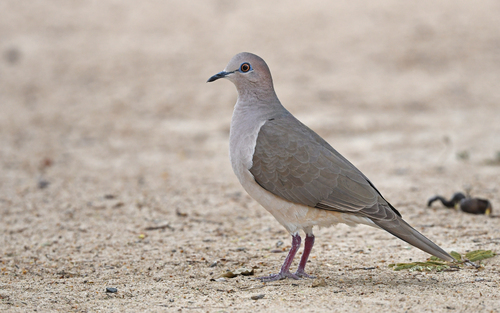
The maguari stork (Ciconia maguari) is a large species of stork that inhabits seasonal wetlands over much of South America, and is very similar in appearance to the white stork; albeit slightly larger. It is the only species of its genus to occur in the New World and is one of the only three New World stork species, together with the wood stork and the jabiru.

The maguari stork was formally described in 1789 by the German naturalist Johann Friedrich Gmelin in his revised and expanded edition of Carl Linnaeus's Systema Naturae. He placed it with the herons, cranes and storks in the genus Ardea and coined the binomial name Ardea maguari. Gmelin's description was ultimately based on the "Maguari Brasiliensibus" that had been described and illustrated in 1648 by the German naturalist Georg Marcgrave in his book Historia Naturalis Brasiliae. The maguari stork is now one of seven storks placed in the genus Ciconia that was introduced in 1760 by the French zoologist Mathurin Jacques Brisson. The genus name is the Latin word for "stork". The specific epithet maguari and the common name are from the Tupi language, "Maguarí" or "Baguarí" means "heavy bill". The species is monotypic... Wikipedia →

Sounds

Call0:10

Argentina · 1985

© Miguel Angel Roda · XC50307 · CC BY-NC-ND 2.5

Call?!0:17

Uruguay · 2007

© Alvaro Riccetto · XC16348 · CC BY-NC-ND 2.5

Global Distribution

Parks Where Found

# Park Country Daily sighting probability
1 Iberá National Park 🇦🇷 Argentina
~40%
2 El Impenetrable National Park 🇦🇷 Argentina
~10%
3 El Palmar National Park 🇦🇷 Argentina
<5%
4 Parque Estadual Encontro das Águas 🇧🇷 Brazil
<5%
5 Serra dos Órgãos National Park 🇧🇷 Brazil
<5%

Cities Where Found

# City Country Daily sighting probability
1 Santa Cruz de la Sierra 🇧🇴 Bolivia
~20%
2 Recife 🇧🇷 Brazil
~10%
3 Buenos Aires 🇦🇷 Argentina
~10%
4 Rosario 🇦🇷 Argentina
<5%
5 Asuncion 🇵🇾 Paraguay
<5%
6 Porto Alegre 🇧🇷 Brazil
<5%

Zoos & Centres Where Found

# Zoo / Centre Country
1 ZooParc de Beauval 🇫🇷 France In captivity
2 Parque das Aves 🇧🇷 Brazil In captivity
3 Zlín-Lešná Zoo 🇨🇿 Czechia In captivity
4 Audubon Zoo 🇺🇸 United States In captivity
5 Berlin Zoological Garden 🇩🇪 Germany In captivity
6 Terra Natura Benidorm 🇪🇸 Spain In captivity
7 Temaikén 🇦🇷 Argentina In captivity
8 Gramado Zoo 🇧🇷 Brazil In captivity
9 Zoológico Municipal de Cascavel 🇧🇷 Brazil In captivity
10 Córdoba Zoo 🇦🇷 Argentina In captivity
11 Seville Zoo 🇪🇸 Spain In captivity
12 Aviario Nacional de Colombia 🇨🇴 Colombia In captivity
13 Aquarium Berlin 🇩🇪 Germany In captivity

Before you go

What are the chances of seeing a Maguari Stork in El Impenetrable National Park?

With luck

About 10% of wildlife watchers report a Maguari Stork sighting in El Impenetrable National Park on a given day, based on 15 verified sightings from GBIF citizen-science data from 2019 to 2026. It is the 165th most-seen of the 219 birds we can rate there. Over three days the chance rises to about 20%, and over a week to about 40%, if each day is a fresh chance.

When is the best time to see a Maguari Stork in El Impenetrable National Park?

October

In that month about 20% of wildlife watchers report a Maguari Stork in El Impenetrable National Park on a given day, against under 5% in January, March–April, June, August–September and November, the lowest months. December has too few records to rate.

What time of day is best to see a Maguari Stork?

Between 10 am and 1 pm

Across all the parks we cover, that three-hour window holds the most Maguari Stork sightings with a recorded time, and nearly all of them come between 6 am and 6 pm: it is a daytime animal.

Is El Impenetrable National Park the best place to see a Maguari Stork?

2nd of 5

Of the 5 parks where we can rate Maguari Stork sightings, El Impenetrable National Park ranks 2nd at about 10%. The best odds are in Iberá National Park (Argentina, about 40%).

Which relatives of the Maguari Stork live in El Impenetrable National Park?

Same family: Ciconiidae

The closest relatives of the Maguari Stork that you can see in El Impenetrable National Park (family Ciconiidae, Storks) are Jabiru (about 20%) and Wood Stork (about 10%), with each one's daily chance of a sighting.

Where does the Maguari Stork sighting chance come from?

GBIF citizen-science records

It is estimated from how often the Maguari Stork is recorded against all the birds logged in El Impenetrable National Park (15 verified sightings from 2019 to 2026), calibrated against known sighting rates. Figures are rounded to the nearest 10% because citizen-science data supports honest approximations, not decimals, and months with records from fewer than five people show "—". How it works.

← Back to El Impenetrable National Park