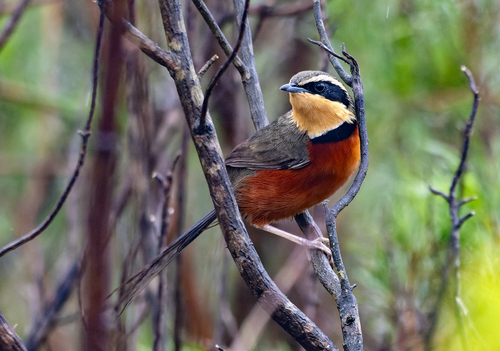
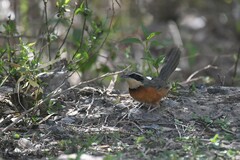
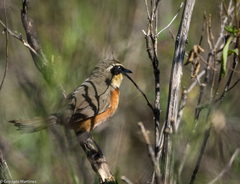

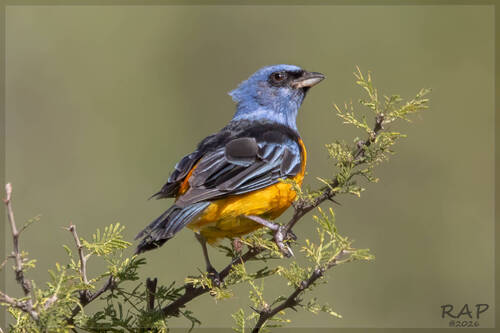
Olive-crowned Crescentchest

Olive-crowned Crescentchest

Melanopareia maximiliani

Silhouette: Sheatherius · PhyloPic

LCLeast ConcernNTVUENCR
Daily sighting probability ~10% · With luck
at El Impenetrable National Park

In 3 days ~20% in a week ~40%

16 Verified sightings at El Impenetrable National Park From 2019 to 2026
16 In 1 park
October Best month
☀️ Diurnal When it's spotted

About the Olive-crowned Crescentchest

The olive-crowned crescentchest (Melanopareia maximiliani) is a species of bird in the family Melanopareiidae. It is found in Argentina, Bolivia, and Paraguay. The crescentchests (genus Melanopareia) were previously included in family Rhinocryptidae, the tapaculos. A 2010 publication confirmed earlier work and created their present genus. The last has been suggested as a separate species due to vocal differences. In addition, a subpopulation of M. m. pallida might be an undescribed taxon.

The olive-crowned crescentchest is 15 cm (5.9 in) long. Males weigh 17.1 to 18.0 g (0.60 to 0.63 oz), one female weighed 16.7 g (0.59 oz), and unsexed specimens weighed 16.9 to 18.2 g (0.60 to 0.64 oz). The nominate subspecies' crown and upperparts are olive-brown, the throat deep buff, and the chest and belly ochraceous. Wikipedia →

Sounds

Song1:25

Paraguay · 2023

© Edgar Romero · XC838470 · CC BY-NC-SA 4.0

Presumed duet0:16

Argentina · 2022

© Niels Krabbe · XC764504 · CC BY-NC-SA 4.0

Alarm call0:16

Argentina · 1984

© Rosendo Fraga · XC439954 · CC BY-NC-SA 4.0

Global Distribution

Parks Where Found

# Park Country Daily sighting probability
1 El Impenetrable National Park 🇦🇷 Argentina
~10%

More parks will be added in future updates.

Cities Where Found

# City Country Daily sighting probability
1 Cordoba 🇦🇷 Argentina
<5%

Before you go

What are the chances of seeing an Olive-crowned Crescentchest in El Impenetrable National Park?

With luck

About 10% of wildlife watchers report an Olive-crowned Crescentchest sighting in El Impenetrable National Park on a given day, based on 16 verified sightings from GBIF citizen-science data from 2019 to 2026. It is the 160th most-seen of the 219 birds we can rate there. Over three days the chance rises to about 20%, and over a week to about 40%, if each day is a fresh chance.

When is the best time to see an Olive-crowned Crescentchest in El Impenetrable National Park?

October

In that month about 20% of wildlife watchers report an Olive-crowned Crescentchest in El Impenetrable National Park on a given day, against under 5% in January to September, the lowest months. December has too few records to rate.

What time of day is best to see an Olive-crowned Crescentchest?

Between 8 and 11 am

Across all the parks we cover, that three-hour window holds the most Olive-crowned Crescentchest sightings with a recorded time, and about 8 in 10 of them come between 6 am and 6 pm: it is a daytime animal.

Where else can you see an Olive-crowned Crescentchest?

Only El Impenetrable National Park, in our data

El Impenetrable National Park is the only park on Wallace's Line with enough records to rate Olive-crowned Crescentchest sightings: about 10% of wildlife watchers there report one on a given day.

Which relatives of the Olive-crowned Crescentchest live in El Impenetrable National Park?

Same order: Passeriformes

The closest relatives of the Olive-crowned Crescentchest that you can see in El Impenetrable National Park (order Passeriformes, Perching Birds) are Brazilian Cardinal (about 80%), Blue-gray Saltator (about 80%) and Pearly-vented Tody-Tyrant (about 70%), with each one's daily chance of a sighting.

Where does the Olive-crowned Crescentchest sighting chance come from?

GBIF citizen-science records

It is estimated from how often the Olive-crowned Crescentchest is recorded against all the birds logged in El Impenetrable National Park (16 verified sightings from 2019 to 2026), calibrated against known sighting rates. Figures are rounded to the nearest 10% because citizen-science data supports honest approximations, not decimals, and months with records from fewer than five people show "—". How it works.

← Back to El Impenetrable National Park