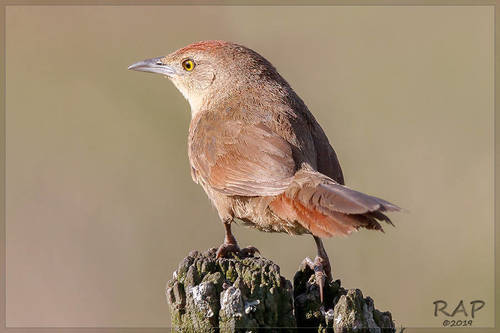

Freckle-breasted Thornbird

Freckle-breasted Thornbird

Phacellodomus striaticollis

Silhouette: Sheatherius · PhyloPic

LCLeast ConcernNTVUENCR
Daily sighting probability ~10% · With luck
at El Palmar National Park

In 3 days ~10% in a week ~30%

14 Verified sightings at El Palmar National Park From 2019 to 2026
14 In 1 park
March Best month
☀️ Diurnal When it's spotted

About the Freckle-breasted Thornbird

The freckle-breasted thornbird (Phacellodomus striaticollis) is a species of bird in the Furnariinae subfamily of the ovenbird family Furnariidae. It is found in Argentina, Brazil, Uruguay, and possibly Paraguay. The freckle-breasted thornbird was first described by Alcide d'Orbigny and Frédéric de Lafresnaye in 1838, from Uruguay.

The freckle-breasted thornbird is monotypic. However, what is now the spot-breasted thornbird (P. maculipectus) was long considered a subspecies of it, but they are not closely related. The freckle-breasted and greater thornbird (P. ruber) are sister species.

The spot-breasted thornbird is 16 to 20 cm (6.3 to 7.9 in) long and weighs about 24 to 27 g (0.85 to 0.95 oz). It is a medium-sized thornbird. The sexes have the same plumage. Adults have an indistinct light brownish supercilium that extends beyond the eye and a very narrow dark brown stripe behind the eye on an otherwise light brownish face. Their crown is brownish chestnut with whitish spots, their back dull reddish brown, and their rump and uppertail coverts a slightly paler reddish brown. Their wings are mostly shades of brown with darker brown primary... Wikipedia →

Sounds

Call0:38

Argentina · 2023

© Bernard BOUSQUET · XC838328 · CC BY-NC-SA 4.0

Song0:16

Argentina · 2022

© Carlos Ferrari · XC724283 · CC BY-NC-SA 4.0

Duet0:45

Uruguay · 2016

© Jorge de Leon Cardozo · XC455615 · CC BY-NC-SA 4.0

Global Distribution

Parks Where Found

# Park Country Daily sighting probability
1 El Palmar National Park 🇦🇷 Argentina
~10%

More parks will be added in future updates.

Cities Where Found

# City Country Daily sighting probability
1 Rosario 🇦🇷 Argentina
~10%
2 Buenos Aires 🇦🇷 Argentina
<5%

Before you go

What are the chances of seeing a Freckle-breasted Thornbird in El Palmar National Park?

With luck

About 10% of wildlife watchers report a Freckle-breasted Thornbird sighting in El Palmar National Park on a given day, based on 14 verified sightings from GBIF citizen-science data from 2019 to 2026. It is the 121st most-seen of the 151 birds we can rate there. Over three days the chance rises to about 10%, and over a week to about 30%, if each day is a fresh chance.

When is the best time to see a Freckle-breasted Thornbird in El Palmar National Park?

March

In that month about 20% of wildlife watchers report a Freckle-breasted Thornbird in El Palmar National Park on a given day, against under 5% in February and June–November, the lowest months.

What time of day is best to see a Freckle-breasted Thornbird?

Between 8 and 11 am

Across all the parks we cover, that three-hour window holds the most Freckle-breasted Thornbird sightings with a recorded time, and about 9 in 10 of them come between 6 am and 6 pm: it is a daytime animal.

Where else can you see a Freckle-breasted Thornbird?

Only El Palmar National Park, in our data

El Palmar National Park is the only park on Wallace's Line with enough records to rate Freckle-breasted Thornbird sightings: about 10% of wildlife watchers there report one on a given day.

Which relatives of the Freckle-breasted Thornbird live in El Palmar National Park?

Same family: Furnariidae

The closest relatives of the Freckle-breasted Thornbird that you can see in El Palmar National Park (family Furnariidae, Ovenbirds and Woodcreepers) are Rufous Hornero (about 70%), Sooty-fronted Spinetail (about 60%) and Narrow-billed Woodcreeper (about 60%), with each one's daily chance of a sighting.

Where does the Freckle-breasted Thornbird sighting chance come from?

GBIF citizen-science records

It is estimated from how often the Freckle-breasted Thornbird is recorded against all the birds logged in El Palmar National Park (14 verified sightings from 2019 to 2026), calibrated against known sighting rates. Figures are rounded to the nearest 10% because citizen-science data supports honest approximations, not decimals, and months with records from fewer than five people show "—". How it works.

← Back to El Palmar National Park