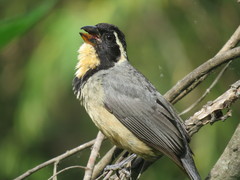

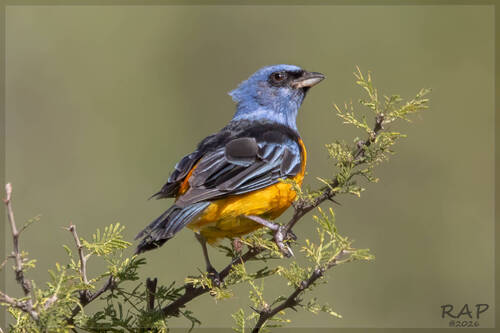
Golden-billed Saltator

Golden-billed Saltator

Saltator aurantiirostris

Silhouette: Sheatherius · PhyloPic

LCLeast ConcernNTVUENCR
Daily sighting probability ~80% · Very likely
at El Palmar National Park

In 3 days >90%

403 Verified sightings at El Palmar National Park From 2019 to 2026
1,188 In all 3 parks
February Best month
☀️ Diurnal When it's spotted

About the Golden-billed Saltator

The golden-billed saltator (Saltator aurantiirostris) is a species of bird in the family Thraupidae, the tanagers and allies. It is found in Argentina, Bolivia, Brazil, Chile, Paraguay, Peru, and Uruguay. The golden-billed saltator was formally described in 1817 with its current binomial Saltator aurantiirostris. Some twentieth century authors treated it and the black-cowled saltator (S. nigriceps) as conspecific.

The golden-billed saltator has these six subspecies: The golden-billed saltator is 19 to 20.5 cm (7.5 to 8.1 in) long and weighs 33 to 55 g (1.2 to 1.9 oz). The species is sexually dimorphic. Adults of the nominate subspecies S. a. aurantiirostris have a blackish forehead, a gray crown and nape, black lores, face, and ear coverts, and a white supercilium that extends around the rear of the ear coverts. Their upperparts and wings are gray and their tail is gray with thin white edges on... Wikipedia →

Sounds

Recording0:06

Argentina · 2024

© Sabrina Andrea Rendon Anaya · XC864542 · CC BY-NC-SA 4.0

Song0:48

Argentina · 2023

© Bernard BOUSQUET · XC830631 · CC BY-NC-SA 4.0

Uncertain0:22

Argentina · 2020

© María Emilia Pérez · XC713243 · CC BY-NC-SA 4.0

Global Distribution

Parks Where Found

# Park Country Daily sighting probability
1 El Palmar National Park 🇦🇷 Argentina
~80%
2 El Impenetrable National Park 🇦🇷 Argentina
~70%
3 Iberá National Park 🇦🇷 Argentina
~30%

Cities Where Found

# City Country Daily sighting probability
1 La Paz 🇧🇴 Bolivia
~50%
2 Buenos Aires 🇦🇷 Argentina
~30%
3 Cochabamba 🇧🇴 Bolivia
~30%
4 Cordoba 🇦🇷 Argentina
~20%
5 Rosario 🇦🇷 Argentina
~10%
6 Mendoza 🇦🇷 Argentina
<5%

Before you go

What are the chances of seeing a Golden-billed Saltator in El Palmar National Park?

Very likely

About 80% of wildlife watchers report a Golden-billed Saltator sighting in El Palmar National Park on a given day, based on 403 verified sightings from GBIF citizen-science data from 2019 to 2026. It is the 5th most-seen of the 151 birds we can rate there. Over three days the chance rises to over 90%, if each day is a fresh chance.

When is the best time to see a Golden-billed Saltator in El Palmar National Park?

February

In that month about 90% of wildlife watchers report a Golden-billed Saltator in El Palmar National Park on a given day, against about 70% in April–May, July–September and November, the lowest months.

What time of day is best to see a Golden-billed Saltator?

Between 10 am and 1 pm

Across all the parks we cover, that three-hour window holds the most Golden-billed Saltator sightings with a recorded time, and about 9 in 10 of them come between 6 am and 6 pm: it is a daytime animal.

Is El Palmar National Park the best place to see a Golden-billed Saltator?

Yes

Of the 3 parks where we can rate Golden-billed Saltator sightings, El Palmar National Park has the highest daily chance: about 80%. Next come El Impenetrable National Park (Argentina, about 70%) and Iberá National Park (Argentina, about 30%).

Which relatives of the Golden-billed Saltator live in El Palmar National Park?

Same genus: Saltator

The closest relatives of the Golden-billed Saltator that you can see in El Palmar National Park (genus Saltator, Typical Saltators) are Green-winged Saltator (about 30%) and Blue-gray Saltator (about 10%), with each one's daily chance of a sighting.

Where does the Golden-billed Saltator sighting chance come from?

GBIF citizen-science records

It is estimated from how often the Golden-billed Saltator is recorded against all the birds logged in El Palmar National Park (403 verified sightings from 2019 to 2026), calibrated against known sighting rates. Figures are rounded to the nearest 10% because citizen-science data supports honest approximations, not decimals, and months with records from fewer than five people show "—". How it works.

← Back to El Palmar National Park