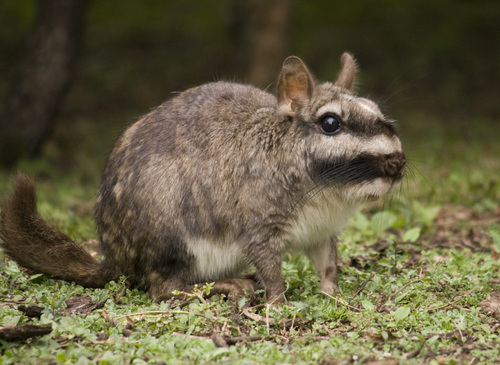
Lesser Grison

Lesser Grison

Galictis cuja

Silhouette: Margot Michaud · PhyloPic

LCLeast ConcernNTVUENCR
Daily sighting probability ~20% · Possible
at El Palmar National Park

In 3 days ~50% in a week ~80%

8 Verified sightings at El Palmar National Park From 2019 to 2026
8 In 1 park
May Best month
☀️ Diurnal When it's spotted

About the Lesser Grison

The lesser grison (Galictis cuja) is a species of mustelid from South America. Lesser grisons have a long, slender body, short legs, and a bushy tail. They have a long neck and a small head with a flattened forehead and rounded ears. They are smaller than the closely related greater grison, with a head-body length of 27 to 52 cm (11 to 20 in) and a tail 14 to 19 cm (5.5 to 7.5 in) long. Adults weigh from 1.2 to 2.4 kg (2.6 to 5.3 lb). Females are slighter smaller and more slender than males.

The top of the head, the back and flanks, and the tail have coarse black guard hairs with buff-coloured tips over a softer undercoat, giving them a grizzled, greyish colour. The remainder of the body is black or nearly so, apart from a pale, buff-coloured stripe running from the forehead to the shoulders along the lower margin of the grey furred area. The feet are webbed, with five toes ending in sharp, curved claws.

Lesser grisons are found throughout most of southern South America from sea level to as high as 4,200 m (13,800 ft) elevation. They are found in a wide range of habitats, although generally near water, including grasslands, forests,... Wikipedia →

Sounds

Recording0:03

Uruguay · 2026

© arturo_puntaespinillo · iNaturalist · CC BY-NC 4.0

Recording0:12

Brazil · 2024

© Lucas Klitzke · iNaturalist · CC BY-NC 4.0

Global Distribution

Parks Where Found

# Park Country Daily sighting probability
1 El Palmar National Park 🇦🇷 Argentina
~20%

More parks will be added in future updates.

Zoos & Centres Where Found

# Zoo / Centre Country
1 Zoobotanic Park of Brusque 🇧🇷 Brazil In captivity
2 Zoological Garden of Belo Horizonte 🇧🇷 Brazil In captivity
3 Zoológico de Brasília 🇧🇷 Brazil In captivity
4 Parque Zoobotânico Arruda Câmara (BICA) 🇧🇷 Brazil In captivity
5 Zoológico Dois Irmãos 🇧🇷 Brazil In captivity
6 Bioparque Municipal Vesty Pakos 🇧🇴 Bolivia In captivity
7 Bioparque Educativo Quillón 🇨🇱 Chile In captivity
8 Buin Zoo 🇨🇱 Chile In captivity
9 Reserva de Fauna y Flora Pan de Azúcar 🇺🇾 Uruguay In captivity
10 Zoológico Municipal de Guarulhos 🇧🇷 Brazil In captivity
11 Chilean National Zoo 🇨🇱 Chile In captivity
12 Granja los Pibes 🇦🇷 Argentina In captivity
13 Belo Horizonte Aquarium 🇧🇷 Brazil In captivity
14 Zooparque Itatiba 🇧🇷 Brazil In captivity

Before you go

What are the chances of seeing a Lesser Grison in El Palmar National Park?

Possible

About 20% of wildlife watchers report a Lesser Grison sighting in El Palmar National Park on a given day, based on 8 verified sightings from GBIF citizen-science data from 2019 to 2026. It is the 8th most-seen of the 8 mammals we can rate there. Over three days the chance rises to about 50%, and over a week to about 80%, if each day is a fresh chance.

When is the best time to see a Lesser Grison in El Palmar National Park?

May

In that month about 60% of wildlife watchers report a Lesser Grison in El Palmar National Park on a given day, against under 5% in January–March, June and August–November, the lowest months.

What time of day is best to see a Lesser Grison?

Between 3 and 6 pm

Across all the parks we cover, that three-hour window holds the most Lesser Grison sightings with a recorded time, and about 8 in 10 of them come between 6 am and 6 pm: it is a daytime animal.

Where else can you see a Lesser Grison?

Only El Palmar National Park, in our data

El Palmar National Park is the only park on Wallace's Line with enough records to rate Lesser Grison sightings: about 20% of wildlife watchers there report one on a given day.

Which relatives of the Lesser Grison live in El Palmar National Park?

Same order: Carnivora

The closest relatives of the Lesser Grison that you can see in El Palmar National Park (order Carnivora, Carnivorans) are Crab-eating Fox (about 70%) and Pampas Fox (about 50%), with each one's daily chance of a sighting.

Where does the Lesser Grison sighting chance come from?

GBIF citizen-science records

It is estimated from how often the Lesser Grison is recorded against all the mammals logged in El Palmar National Park (8 verified sightings from 2019 to 2026), calibrated against known sighting rates. Figures are rounded to the nearest 10% because citizen-science data supports honest approximations, not decimals, and months with records from fewer than five people show "—". How it works.

← Back to El Palmar National Park