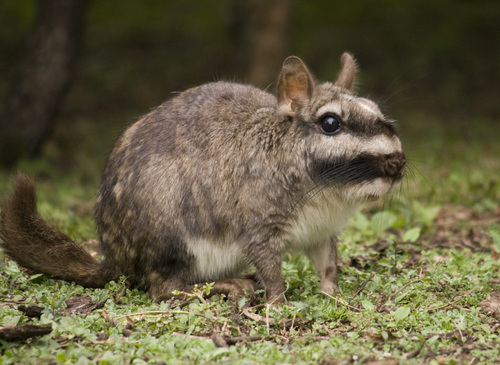
Pampas Fox

Pampas Fox

Lycalopex gymnocercus

Silhouette: PhyloPic

LCLeast ConcernNTVUENCR
Daily sighting probability ~50% · Likely
at El Palmar National Park

In 3 days ~90% in a week >90%

46 Verified sightings at El Palmar National Park From 2019 to 2026
319 In all 6 parks
June Best month
☀️ Diurnal When it's spotted

About the Pampas Fox

The Pampas fox (Lycalopex gymnocercus), also known as the grey pampean fox, Pampas zorro, Azara's fox, or Azara's zorro (in Guaraní also called aguará chaí, anglicized as aguarachay, in Portuguese also called graxaim ([ɡɾaʃaˈĩ]), is a medium-sized zorro, or "false" fox, native to the South American Pampas. Azara in some of its alternative common names is a reference to Spanish naturalist Félix de Azara.

The Pampas fox resembles the culpeo or Andean fox in appearance and size, but has a proportionately wider snout, reddish fur on the head and neck, and a black mark on the muzzle. Its short, dense fur is grey over most of the body, with a black line running down the back and onto the tail, and pale, almost white, underparts. The ears are triangular, broad, and relatively large, and are reddish on the outer surface and white on the inner surface. The inner surfaces of the legs are similar in color to the underparts, while the outer surface is reddish on the fore limbs, and grey on the hind limbs; the lower hind limb also bears a distinctive black spot. Adults range from 51 to 80 cm (20 to 31 in) in body length, and weigh 2.4 to 8.0 kg (5.3 to 17.6 lb); males are about... Wikipedia →

Sounds

Alarm call0:21

Brazil · 2024

© Douglas Meyer · XC983454 · CC BY-NC-SA 4.0

Recording0:16

Brazil · 2024

© Gabriel Broering Rohden · XC961215 · CC BY-NC-SA 4.0

Recording0:47

Uruguay · 2024

Gabriel Laufer · iNaturalist · CC0

Global Distribution

Parks Where Found

# Park Country Daily sighting probability
1 Vicente Pérez Rosales National Park 🇨🇱 Chile
~90%
2 El Palmar National Park 🇦🇷 Argentina
~50%
3 Iberá National Park 🇦🇷 Argentina
~50%
4 Torres del Paine National Park 🇨🇱 Chile
~40%
5 Península Valdés 🇦🇷 Argentina
~40%
6 Tierra del Fuego National Park 🇦🇷 Argentina
~20%

Cities Where Found

# City Country Daily sighting probability
1 Mendoza 🇦🇷 Argentina
~30%
2 Cordoba 🇦🇷 Argentina
~20%
3 Buenos Aires 🇦🇷 Argentina
<5%

Zoos & Centres Where Found

# Zoo / Centre Country
1 Bioparque "Washington Rodriguez Piquinela" 🇺🇾 Uruguay In captivity
2 Parque Ecológico de São Carlos 🇧🇷 Brazil In captivity
3 Reserva de Fauna y Flora Pan de Azúcar 🇺🇾 Uruguay In captivity
4 Granja los Pibes 🇦🇷 Argentina In captivity
5 Zoologico Mundo Andino - Tipon 🇵🇪 Peru In captivity

Before you go

What are the chances of seeing a Pampas Fox in El Palmar National Park?

Likely

About 50% of wildlife watchers report a Pampas Fox sighting in El Palmar National Park on a given day, based on 46 verified sightings from GBIF citizen-science data from 2019 to 2026. It is the 4th most-seen of the 8 mammals we can rate there. Over three days the chance rises to about 90%, and over a week to over 90%, if each day is a fresh chance.

When is the best time to see a Pampas Fox in El Palmar National Park?

June

In that month about 80% of wildlife watchers report a Pampas Fox in El Palmar National Park on a given day, against about 10% in July, the lowest month.

What time of day is best to see a Pampas Fox?

Between noon and 3 pm

Across all the parks we cover, that three-hour window holds the most Pampas Fox sightings with a recorded time, and about 8 in 10 of them come between 6 am and 6 pm: it is a daytime animal.

Is El Palmar National Park the best place to see a Pampas Fox?

2nd of 6

Of the 6 parks where we can rate Pampas Fox sightings, El Palmar National Park ranks 2nd at about 50%. The best odds are in Vicente Pérez Rosales National Park (Chile, about 90%). All parks ranked.

Where does the Pampas Fox sighting chance come from?

GBIF citizen-science records

It is estimated from how often the Pampas Fox is recorded against all the mammals logged in El Palmar National Park (46 verified sightings from 2019 to 2026), calibrated against known sighting rates. Figures are rounded to the nearest 10% because citizen-science data supports honest approximations, not decimals, and months with records from fewer than five people show "—". How it works.

← Back to El Palmar National Park