Urutu Lancehead

Urutu Lancehead

Bothrops alternatus

Silhouette: Steven Traver · PhyloPic

LCLeast ConcernNTVUENCR
Daily sighting probability ~30% · Possible
at El Palmar National Park

In 3 days ~60% in a week ~90%

10 Verified sightings at El Palmar National Park From 2019 to 2026
43 In all 3 parks
September Best month
☀️ Diurnal When it's spotted

About the Urutu Lancehead

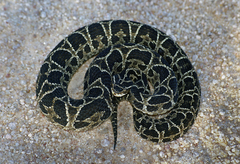
Bothrops alternatus, known by the common names crossed pit viper, yarará grande, and urutu, among others, is a highly venomous pit viper species found in South America (Brazil, Paraguay, Uruguay and Argentina). Within its range, it is an important cause of a snakebite. The specific name, alternatus, which is Latin for "alternating", is apparently a reference to the staggered markings along its body. No subspecies are currently recognized.

Large and stout, B. alternatus reportedly exceeds 2 m (6.6 ft) in total length, although the verified maximum is 1.69 m (5.5 ft). Most specimens are 0.8–1.2 m (2.6–3.9 ft) in total length, with females being significantly longer and heavier than males.

Scalation includes 25-35 (usually 27-31/29-33 in males/females) rows of dorsal scales at midbody, 155-183/164-190 ventral scales in males/females, and 38-53/30-44 subcaudal scales in males/females. On the head are 8-13 strongly keeled intersupraocular scales, 8-10 supralabial scales, none of which is fused with the prelacunal, and 12-14 sublabial scales.

The color pattern is exceedingly variable. The ground color may be brown, tan, or gray, sometimes... Wikipedia →

Global Distribution

Parks Where Found

# Park Country Daily sighting probability
1 Emas National Park 🇧🇷 Brazil
~40%
2 El Palmar National Park 🇦🇷 Argentina
~30%
3 Iberá National Park 🇦🇷 Argentina
~20%

Cities Where Found

# City Country Daily sighting probability
1 Buenos Aires 🇦🇷 Argentina
~20%

Zoos & Centres Where Found

# Zoo / Centre Country
1 São Paulo Zoo 🇧🇷 Brazil In captivity
2 Municipal Zoological Park Quinzinho de Barros 🇧🇷 Brazil In captivity
3 Parque Ecológico de São Carlos 🇧🇷 Brazil In captivity
4 Gladys Porter Zoo 🇺🇸 United States In captivity
5 Chattanooga Zoo at Warner Park 🇺🇸 United States In captivity

Before you go

What are the chances of seeing an Urutu Lancehead in El Palmar National Park?

Possible

About 30% of wildlife watchers report an Urutu Lancehead sighting in El Palmar National Park on a given day, based on 10 verified sightings from GBIF citizen-science data from 2019 to 2026. Over three days the chance rises to about 60%, and over a week to about 90%, if each day is a fresh chance.

When is the best time to see an Urutu Lancehead in El Palmar National Park?

May and September

In those months about 50% of wildlife watchers report an Urutu Lancehead in El Palmar National Park on a given day, against under 5% in March–April, July–August, October and December, the lowest months.

What time of day is best to see an Urutu Lancehead?

Between 11 am and 2 pm

Across all the parks we cover, that three-hour window holds the most Urutu Lancehead sightings with a recorded time, and about 8 in 10 of them come between 6 am and 6 pm: it is a daytime animal.

Is El Palmar National Park the best place to see an Urutu Lancehead?

2nd of 3

Of the 3 parks where we can rate Urutu Lancehead sightings, El Palmar National Park ranks 2nd at about 30%. The best odds are in Emas National Park (Brazil, about 40%).

Where does the Urutu Lancehead sighting chance come from?

GBIF citizen-science records

It is estimated from how often the Urutu Lancehead is recorded against all the reptiles logged in El Palmar National Park (10 verified sightings from 2019 to 2026), calibrated against known sighting rates. Figures are rounded to the nearest 10% because citizen-science data supports honest approximations, not decimals, and months with records from fewer than five people show "—". How it works.

← Back to El Palmar National Park