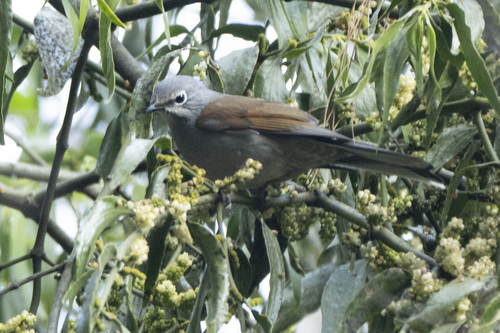
White-bellied Chachalaca

White-bellied Chachalaca

Ortalis leucogastra

Silhouette: PhyloPic

LCLeast ConcernNTVUENCR
Daily sighting probability <5% · Rare
at El Triunfo

In 3 days ~10% in a week ~30%

8 Verified sightings at El Triunfo From 2019 to 2026
8 In 1 park
February Best month
☀️ Diurnal When it's spotted

About the White-bellied Chachalaca

The white-bellied chachalaca (Ortalis leucogastra) is a species of bird in the family Cracidae, the chachalacas, guans, and curassows. It is found in El Salvador, Guatemala, Honduras, Mexico, and Nicaragua. The white-bellied chachalaca was at one time considered a subspecies of plain chachalaca (Ortalis vetula). It is believed to be most closely related to the speckled chachalaca (O. guttata). It is monotypic.

The white-bellied chachalaca is 43 to 50 cm (1.4 to 1.6 ft) long and weighs 439 to 560 g (0.97 to 1.2 lb). Its head, upperparts, and breast are brown and the belly dull white. Its brown tail is tipped with white. Bare dark slate facial skin surrounds the eye.

The white-bellied chachalaca is found from southeastern Chiapas in extreme southwestern Mexico through southern Guatemala, El Salvador, and southern Honduras into northwestern Nicaragua. It primarily inhabits swamp forest and swamps with thick scrub and is also found in dry forest, pasture edges, and mangroves. It is most common on the Pacific coastal plain but in Guatemala ranges as high as about 1,500 m (4,900 ft). Wikipedia →

Sounds

Song1:22

Guatemala · 2023

© Scott Olmstead · XC811837 · CC BY-NC-SA 4.0

Call1:21

Guatemala · 2018

© Oscar Campbell · XC433809 · CC BY-NC-SA 4.0

Dawn chorus0:07

Mexico · 2001

© Peter Boesman · XC226983 · CC BY-NC-ND 4.0

Global Distribution

Parks Where Found

# Park Country Daily sighting probability
1 El Triunfo 🇲🇽 Mexico
<5%

More parks will be added in future updates.

Cities Where Found

# City Country Daily sighting probability
1 San Salvador 🇸🇻 El Salvador
~20%

Zoos & Centres Where Found

# Zoo / Centre Country
1 Aviario Nacional de Colombia 🇨🇴 Colombia In captivity

Before you go

What are the chances of seeing a White-bellied Chachalaca in El Triunfo?

Rare

Under 5% of wildlife watchers report a White-bellied Chachalaca sighting in El Triunfo on a given day, based on 8 verified sightings from GBIF citizen-science data from 2019 to 2026. It is the 196th most-seen of the 221 birds we can rate there. Over three days the chance rises to about 10%, and over a week to about 30%, if each day is a fresh chance.

When is the best time to see a White-bellied Chachalaca in El Triunfo?

February

In that month about 20% of wildlife watchers report a White-bellied Chachalaca in El Triunfo on a given day, against under 5% in April–May and July–January, the lowest months. That is one of El Triunfo's driest months, with about 15 mm of rain against 420 mm in June. June has too few records to rate.

What time of day is best to see a White-bellied Chachalaca?

Between 6 and 9 am

Across all the parks we cover, that three-hour window holds the most White-bellied Chachalaca sightings with a recorded time, and about 9 in 10 of them come between 6 am and 6 pm: it is a daytime animal.

Where else can you see a White-bellied Chachalaca?

Only El Triunfo, in our data

El Triunfo is the only park on Wallace's Line with enough records to rate White-bellied Chachalaca sightings: under 5% of wildlife watchers there report one on a given day.

Which relatives of the White-bellied Chachalaca live in El Triunfo?

Same family: Cracidae

The closest relatives of the White-bellied Chachalaca that you can see in El Triunfo (family Cracidae, Guans, Chachalacas, and Curassows) are Highland Guan (about 30%), Horned Guan (about 20%) and Crested Guan (about 10%), with each one's daily chance of a sighting.

Where does the White-bellied Chachalaca sighting chance come from?

GBIF citizen-science records

It is estimated from how often the White-bellied Chachalaca is recorded against all the birds logged in El Triunfo (8 verified sightings from 2019 to 2026), calibrated against known sighting rates. Figures are rounded to the nearest 10% because citizen-science data supports honest approximations, not decimals, and months with records from fewer than five people show "—". How it works.

← Back to El Triunfo