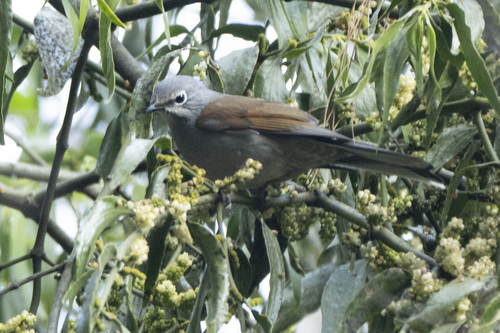
Highland Guan

Highland Guan

Penelopina nigra

Silhouette: Sheatherius · PhyloPic

LCNTVUVulnerableENCR
Daily sighting probability ~30% · Possible
at El Triunfo

In 3 days ~70% in a week ~90%

81 Verified sightings at El Triunfo From 2019 to 2026
170 In all 4 parks
April Best month
☀️ Diurnal When it's spotted

About the Highland Guan

The highland guan (Penelopina nigra) is a species of bird in the family Cracidae. It is found in the highlands of El Salvador, Guatemala, Honduras, southern Mexico, and Nicaragua. Its natural habitat is subtropical or tropical moist montane forest. Its population has declined much in recent times: Listed as a species of Least Concern in 1994, it was uplisted to Near Threatened in 2000 and, as it was determined to be less common than previously believed, to Vulnerable in the 2007 IUCN Red List.

The highland guan grows to a length of 590 to 650 millimetres (23 to 26 in). The plumage of the male is black, the upper parts glossed with green or blue, the underparts rather duller. The iris of the eye is reddish-brown and there is reddish-brown or purplish bare skin around and behind the eye. The beak, the bare skin on the throat, the large wattle, the legs and feet are reddish-orange. The female, by contrast, is black, heavily mottled and barred with reddish-brown and cinnamon, with a red beak and bare skin round the beak, and purplish bare skin round the eye.

The three syntype specimens of Penelope niger Fraser (Proc. Zool. Soc. London, 1850 (1852), p.246... Wikipedia →

Sounds

Song0:52

Mexico · 2022

© Manuel Grosselet · XC713016 · CC BY-NC-SA 4.0

Call0:11

Honduras · 2017

© Alfonso Auerbach · XC355842 · CC BY-NC-SA 4.0

Call0:13

Mexico · 2015

© Richard E. Webster · XC334377 · CC BY-NC-SA 4.0

Global Distribution

Parks Where Found

# Park Country Daily sighting probability
1 El Triunfo 🇲🇽 Mexico
~30%
2 Celaque National Park 🇭🇳 Honduras
~10%
3 Cusuco National Park 🇭🇳 Honduras
<5%
4 Cañón del Sumidero National Park 🇲🇽 Mexico
<5%

Zoos & Centres Where Found

# Zoo / Centre Country
1 Macaw mountain bird park 🇭🇳 Honduras In captivity
2 Zoológico Miguél Álvarez del Toro 🇲🇽 Mexico In captivity

Before you go

What are the chances of seeing a Highland Guan in El Triunfo?

Possible

About 30% of wildlife watchers report a Highland Guan sighting in El Triunfo on a given day, based on 81 verified sightings from GBIF citizen-science data from 2019 to 2026. It is the 29th most-seen of the 221 birds we can rate there. Over three days the chance rises to about 70%, and over a week to about 90%, if each day is a fresh chance.

When is the best time to see a Highland Guan in El Triunfo?

April

In that month about 70% of wildlife watchers report a Highland Guan in El Triunfo on a given day, against about 10% in November, the lowest month. That is one of El Triunfo's driest months, with about 65 mm of rain against 420 mm in June. June has too few records to rate.

What time of day is best to see a Highland Guan?

Between 9 am and noon

Across all the parks we cover, that three-hour window holds the most Highland Guan sightings with a recorded time, and about 7 in 10 of them come between 6 am and 6 pm: it is a daytime animal.

Is El Triunfo the best place to see a Highland Guan?

Yes

Of the 4 parks where we can rate Highland Guan sightings, El Triunfo has the highest daily chance: about 30%. Next come Celaque National Park (Honduras, about 10%) and Cusuco National Park (Honduras, under 5%).

Which relatives of the Highland Guan live in El Triunfo?

Same family: Cracidae

The closest relatives of the Highland Guan that you can see in El Triunfo (family Cracidae, Guans, Chachalacas, and Curassows) are Horned Guan (about 20%) and Crested Guan (about 10%), with each one's daily chance of a sighting.

Where does the Highland Guan sighting chance come from?

GBIF citizen-science records

It is estimated from how often the Highland Guan is recorded against all the birds logged in El Triunfo (81 verified sightings from 2019 to 2026), calibrated against known sighting rates. Figures are rounded to the nearest 10% because citizen-science data supports honest approximations, not decimals, and months with records from fewer than five people show "—". How it works.

← Back to El Triunfo