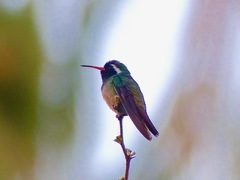
Xantus's Hummingbird

Xantus's Hummingbird

Basilinna xantusii

Silhouette: Ferran Sayol · PhyloPic

LCLeast ConcernNTVUENCR Endemic
Daily sighting probability ~10% · With luck
at El Vizcaíno Biosphere Reserve

In 3 days ~20% in a week ~30%

87 Verified sightings at El Vizcaíno Biosphere Reserve From 2019 to 2026
510 In all 3 parks
March Best month
☀️ Diurnal When it's spotted

About the Xantus's Hummingbird

Xantus's hummingbird (Basilinna xantusii), previously known as the black-fronted hummingbird, is a species in the "emeralds", tribe Trochilini of subfamily Trochilinae. It is endemic to the Baja California Peninsula. Xantus's hummingbird was early placed in genus Basilinna, which predated its discovery, then moved to genus Hylocharis, and then in the early 2000s moved back to Basilinna. It shares that genus only with the white-eared hummingbird (B. leucotis). It is monotypic.

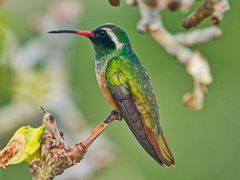
It is named for John Xantus de Vesey (Xántus János), a Hungarian zoologist who collected the first specimen. Xantus's hummingbird is 8.5 to 9.5 cm (3.3 to 3.7 in) long. Males weigh an average of 3.5 g (0.12 oz) and females 3.4 g (0.12 oz). Their bills are straight and about 1.7 cm (0.67 in) long; males' are red with a black tip. Females' maxilla is black with a pinkish base and their mandible pinkish red with a black tip. Males have a golden green to emerald green crown, nape, and upperparts with rufous edging on the uppertail coverts. Their forehead and chin are black, their face mostly black with a wide white stripe behind the eye, and their throat iridescent emerald... Wikipedia →

Sounds

Call0:13

Mexico · 2015

© Frank Lambert · XC352767 · CC BY-NC-ND 4.0

Flight call0:07

Mexico · 2007

© Richard E Webster · XC21265 · CC BY-NC-ND 2.5

Call0:11

Mexico · 2023

© Sue Riffe · XC785643 · CC BY-NC-SA 4.0

Global Distribution

Parks Where Found

# Park Country Daily sighting probability
1 Cabo Pulmo National Park 🇲🇽 Mexico
~30%
2 Bahía de Loreto National Park 🇲🇽 Mexico
~30%
3 El Vizcaíno Biosphere Reserve 🇲🇽 Mexico
~10%

Before you go

What are the chances of seeing a Xantus's Hummingbird in El Vizcaíno Biosphere Reserve?

With luck

About 10% of wildlife watchers report a Xantus's Hummingbird sighting in El Vizcaíno Biosphere Reserve on a given day, based on 87 verified sightings from GBIF citizen-science data from 2019 to 2026. It is the 135th most-seen of the 237 birds we can rate there. Over three days the chance rises to about 20%, and over a week to about 30%, if each day is a fresh chance.

When is the best time to see a Xantus's Hummingbird in El Vizcaíno Biosphere Reserve?

February and March

In those months about 10% of wildlife watchers report a Xantus's Hummingbird in El Vizcaíno Biosphere Reserve on a given day, against under 5% in April to January, the lowest months.

What time of day is best to see a Xantus's Hummingbird?

Between 9 am and noon

Across all the parks we cover, that three-hour window holds the most Xantus's Hummingbird sightings with a recorded time, and about 9 in 10 of them come between 6 am and 6 pm: it is a daytime animal.

Is El Vizcaíno Biosphere Reserve the best place to see a Xantus's Hummingbird?

3rd of 3

Of the 3 parks where we can rate Xantus's Hummingbird sightings, El Vizcaíno Biosphere Reserve ranks 3rd at about 10%. The best odds are in Cabo Pulmo National Park (Mexico, about 30%) and Bahía de Loreto National Park (Mexico, about 30%).

Which relatives of the Xantus's Hummingbird live in El Vizcaíno Biosphere Reserve?

Same family: Trochilidae

The closest relatives of the Xantus's Hummingbird that you can see in El Vizcaíno Biosphere Reserve (family Trochilidae, Hummingbirds) are Anna's Hummingbird (about 20%) and Costa's Hummingbird (about 20%), with each one's daily chance of a sighting.

Where does the Xantus's Hummingbird sighting chance come from?

GBIF citizen-science records

It is estimated from how often the Xantus's Hummingbird is recorded against all the birds logged in El Vizcaíno Biosphere Reserve (87 verified sightings from 2019 to 2026), calibrated against known sighting rates. Figures are rounded to the nearest 10% because citizen-science data supports honest approximations, not decimals, and months with records from fewer than five people show "—". How it works.

← Back to El Vizcaíno Biosphere Reserve