
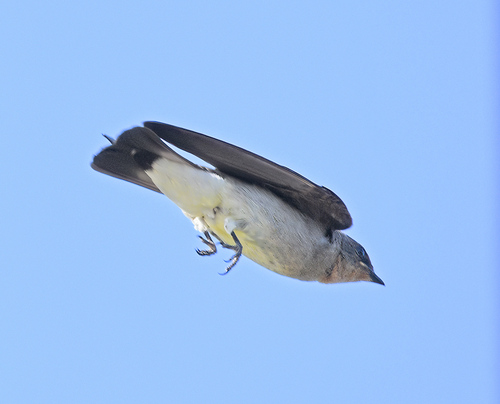
Fawn-breasted Wren

Fawn-breasted Wren

Cantorchilus guarayanus

Silhouette: Matt Wilkins · PhyloPic

LCLeast ConcernNTVUENCR
Daily sighting probability ~10% · With luck
at Parque Estadual Encontro das Águas

In 3 days ~20% in a week ~40%

120 Verified sightings at Parque Estadual Encontro das Águas From 2019 to 2026
132 In all 2 parks
August Best month
☀️ Diurnal When it's spotted

About the Fawn-breasted Wren

The fawn-breasted wren (Cantorchilus guarayanus) is a species of bird in the family Troglodytidae. It is found in Bolivia, Brazil, and Paraguay. The fawn-breasted wren has sometimes been treated as conspecific with the buff-breasted wren (Cantorchilus leucotis), though they have very different vocalizations. The species is monotypic.

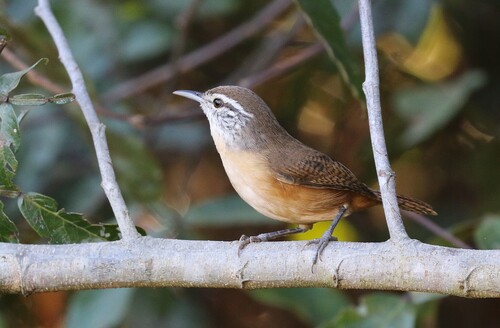
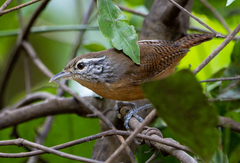
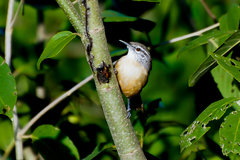
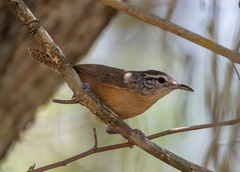
The fawn-breasted wren is 13.5 cm (5.3 in) long and weighs 13 to 14 g (0.46 to 0.49 oz). Adults have a plain medium brown crown and upperparts that becomes rufescent on the lower back and rump. Their tail is reddish brown with crisp black bars. They have a narrow white supercilium mostly behind the eye, cheeks mottled gray-white and blackish, and black malar and moustachial stripes. Their chin is whitish, the chest a warm orange-buff, and the belly and vent area a deeper orange-buff. Juveniles are similar but their facial markings are less distinct.

The fawn-breasted wren is found across much of northeastern Bolivia, a fairly thin slice of adjacent western Brazil, and a small part of northeastern Paraguay. It inhabits várzea scrubland and secondary forest, mostly near water... Wikipedia →

Sounds

Call1:13

Bolivia · 2023

© Richard E. Webster · XC864694 · CC BY-NC-SA 4.0

Canto0:18

Brazil · 2019

© Caio Brito · XC556189 · CC BY-NC-SA 4.0

Song0:10

Brazil · 2019

© JAYRSON ARAUJO DE OLIVEIRA · XC461417 · CC BY-NC-SA 4.0

Global Distribution

Parks Where Found

# Park Country Daily sighting probability
1 Parque Estadual Encontro das Águas 🇧🇷 Brazil
~10%
2 Amboró National Park 🇧🇴 Bolivia
<5%

Cities Where Found

# City Country Daily sighting probability
1 Santa Cruz de la Sierra 🇧🇴 Bolivia
<5%

Before you go

What are the chances of seeing a Fawn-breasted Wren in Parque Estadual Encontro das Águas?

With luck

About 10% of wildlife watchers report a Fawn-breasted Wren sighting in Parque Estadual Encontro das Águas on a given day, based on 120 verified sightings from GBIF citizen-science data from 2019 to 2026. It is the 159th most-seen of the 308 birds we can rate there. Over three days the chance rises to about 20%, and over a week to about 40%, if each day is a fresh chance.

When is the best time to see a Fawn-breasted Wren in Parque Estadual Encontro das Águas?

June and August–October

In those months about 10% of wildlife watchers report a Fawn-breasted Wren in Parque Estadual Encontro das Águas on a given day, against under 5% in May, July and November–December, the lowest months. Those are among Parque Estadual Encontro das Águas's driest months, with about 30 mm of rain a month against 190 mm in January. January to April have too few records to rate.

What time of day is best to see a Fawn-breasted Wren?

Between 8 and 11 am

Across all the parks we cover, that three-hour window holds the most Fawn-breasted Wren sightings with a recorded time, and about 9 in 10 of them come between 6 am and 6 pm: it is a daytime animal.

Is Parque Estadual Encontro das Águas the best place to see a Fawn-breasted Wren?

Yes

Of the 2 parks where we can rate Fawn-breasted Wren sightings, Parque Estadual Encontro das Águas has the highest daily chance: about 10%. Next come Amboró National Park (Bolivia, under 5%).

Where does the Fawn-breasted Wren sighting chance come from?

GBIF citizen-science records

It is estimated from how often the Fawn-breasted Wren is recorded against all the birds logged in Parque Estadual Encontro das Águas (120 verified sightings from 2019 to 2026), calibrated against known sighting rates. Figures are rounded to the nearest 10% because citizen-science data supports honest approximations, not decimals, and months with records from fewer than five people show "—". How it works.

← Back to Parque Estadual Encontro das Águas