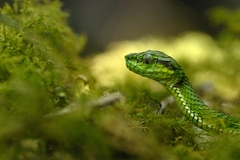
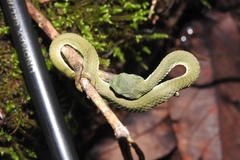
Large-scaled Pit Viper

Large-scaled Pit Viper

Craspedocephalus macrolepis

Silhouette: Vijay Karthick · PhyloPic

Daily sighting probability ~40% · Likely
at Eravikulam National Park

In 3 days ~80% in a week >90%

81 Verified sightings at Eravikulam National Park From 2019 to 2026
81 In 1 park
October Best month
🌅 Crepuscular When it's spotted

About the Large-scaled Pit Viper

Craspedocephalus macrolepis, commonly known as the large-scaled pit viper, is a venomous pitviper species endemic to the Southern Western Ghats of South India. No subspecies are currently recognized. It is found in the mountains of southern Western Ghats south of Palakkad Gap, in the Indian states of Kerala and Tamil Nadu. It is a high-elevation specialist, not normally recorded anywhere below 1200 m asl. Precise records are from Nelliyampathy, Munnar, Anaimalai, Palni hills, Meghamalai, Periyar Tiger Reserve, Agasthyamalai and Kalakkad Mundanthurai Tiger Reserve. at elevations of 1200-2695 m asl. The type locality is listed as "Anamalai hills (Tamil Nadu State, southwestern India)".

Adults may attain a total length of 68 cm (27 in), which includes a tail 12 cm (4.7 in) long. Dorsally, C. macrolepis is bright green, with blackish skin between the scales in some places. There is a yellow or white stripe on each side of the body, which runs along the first dorsal scale row. The upper lips are pale green, and there may be a black streak behind the eye. Ventrally, it is pale greenish.

The dorsal scales, which are large, keeled, and overlapping, are... Wikipedia →

Global Distribution

Parks Where Found

# Park Country Daily sighting probability
1 Eravikulam National Park 🇮🇳 India
~40%

More parks will be added in future updates.

Before you go

What are the chances of seeing a Large-scaled Pit Viper in Eravikulam National Park?

Likely

About 40% of wildlife watchers report a Large-scaled Pit Viper sighting in Eravikulam National Park on a given day, based on 81 verified sightings from GBIF citizen-science data from 2019 to 2026. Over three days the chance rises to about 80%, and over a week to over 90%, if each day is a fresh chance.

When is the best time to see a Large-scaled Pit Viper in Eravikulam National Park?

August and October

In those months about 50% of wildlife watchers report a Large-scaled Pit Viper in Eravikulam National Park on a given day, against about 20% in February and March, the lowest months. Those are among Eravikulam National Park's wettest months, with about 360 mm of rain a month against 25 mm in February.

What time of day is best to see a Large-scaled Pit Viper?

Between 5 and 8 pm

Across all the parks we cover, that three-hour window holds the most Large-scaled Pit Viper sightings with a recorded time, and about 6 in 10 of them come between 6 am and 6 pm: it is most active around dawn and dusk.

Where else can you see a Large-scaled Pit Viper?

Only Eravikulam National Park, in our data

Eravikulam National Park is the only park on Wallace's Line with enough records to rate Large-scaled Pit Viper sightings: about 40% of wildlife watchers there report one on a given day.

Where does the Large-scaled Pit Viper sighting chance come from?

GBIF citizen-science records

It is estimated from how often the Large-scaled Pit Viper is recorded against all the reptiles logged in Eravikulam National Park (81 verified sightings from 2019 to 2026), calibrated against known sighting rates. Figures are rounded to the nearest 10% because citizen-science data supports honest approximations, not decimals, and months with records from fewer than five people show "—". How it works.

← Back to Eravikulam National Park