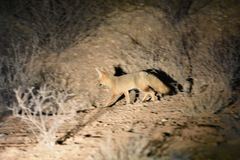
Cape Fox

Cape Fox

Vulpes chama

Silhouette: Margot Michaud · PhyloPic

LCLeast ConcernNTVUENCR
Daily sighting probability ~10% · With luck
at Etosha National Park

In 3 days ~40% in a week ~70%

14 Verified sightings at Etosha National Park From 2019 to 2026
62 In all 3 parks
January Best month
☀️🌙 Day & Night When it's spotted

About the Cape Fox

The Cape fox (Vulpes chama), also called the asse, cama fox or the silver-backed fox, is a small species of fox, native to southern Africa. It is the only "true fox" occurring in sub-Saharan Africa, and it retains primitive characteristics of Vulpes because it diverged early in the evolutionary history of the group.

Vulpes chama is a small-built canid, usually measuring 45 to 62 cm (17.5 to 24.5 in) long, not including its tail, which is typically 30 to 40 cm (12 to 15.5 in). It is 30 to 35 cm (12 to 14 in) tall at the shoulder, and usually weighs from 2.5 to 4.5 kg (5.5 to 9.9 lb). The skull is very similar to that of V. bengalensis, although the cranium of V. chama is slightly wider and the maxillary region is slightly shorter.

The ears are relatively large and sharp, the muzzle is small and pointed. Pelage colour is silvery-gray, tawny at the back of the ears, with white hairs appearing around the side of the pinna in the center. The colour of the neck and sides is lighter, and the underparts are pale tawny to pale buff. The head is dull red and the lower jaw is dark brown. There are white marks on the throat. The legs are more tawny than the rest of the body.... Wikipedia →

Sounds

Recording0:04

South Africa · 2021

© VanDamily · iNaturalist · CC BY-NC 4.0

Recording1:38

South Africa · 2013

© Marion Maclean · iNaturalist · CC BY-NC 4.0

Global Distribution

Parks Where Found

# Park Country Daily sighting probability
1 Kgalagadi Transfrontier Park 🇿🇦 South Africa
~20%
2 Namib-Naukluft National Park 🇳🇦 Namibia
~20%
3 Etosha National Park 🇳🇦 Namibia
~10%

Zoos & Centres Where Found

# Zoo / Centre Country
1 World of Birds Wildlife Sanctuary and Monkey Park 🇿🇦 South Africa In captivity
2 Hartbeespoort Dam Snake and Animal Park 🇿🇦 South Africa In captivity

Before you go

What are the chances of seeing a Cape Fox in Etosha National Park?

With luck

About 10% of wildlife watchers report a Cape Fox sighting in Etosha National Park on a given day, based on 14 verified sightings from GBIF citizen-science data from 2019 to 2026. It is the 29th most-seen of the 37 mammals we can rate there. Over three days the chance rises to about 40%, and over a week to about 70%, if each day is a fresh chance.

When is the best time to see a Cape Fox in Etosha National Park?

January

In that month about 30% of wildlife watchers report a Cape Fox in Etosha National Park on a given day, against under 5% in February, April–May and December, the lowest months. That is one of Etosha National Park's wettest months, with about 75 mm of rain against almost none in June.

What time of day is best to see a Cape Fox?

Between 8 and 11 pm

Across all the parks we cover, that three-hour window holds the most Cape Fox sightings with a recorded time, and about 6 in 10 of them come between 6 pm and 6 am: it is seen both by day and at night.

Is Etosha National Park the best place to see a Cape Fox?

3rd of 3

Of the 3 parks where we can rate Cape Fox sightings, Etosha National Park ranks 3rd at about 10%. The best odds are in Kgalagadi Transfrontier Park (South Africa, about 20%) and Namib-Naukluft National Park (Namibia, about 20%).

Where does the Cape Fox sighting chance come from?

GBIF citizen-science records

It is estimated from how often the Cape Fox is recorded against all the mammals logged in Etosha National Park (14 verified sightings from 2019 to 2026), calibrated against known sighting rates. Figures are rounded to the nearest 10% because citizen-science data supports honest approximations, not decimals, and months with records from fewer than five people show "—". How it works.

← Back to Etosha National Park