Cape Ground Squirrel

Cape Ground Squirrel

Xerus inauris

Silhouette: Joseph Smit · PhyloPic

Daily sighting probability ~50% · Likely
at Etosha National Park

In 3 days ~90% in a week >90%

182 Verified sightings at Etosha National Park From 2019 to 2026
372 In all 3 parks
November Best month
☀️ Diurnal When it's spotted

About the Cape Ground Squirrel

The Cape ground squirrel or South African ground squirrel (Geosciurus inauris) is found in most of the drier parts of southern Africa from South Africa, through to Botswana, and into Namibia, including Etosha National Park.

The name Cape ground squirrel is somewhat misleading as it actually has a much wider area of habitation. This common name may have been arrived at to distinguish it from a tree squirrel (the eastern grey squirrel) found around Cape Town, which was imported from Europe by Cecil John Rhodes.

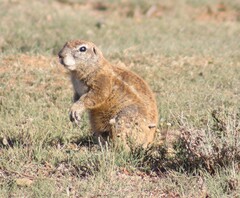
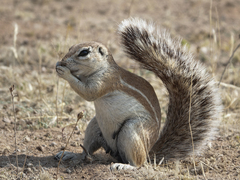
The species has also been known as the fan-tailed squirrel. The Cape ground squirrel has black skin with a coat made of short stiff hairs without underfur. The fur is cinnamon on the back while the face, underbelly, sides of neck and ventral sides of limbs are white. The sides of its body each have a white stripe that stretches from the shoulders to the thighs. The eyes are fairly large and have white lines around them. The pinnae are small. The tail is flattened on the back and underside and is covered with white hair and two black bands at the base. The Cape ground's sexual dimorphism is subtle. Males usually weigh 423–649 grams (0.933–1.431 lb), 8 to 12... Wikipedia →

Global Distribution

Parks Where Found

# Park Country Daily sighting probability
1 Etosha National Park 🇳🇦 Namibia
~50%
2 Kgalagadi Transfrontier Park 🇿🇦 South Africa
~50%
3 Namib-Naukluft National Park 🇳🇦 Namibia
~30%

Cities Where Found

# City Country Daily sighting probability
1 Johannesburg 🇿🇦 South Africa
~10%

Before you go

What are the chances of seeing a Cape Ground Squirrel in Etosha National Park?

Likely

About 50% of wildlife watchers report a Cape Ground Squirrel sighting in Etosha National Park on a given day, based on 182 verified sightings from GBIF citizen-science data from 2019 to 2026. It is the 14th most-seen of the 37 mammals we can rate there. Over three days the chance rises to about 90%, and over a week to over 90%, if each day is a fresh chance.

When is the best time to see a Cape Ground Squirrel in Etosha National Park?

March, July and November–January

In those months about 60% of wildlife watchers report a Cape Ground Squirrel in Etosha National Park on a given day, against about 40% in April, the lowest month. Those are among Etosha National Park's wettest months, with about 40 mm of rain a month against almost none in June.

What time of day is best to see a Cape Ground Squirrel?

Between 10 am and 1 pm

Across all the parks we cover, that three-hour window holds the most Cape Ground Squirrel sightings with a recorded time, and about 8 in 10 of them come between 6 am and 6 pm: it is a daytime animal.

Is Etosha National Park the best place to see a Cape Ground Squirrel?

Yes

Of the 3 parks where we can rate Cape Ground Squirrel sightings, Etosha National Park has the highest daily chance: about 50%. Next come Kgalagadi Transfrontier Park (South Africa, about 50%) and Namib-Naukluft National Park (Namibia, about 30%).

Where does the Cape Ground Squirrel sighting chance come from?

GBIF citizen-science records

It is estimated from how often the Cape Ground Squirrel is recorded against all the mammals logged in Etosha National Park (182 verified sightings from 2019 to 2026), calibrated against known sighting rates. Figures are rounded to the nearest 10% because citizen-science data supports honest approximations, not decimals, and months with records from fewer than five people show "—". How it works.

← Back to Etosha National Park