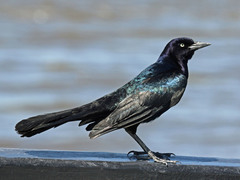
Boat-tailed Grackle

Boat-tailed Grackle

Quiscalus major

Silhouette: Ferran Sayol · PhyloPic

LCLeast ConcernNTVUENCR Endemic
Daily sighting probability ~40% · Likely
at Everglades National Park

In 3 days ~80% in a week >90%

4,566 Verified sightings at Everglades National Park From 2019 to 2026
15,661 In all 3 parks
March Best month
☀️ Diurnal When it's spotted

About the Boat-tailed Grackle

The boat-tailed grackle (Quiscalus major) is a passerine bird of the family Icteridae found as a permanent resident on the coasts of the Southeastern and Mid-Atlantic United States. The boat-tailed grackle is found in coastal saltwater marshes and across the Florida peninsula. In salt marsh areas, least bitterns will often associate with and make mixed colonies with grackles. Boat-tailed grackles have established significant populations in several United States Gulf Coast cities and towns, using human activity as protection against predation and scavenging through human trash. Urban boat-tailed grackle populations can be found foraging in trash bins, parking lots, and outdoor restaurant patios.

The nest is a well-concealed cup in trees and shrubs near water; the average clutch size is just over three eggs. Male boat-tailed grackles compete to defend and mate with a harem of closely nesting females, although DNA evidence shows that females often successfully mate with other males while away from their colony, with only about a quarter of the young being fathered by the dominant male.

The male boat-tailed grackle is 37–43 cm (15–17 in) long... Wikipedia →

Sounds

Call0:36

United States · 2025

© Sue Riffe · XC1042815 · CC BY-NC-SA 4.0

Song0:34

United States · 2025

© Bobby Wilcox · XC1037278 · CC BY-NC-SA 4.0

Alarm call0:16

United States · 2022

© Paul Driver · XC705390 · CC BY-NC-SA 4.0

Global Distribution

Parks Where Found

# Park Country Daily sighting probability
1 Merritt Island National Wildlife Refuge 🇺🇸 United States
~70%
2 Everglades National Park 🇺🇸 United States
~40%
3 Big Cypress National Preserve 🇺🇸 United States
~40%

Cities Where Found

# City Country Daily sighting probability
1 Miami 🇺🇸 United States
~60%
2 Orlando 🇺🇸 United States
~20%
3 New York City 🇺🇸 United States
<5%

Zoos & Centres Where Found

# Zoo / Centre Country
1 Brevard Zoo 🇺🇸 United States In captivity

Before you go

What are the chances of seeing a Boat-tailed Grackle in Everglades National Park?

Likely

About 40% of wildlife watchers report a Boat-tailed Grackle sighting in Everglades National Park on a given day, based on 4,566 verified sightings from GBIF citizen-science data from 2019 to 2026. It is the 20th most-seen of the 273 birds we can rate there. Over three days the chance rises to about 80%, and over a week to over 90%, if each day is a fresh chance.

When is the best time to see a Boat-tailed Grackle in Everglades National Park?

March and April

In those months about 50% of wildlife watchers report a Boat-tailed Grackle in Everglades National Park on a given day, against about 30% in August–September and December, the lowest months. Those are among Everglades National Park's driest months, with about 55 mm of rain a month against 240 mm in June.

What time of day is best to see a Boat-tailed Grackle?

Between 11 am and 2 pm

Across all the parks we cover, that three-hour window holds the most Boat-tailed Grackle sightings with a recorded time, and about 9 in 10 of them come between 6 am and 6 pm: it is a daytime animal.

Is Everglades National Park the best place to see a Boat-tailed Grackle?

2nd of 3

Of the 3 parks where we can rate Boat-tailed Grackle sightings, Everglades National Park ranks 2nd at about 40%. The best odds are in Merritt Island National Wildlife Refuge (United States, about 70%).

Where does the Boat-tailed Grackle sighting chance come from?

GBIF citizen-science records

It is estimated from how often the Boat-tailed Grackle is recorded against all the birds logged in Everglades National Park (4,566 verified sightings from 2019 to 2026), calibrated against known sighting rates. Figures are rounded to the nearest 10% because citizen-science data supports honest approximations, not decimals, and months with records from fewer than five people show "—". How it works.

← Back to Everglades National Park