Fairy Prion

Fairy Prion

Pachyptila turtur

Silhouette: Alexandre Vong · PhyloPic

LCLeast ConcernNTVUENCR
Daily sighting probability <5% · Rare
at Falkland Islands

In 3 days <5%

11 Verified sightings at Falkland Islands From 2019 to 2026
77 In all 3 parks
October Best month
☀️ Diurnal When it's spotted

About the Fairy Prion

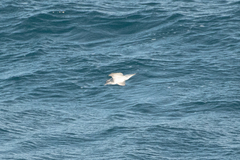
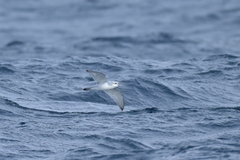
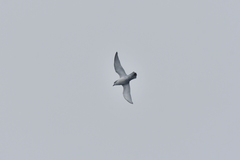
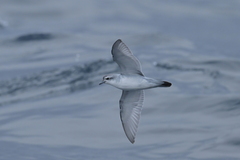
The fairy prion (Pachyptila turtur) is a small seabird with the standard prion plumage of blue-grey upperparts with a prominent dark "M" marking and white underneath. The sexes are alike. It is a small prion which frequents the low subantarctic and subtropic seas.

The fairy prion was formally described in 1820 by the German naturalist Heinrich Kuhl under the binomial name Procellaria turtur. It is now placed with the other prions in the genus Pachyptila, introduced in 1811 by Johann Karl Wilhelm Illiger. The genus name combines the Ancient Greek pakhus, meaning "dense" or "thick", with ptilon, meaning "feather" or "plumage". The specific epithet turtur is Latin for "turtle dove". The word prion comes from the Ancient Greek word priōn, meaning "a saw", which refers to the serrated edges of its bill.

The fairy prion is a member of the genus Pachyptila and of the subgenus Pseudoprion Coues, 1866. Along with the blue petrel, they make up the prions. They in turn are members of the family Procellariidae, and the order Procellariiformes. Prions are small and typically eat just zooplankton but, as members of the Procellariiformes, they share certain identifying features. They...

Wikipedia →

Sounds

Song0:45

New Zealand · 2010

© Todd Mark · XC75791 · CC BY-NC-SA 3.0

Call0:09

New Zealand · 2015

© Dan Lane · XC293340 · CC BY-NC-SA 4.0

Global Distribution

Parks Where Found

# Park Country Daily sighting probability
1 South Georgia and the South Sandwich Islands 🇬🇸 South Georgia and the South Sandwich Islands
~10%
2 Rakiura National Park 🇳🇿 New Zealand
<5%
3 Falkland Islands 🇫🇰 Falkland Islands
<5%

Cities Where Found

# City Country Daily sighting probability
1 Sydney 🇦🇺 Australia
<5%

Before you go

What are the chances of seeing a Fairy Prion in Falkland Islands?

Rare

Under 5% of wildlife watchers report a Fairy Prion sighting in Falkland Islands on a given day, based on 11 verified sightings from GBIF citizen-science data from 2019 to 2026. It is the 72nd most-seen of the 79 birds we can rate there. Over three days the chance rises to under 5%, if each day is a fresh chance.

When is the best time to see a Fairy Prion in Falkland Islands?

Any time of year

In every month with enough records, under 5% of wildlife watchers report a Fairy Prion in Falkland Islands on a given day, so our monthly data shows no clear season.

What time of day is best to see a Fairy Prion?

Between 10 am and 1 pm

Across all the parks we cover, that three-hour window holds the most Fairy Prion sightings with a recorded time, and about 9 in 10 of them come between 6 am and 6 pm: it is a daytime animal.

Is Falkland Islands the best place to see a Fairy Prion?

3rd of 3

Of the 3 parks where we can rate Fairy Prion sightings, Falkland Islands ranks 3rd at under 5%. The best odds are in South Georgia and the South Sandwich Islands (South Georgia and the South Sandwich Islands, about 10%) and Rakiura National Park (New Zealand, under 5%).

Where does the Fairy Prion sighting chance come from?

GBIF citizen-science records

It is estimated from how often the Fairy Prion is recorded against all the birds logged in Falkland Islands (11 verified sightings from 2019 to 2026), calibrated against known sighting rates. Figures are rounded to the nearest 10% because citizen-science data supports honest approximations, not decimals, and months with records from fewer than five people show "—". How it works.

← Back to Falkland Islands