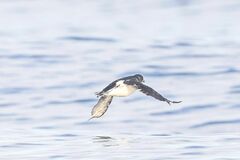
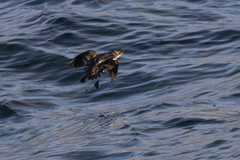
The common diving petrel (Pelecanoides urinatrix), also known as the smaller diving petrel or simply the diving petrel, is a diving petrel, one of four very similar auk-like small petrels of the southern oceans. It is native to South Atlantic islands and islands of the subantarctic southern Indian Ocean, islands and islets off New Zealand and south-eastern Australian islands.
The common diving petrel was formally described in 1777 by the German naturalist Johann Reinhold Forster. He placed it with the other petrels in the genus Procellaria and coined the binomial name Procellaria tridactyla. Gmelin based his description on the "diving petrel" that had been described in 1785 by the English ornithologist John Latham in the second volume of his A General Synopsis of Birds. Latham reported that they were found in great numbers in Queen Charlotte Sound at the northern end of South Island, New Zealand. The common diving petrel is now one of four petrels placed in the genus Pelecanoides that was introduced in 1799 by the French naturalist Bernard Germain de Lacépède. The genus name, Pelecanoides, means "Pelican-resembling", which was assigned to the diving petrels on account...