Two-Banded Plover

Two-Banded Plover

Charadrius falklandicus

LCLeast ConcernNTVUENCR
Daily sighting probability ~50% · Likely
at Falkland Islands

In 3 days ~90% in a week >90%

590 Verified sightings at Falkland Islands From 2019 to 2026
696 In all 2 parks
December Best month
☀️ Diurnal When it's spotted

About the Two-Banded Plover

The two-banded plover (Anarhynchus falklandicus) is a species of bird in subfamily Charadriinae of family Charadriidae. It is found in Argentina, Brazil, Chile, the Falkland Islands, and Uruguay. The two-banded plover has at times been considered conspecific with the puna plover (A. alticola) but now some treat the two as a superspecies. The puna plover is monotypic, but the mainland and Falkland populations might represent subspecies.

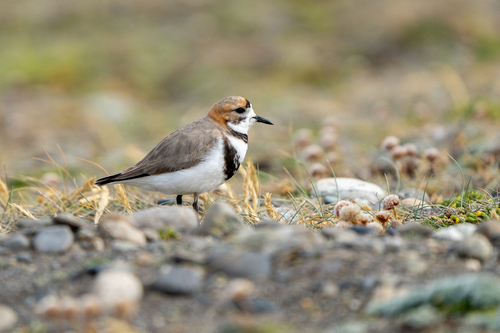
The two-banded plover is 17 to 19 cm (6.7 to 7.5 in) long and weighs 62 to 72 g (2.2 to 2.5 oz). It has a potbellied appearance and its bill and legs are black. Adult males in breeding have a white forehead, lower face, breast, and belly. They have a black bar on the forecrown and a chestnut crown and hindneck. Their upperparts are brown. They have two black breastbands, the upper one of which is frequently incomplete. (This feature is more prevalent in the Falklands population.) Adult females' crown is duller than the male's, what is black on the male is brownish on the female, and the upper breastband has white flecks throughout. Non-breeding adults have gray instead of black and gray-brown instead of...
Wikipedia →

Sounds

Call0:12

Chile · 2018

© Peter Boesman · XC449854 · CC BY-NC-ND 4.0

Song0:12

Chile · 2011

© Andrew Spencer · XC89437 · CC BY-NC-ND 2.5

Call0:21

Chile · 2020

© Dante Buzzetti · XC534309 · CC BY-NC-SA 4.0

Global Distribution

Parks Where Found

# Park Country Daily sighting probability
1 Falkland Islands 🇫🇰 Falkland Islands
~50%
2 Península Valdés 🇦🇷 Argentina
~30%

Before you go

What are the chances of seeing a Two-Banded Plover in Falkland Islands?

Likely

About 50% of wildlife watchers report a Two-Banded Plover sighting in Falkland Islands on a given day, based on 590 verified sightings from GBIF citizen-science data from 2019 to 2026. It is the 20th most-seen of the 79 birds we can rate there. Over three days the chance rises to about 90%, and over a week to over 90%, if each day is a fresh chance.

When is the best time to see a Two-Banded Plover in Falkland Islands?

June and December–January

In those months about 60% of wildlife watchers report a Two-Banded Plover in Falkland Islands on a given day, against about 40% in May and October, the lowest months. July and August have too few records to rate.

What time of day is best to see a Two-Banded Plover?

Between 11 am and 2 pm

Across all the parks we cover, that three-hour window holds the most Two-Banded Plover sightings with a recorded time, and about 9 in 10 of them come between 6 am and 6 pm: it is a daytime animal.

Is Falkland Islands the best place to see a Two-Banded Plover?

Yes

Of the 2 parks where we can rate Two-Banded Plover sightings, Falkland Islands has the highest daily chance: about 50%. Next come Península Valdés (Argentina, about 30%).

Where does the Two-Banded Plover sighting chance come from?

GBIF citizen-science records

It is estimated from how often the Two-Banded Plover is recorded against all the birds logged in Falkland Islands (590 verified sightings from 2019 to 2026), calibrated against known sighting rates. Figures are rounded to the nearest 10% because citizen-science data supports honest approximations, not decimals, and months with records from fewer than five people show "—". How it works.

← Back to Falkland Islands