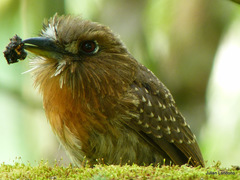
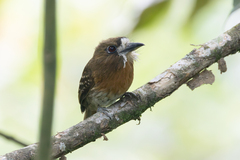
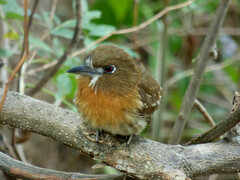
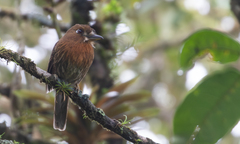
Moustached Puffbird

Moustached Puffbird

Malacoptila mystacalis

Silhouette: Matt Wilkins (Photo by Len Blumin) · PhyloPic

LCLeast ConcernNTVUENCR Endemic
Daily sighting probability ~10% · With luck
at Farallones de Cali National Natural Park

In 3 days ~30% in a week ~50%

368 Verified sightings at Farallones de Cali National Natural Park From 2019 to 2026
433 In all 3 parks
July Best month
☀️ Diurnal When it's spotted

About the Moustached Puffbird

The moustached puffbird (Malacoptila mystacalis) is a species of near-passerine bird in the family Bucconidae, the puffbirds, nunlets, and nunbirds. It is one of seven species in the genus Malacoptila. It is found in Colombia, Ecuador, and Venezuela.

The moustached puffbird is monotypic, though the population in southwestern Colombia might merit treatment as a subspecies. It is thought to form a superspecies with the white-whiskered puffbird (M. panamensis) and black-streaked puffbird (M. fulvogularis).

The moustached puffbird is 20 to 23 cm (7.9 to 9.1 in) long and weighs 47 to 50 g (1.7 to 1.8 oz). Unlike most puffbirds, the male and female have different plumages. Both sexes have bristles around the base of the large bill, and white "whiskers", which are actually tufts of feathers. The adult male is drab brown above with white to buffy spots on the back and the wing coverts. Its tail is brown with small buffy markings. Its lores and a half ring behind the eye are white. The chin, throat, and breast are rufous with indistinct darker streaks on the last. The belly is white and the flanks dull brown with whitish bars and streaks. The... Wikipedia →

Sounds

Call0:40

Colombia · 2023

© David Monroy Rengifo · XC816668 · CC BY-NC-SA 4.0

Song0:22

Colombia · 2019

© Paul van Els · XC522748 · CC BY-NC-SA 4.0

Recording0:21

Colombia · 2002

© Sergio Córdoba-Córdoba (Colección de Sonidos Ambientales - Instituto Humboldt) · XC532594 · CC BY-NC-SA 4.0

Global Distribution

Parks Where Found

# Park Country Daily sighting probability
1 Farallones de Cali National Natural Park 🇨🇴 Colombia
~10%
2 Henri Pittier National Park 🇻🇪 Venezuela
<5%
3 Los Nevados National Natural Park 🇨🇴 Colombia
<5%

Before you go

What are the chances of seeing a Moustached Puffbird in Farallones de Cali National Natural Park?

With luck

About 10% of wildlife watchers report a Moustached Puffbird sighting in Farallones de Cali National Natural Park on a given day, based on 368 verified sightings from GBIF citizen-science data from 2019 to 2026. It is the 116th most-seen of the 542 birds we can rate there. Over three days the chance rises to about 30%, and over a week to about 50%, if each day is a fresh chance.

When is the best time to see a Moustached Puffbird in Farallones de Cali National Natural Park?

May and July

In those months about 20% of wildlife watchers report a Moustached Puffbird in Farallones de Cali National Natural Park on a given day, against about 10% in June and August–April, the lowest months.

What time of day is best to see a Moustached Puffbird?

Between 7 and 10 am

Across all the parks we cover, that three-hour window holds the most Moustached Puffbird sightings with a recorded time, and about 9 in 10 of them come between 6 am and 6 pm: it is a daytime animal.

Is Farallones de Cali National Natural Park the best place to see a Moustached Puffbird?

Yes

Of the 3 parks where we can rate Moustached Puffbird sightings, Farallones de Cali National Natural Park has the highest daily chance: about 10%. Next come Henri Pittier National Park (Venezuela, under 5%) and Los Nevados National Natural Park (Colombia, under 5%).

Where does the Moustached Puffbird sighting chance come from?

GBIF citizen-science records

It is estimated from how often the Moustached Puffbird is recorded against all the birds logged in Farallones de Cali National Natural Park (368 verified sightings from 2019 to 2026), calibrated against known sighting rates. Figures are rounded to the nearest 10% because citizen-science data supports honest approximations, not decimals, and months with records from fewer than five people show "—". How it works.

← Back to Farallones de Cali National Natural Park