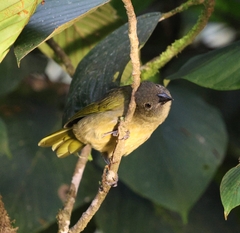
Ochre-breasted Tanager

Ochre-breasted Tanager

Chlorothraupis stolzmanni

Silhouette: Sheatherius · PhyloPic

Daily sighting probability ~10% · With luck
at Farallones de Cali National Natural Park

In 3 days ~20% in a week ~50%

340 Verified sightings at Farallones de Cali National Natural Park From 2019 to 2026
340 In 1 park
November Best month
☀️ Diurnal When it's spotted

About the Ochre-breasted Tanager

The ochre-breasted tanager (Chlorothraupis stolzmanni) is a species of bird in the family Cardinalidae. It is found in Colombia and Ecuador where its natural habitats are subtropical or tropical moist lowland forests and subtropical or tropical moist montane forests. As a fairly common species with a stable population, the International Union for Conservation of Nature has rated this bird as being of "least concern".

The ochre-breasted tanager grows to a length of about 18 cm (7 in). The sexes are similar in appearance, the upper parts being drab olive-green. Birds in Colombia show a slight grey shading on the head. The iris of the eye is pale bluish-grey. The underparts are ochraceous buff, with some olive shading on the flanks and breast, the throat being the palest region. It is similar in appearance to the lemon-spectacled tanager and the olive tanager but the three species do not share common ranges; the lemon-spectacled tanager is native to western Colombia and northwestern Ecuador, the ochre-breasted tanager occurs at higher elevations, and the olive tanager occurs further south in the eastern foothills of the Andes in southern Colombia, Peru and Bolivia, with... Wikipedia →

Sounds

Call0:25

Ecuador · 2018

© Hans Matheve · XC512745 · CC BY-NC-ND 4.0

Song0:12

Colombia · 2019

© David Monroy Rengifo · XC506964 · CC BY-NC-SA 4.0

Dawn song0:47

Ecuador · 2005

© Patricio Mena Valenzuela · XC275656 · CC BY-NC-SA 4.0

Global Distribution

Parks Where Found

# Park Country Daily sighting probability
1 Farallones de Cali National Natural Park 🇨🇴 Colombia
~10%

More parks will be added in future updates.

Before you go

What are the chances of seeing an Ochre-breasted Tanager in Farallones de Cali National Natural Park?

With luck

About 10% of wildlife watchers report an Ochre-breasted Tanager sighting in Farallones de Cali National Natural Park on a given day, based on 340 verified sightings from GBIF citizen-science data from 2019 to 2026. It is the 122nd most-seen of the 542 birds we can rate there. Over three days the chance rises to about 20%, and over a week to about 50%, if each day is a fresh chance.

When is the best time to see an Ochre-breasted Tanager in Farallones de Cali National Natural Park?

July and November

In those months about 20% of wildlife watchers report an Ochre-breasted Tanager in Farallones de Cali National Natural Park on a given day, against under 5% in January–February and April, the lowest months.

What time of day is best to see an Ochre-breasted Tanager?

Between 6 and 9 am

Across all the parks we cover, that three-hour window holds the most Ochre-breasted Tanager sightings with a recorded time, and about 8 in 10 of them come between 6 am and 6 pm: it is a daytime animal.

Where else can you see an Ochre-breasted Tanager?

Only Farallones de Cali National Natural Park, in our data

Farallones de Cali National Natural Park is the only park on Wallace's Line with enough records to rate Ochre-breasted Tanager sightings: about 10% of wildlife watchers there report one on a given day.

Where does the Ochre-breasted Tanager sighting chance come from?

GBIF citizen-science records

It is estimated from how often the Ochre-breasted Tanager is recorded against all the birds logged in Farallones de Cali National Natural Park (340 verified sightings from 2019 to 2026), calibrated against known sighting rates. Figures are rounded to the nearest 10% because citizen-science data supports honest approximations, not decimals, and months with records from fewer than five people show "—". How it works.

← Back to Farallones de Cali National Natural Park