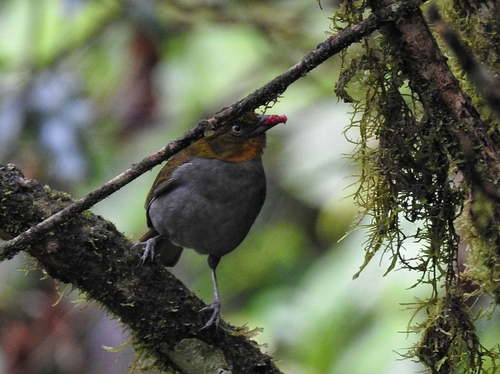
Olive Finch

Olive Finch

Arremon castaneiceps

Silhouette: Juan Camilo Cepeda-Duque · PhyloPic

LCNTNear ThreatenedVUENCR
Daily sighting probability <5% · Rare
at Farallones de Cali National Natural Park

In 3 days <5% in a week ~10%

43 Verified sightings at Farallones de Cali National Natural Park From 2019 to 2026
124 In all 2 parks
March Best month
☀️ Diurnal When it's spotted

About the Olive Finch

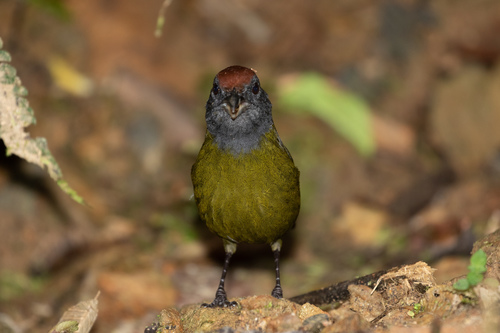
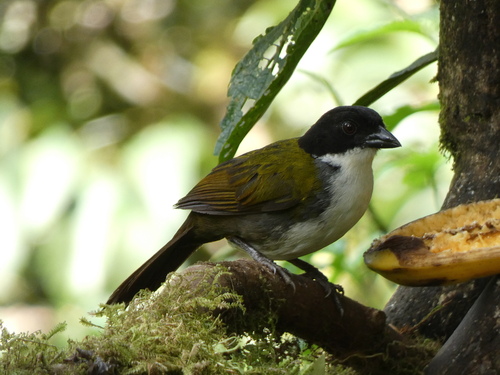
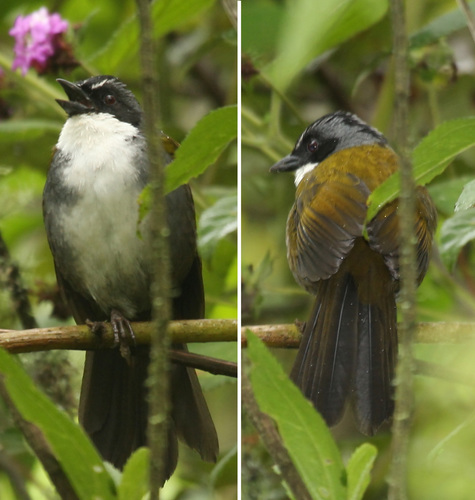
The olive finch (Arremon castaneiceps) is a species of bird in the family Passerellidae. Until recently, it was placed in the genus Lysurus. It is found in the Andes of Colombia, Ecuador and far northern Peru where its natural habitat is subtropical or tropical moist montane forest. The olive finch is listed as Near Threatened by the IUCN Red List. The olive finch is related to the sooty-faced finch and ornithologist Carl Eduard Hallmayr even suggested they should be classified as the same species.

The olive finch is found in humid, low mountain forests, often near ravines, forest edges, rivers, and streams. It is found at elevations between 700-2200 meters in Columbia, 800-1800 m in Ecuador, and 750-1800 m in Peru.

The olive finch has olive green plumage with a chestnut crown and nape. The face and throat are dark gray, and the wings and tail are darker in color than the rest. The tail is more rounded compared to other Arremon species. A juvenile olive finch presents similarly to adults but with a duller crown, olive throat and face, and uneven plumage coloration. More specific information on the bird's molt and its timing is not available... Wikipedia →

Sounds

Song0:29

Ecuador · 2021

© Francisco Sornoza · XC647271 · CC BY-NC-SA 4.0

Subsong1:15

Colombia · 2021

© Mauricio Cuellar Ramirez (@Birding.travel) · XC638346 · CC BY-NC-SA 4.0

Call0:26

Colombia · 1995

© Paul Coopmans · XC264880 · CC BY-NC-SA 4.0

Global Distribution

Parks Where Found

# Park Country Daily sighting probability
1 Podocarpus National Park 🇪🇨 Ecuador
~10%
2 Farallones de Cali National Natural Park 🇨🇴 Colombia
<5%

Before you go

What are the chances of seeing an Olive Finch in Farallones de Cali National Natural Park?

Rare

Under 5% of wildlife watchers report an Olive Finch sighting in Farallones de Cali National Natural Park on a given day, based on 43 verified sightings from GBIF citizen-science data from 2019 to 2026. It is the 331st most-seen of the 542 birds we can rate there. Over three days the chance rises to under 5%, and over a week to about 10%, if each day is a fresh chance.

When is the best time to see an Olive Finch in Farallones de Cali National Natural Park?

March

In that month about 10% of wildlife watchers report an Olive Finch in Farallones de Cali National Natural Park on a given day, against under 5% in April to February, the lowest months.

What time of day is best to see an Olive Finch?

Between 6 and 9 am

Across all the parks we cover, that three-hour window holds the most Olive Finch sightings with a recorded time, and about 9 in 10 of them come between 6 am and 6 pm: it is a daytime animal.

Is Farallones de Cali National Natural Park the best place to see an Olive Finch?

2nd of 2

Of the 2 parks where we can rate Olive Finch sightings, Farallones de Cali National Natural Park ranks 2nd at under 5%. The best odds are in Podocarpus National Park (Ecuador, about 10%).

Which relatives of the Olive Finch live in Farallones de Cali National Natural Park?

Same genus: Arremon

The closest relatives of the Olive Finch that you can see in Farallones de Cali National Natural Park (genus Arremon, Arremon Brushfinches and Sparrows) are Black-headed Brushfinch (about 30%) and Chestnut-capped Brushfinch (about 30%), with each one's daily chance of a sighting.

Where does the Olive Finch sighting chance come from?

GBIF citizen-science records

It is estimated from how often the Olive Finch is recorded against all the birds logged in Farallones de Cali National Natural Park (43 verified sightings from 2019 to 2026), calibrated against known sighting rates. Figures are rounded to the nearest 10% because citizen-science data supports honest approximations, not decimals, and months with records from fewer than five people show "—". How it works.

← Back to Farallones de Cali National Natural Park