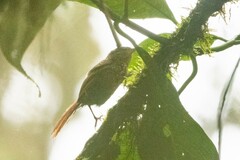
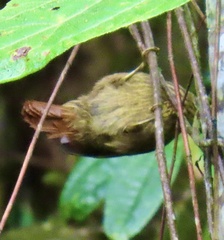

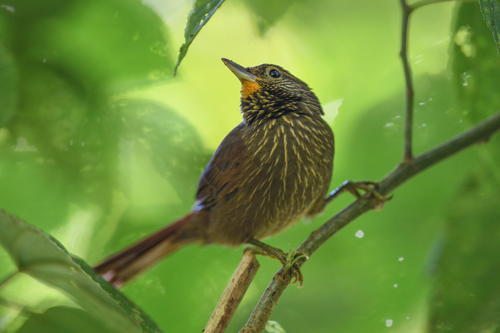
Rusty-winged Barbtail

Rusty-winged Barbtail

Premnornis guttuliger

Silhouette: Sheatherius · PhyloPic

LCLeast ConcernNTVUENCR
Daily sighting probability <5% · Rare
at Farallones de Cali National Natural Park

In 3 days <5%

24 Verified sightings at Farallones de Cali National Natural Park From 2019 to 2026
149 In all 2 parks
December Best month
☀️ Diurnal When it's spotted

About the Rusty-winged Barbtail

The rusty-winged barbtail (Premnornis guttuliger) is a species of bird in the Furnariinae subfamily of the ovenbird family Furnariidae. It is found in Colombia, Ecuador, Peru, and Venezuela. The rusty-winged barbtail is the only member of its genus.

The rusty-winged barbtail is a sister species of the two species in genus Tarphonomus and the two of them are sister to the tuftedcheeks of genus Pseudocolaptes. The rusty-winged barbtail is not closely related to the two barbtails of genus Premnoplex nor to the Roraiman barbtail (Roraimia adjusta).

The rusty-winged barbtail is 13 to 14.5 cm (5.1 to 5.7 in) long and weighs 13 to 17 g (0.46 to 0.60 oz). The sexes' plumages are alike. Adults of the nominate subspecies have a pale buffish or brownish buff supercilium and a dark brown stripe behind the eye; the rest of their face is streaked brown and buff. Their crown is dark olive-brown with a faint scallop pattern. The sides of their neck and upper back are brownish with pale buff spots, their lower back is browner... Wikipedia →

Sounds

Song0:54

Ecuador · 2023

© Juan Freile · XC1172515 · CC BY-NC-SA 4.0

Call0:31

Colombia · 2019

© Manuel Sánchez-Nivicela · XC1162561 · CC BY-NC-ND 4.0

Flight call0:28

Colombia · 2021

© Jorge L. Peña · XC701377 · CC BY-NC-SA 4.0

Global Distribution

Parks Where Found

# Park Country Daily sighting probability
1 Los Nevados National Natural Park 🇨🇴 Colombia
<5%
2 Farallones de Cali National Natural Park 🇨🇴 Colombia
<5%

Before you go

What are the chances of seeing a Rusty-winged Barbtail in Farallones de Cali National Natural Park?

Rare

Under 5% of wildlife watchers report a Rusty-winged Barbtail sighting in Farallones de Cali National Natural Park on a given day, based on 24 verified sightings from GBIF citizen-science data from 2019 to 2026. It is the 410th most-seen of the 542 birds we can rate there. Over three days the chance rises to under 5%, if each day is a fresh chance.

When is the best time to see a Rusty-winged Barbtail in Farallones de Cali National Natural Park?

Any time of year

In every month with enough records, under 5% of wildlife watchers report a Rusty-winged Barbtail in Farallones de Cali National Natural Park on a given day, so our monthly data shows no clear season.

What time of day is best to see a Rusty-winged Barbtail?

Between 7 and 10 am

Across all the parks we cover, that three-hour window holds the most Rusty-winged Barbtail sightings with a recorded time, and about 9 in 10 of them come between 6 am and 6 pm: it is a daytime animal.

Is Farallones de Cali National Natural Park the best place to see a Rusty-winged Barbtail?

Among the best

Of the 2 parks where we can rate Rusty-winged Barbtail sightings, Farallones de Cali National Natural Park ranks 2nd at under 5%, level with the leaders once rounded. The best odds are in Los Nevados National Natural Park (Colombia, under 5%).

Which relatives of the Rusty-winged Barbtail live in Farallones de Cali National Natural Park?

Same family: Furnariidae

The closest relatives of the Rusty-winged Barbtail that you can see in Farallones de Cali National Natural Park (family Furnariidae, Ovenbirds and Woodcreepers) are Red-faced Spinetail (about 50%), Montane Woodcreeper (about 10%) and Azara's Spinetail (about 10%), with each one's daily chance of a sighting.

Where does the Rusty-winged Barbtail sighting chance come from?

GBIF citizen-science records

It is estimated from how often the Rusty-winged Barbtail is recorded against all the birds logged in Farallones de Cali National Natural Park (24 verified sightings from 2019 to 2026), calibrated against known sighting rates. Figures are rounded to the nearest 10% because citizen-science data supports honest approximations, not decimals, and months with records from fewer than five people show "—". How it works.

← Back to Farallones de Cali National Natural Park