Scarlet-and-white Tanager

Scarlet-and-white Tanager

Chrysothlypis salmoni

Silhouette: Sheatherius · PhyloPic

LCLeast ConcernNTVUENCR
Daily sighting probability ~10% · With luck
at Farallones de Cali National Natural Park

In 3 days ~10% in a week ~30%

217 Verified sightings at Farallones de Cali National Natural Park From 2019 to 2026
217 In 1 park
June Best month
☀️ Diurnal When it's spotted

About the Scarlet-and-white Tanager

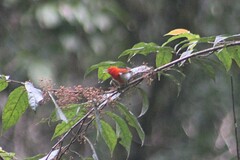
The scarlet-and-white tanager (Chrysothlypis salmoni) is a species of bird in the family Thraupidae. It is found in Colombia and northern Ecuador. Its natural habitats are subtropical or tropical moist lowland forests and heavily degraded former forest. The male is highly distinctive and has bright scarlet upperparts, darker red wings and undertail coverts, and white underparts with a scarlet median stripe running down the throat and belly. Females are patterned like the males, but are olive-brown instead of scarlet.

The scarlet-and-white tanager is found in secondary growth and disturbed vegetation, mostly between elevations of 25–1,200 m (100–3,900 ft), but sometimes up to elevations of 1,700 m (5,600 ft). It feeds mainly on fruit and arthropods. Foraging occurs singly, in pairs, or in groups of up to six, and it can be found in mixed-species flocks with other tanagers, especially those in the genus Tangara.

The scarlet-and-white tanager is listed as least concern by the International Union for Conservation of Nature (IUCN) on the IUCN Red List, due to its large range and relative commonness. It is threatened by increasing deforestation throughout its range, especially in foothills, but is unlikely to be in immediate danger due to its affinity for disturbed habitats. Wikipedia →

Sounds

Call0:32

Colombia · 2020

© Jerome Fischer · XC534049 · CC BY-NC-SA 4.0

Flight call0:07

Ecuador · 1997

© Olaf Jahn · XC262530 · CC BY-NC-SA 4.0

Call0:23

Ecuador · 2000

© Patricio Mena Valenzuela · XC275605 · CC BY-NC-SA 4.0

Global Distribution

Parks Where Found

# Park Country Daily sighting probability
1 Farallones de Cali National Natural Park 🇨🇴 Colombia
~10%

More parks will be added in future updates.

Before you go

What are the chances of seeing a Scarlet-and-white Tanager in Farallones de Cali National Natural Park?

With luck

About 10% of wildlife watchers report a Scarlet-and-white Tanager sighting in Farallones de Cali National Natural Park on a given day, based on 217 verified sightings from GBIF citizen-science data from 2019 to 2026. It is the 191st most-seen of the 542 birds we can rate there. Over three days the chance rises to about 10%, and over a week to about 30%, if each day is a fresh chance.

When is the best time to see a Scarlet-and-white Tanager in Farallones de Cali National Natural Park?

June

In that month about 20% of wildlife watchers report a Scarlet-and-white Tanager in Farallones de Cali National Natural Park on a given day, against under 5% in August and October–April, the lowest months.

What time of day is best to see a Scarlet-and-white Tanager?

Between 11 am and 2 pm

Across all the parks we cover, that three-hour window holds the most Scarlet-and-white Tanager sightings with a recorded time, and about 9 in 10 of them come between 6 am and 6 pm: it is a daytime animal.

Where else can you see a Scarlet-and-white Tanager?

Only Farallones de Cali National Natural Park, in our data

Farallones de Cali National Natural Park is the only park on Wallace's Line with enough records to rate Scarlet-and-white Tanager sightings: about 10% of wildlife watchers there report one on a given day.

Which relatives of the Scarlet-and-white Tanager live in Farallones de Cali National Natural Park?

Same family: Thraupidae

The closest relatives of the Scarlet-and-white Tanager that you can see in Farallones de Cali National Natural Park (family Thraupidae, Tanagers and Allies) are Flame-rumped Tanager (about 70%), Blue-gray Tanager (about 70%) and Green Honeycreeper (about 70%), with each one's daily chance of a sighting.

Where does the Scarlet-and-white Tanager sighting chance come from?

GBIF citizen-science records

It is estimated from how often the Scarlet-and-white Tanager is recorded against all the birds logged in Farallones de Cali National Natural Park (217 verified sightings from 2019 to 2026), calibrated against known sighting rates. Figures are rounded to the nearest 10% because citizen-science data supports honest approximations, not decimals, and months with records from fewer than five people show "—". How it works.

← Back to Farallones de Cali National Natural Park