Eastern Bath White

Eastern Bath White

Pontia edusa

Daily sighting probability ~10% · With luck
at Fertő-Hanság National Park

In 3 days ~20% in a week ~50%

10 Verified sightings at Fertő-Hanság National Park From 2019 to 2026
28 In all 3 parks
September Best month
☀️ Diurnal When it's spotted

About the Eastern Bath White

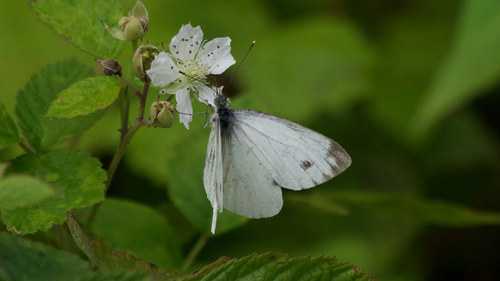
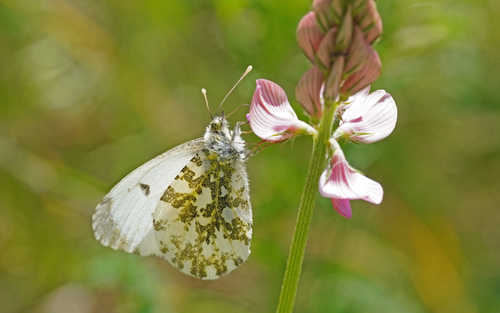
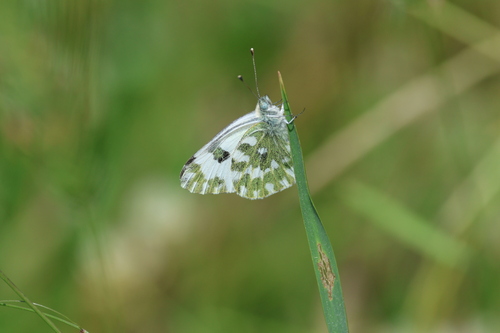
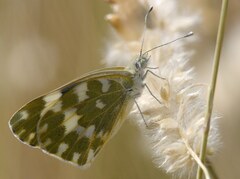
Pontia edusa, the eastern Bath white, is a butterfly in the family Pieridae. Pontia edusa is a small to medium-sized migrant butterfly, with a wingspan reaching about 45 mm. The upperside of the wings is white, with black stains on the top of the forewing and hindwing. The hindwing undersides have greenish-grey spots. The butterfly is nearly identical to Pontia daplidice, making the western extent of its range difficult to ascertain. Investigations of the genitals and DNA analysis are the only way to distinguish between these two types.

The adults fly from March to October with two to four generations depending on the latitude. The eggs are laid singly and have an incubation period of seven days. The caterpillars are present from May. They are greyish-greenish, with black dots and broad yellow stripes, quite similar to the larva of the cabbage butterfly (Pieris brassicae). The larvae feed on Resedaceae species. Pontia edusa hibernates in the chrysalis stage.

It is found from the south east of Europe (southern France, Italy, Corsica, Sardinia) up to central Europe and the Middle East in Iran and Iraq. It is a migrant which can also be encountered... Wikipedia →
Global Distribution

Parks Where Found

# Park Country Daily sighting probability
1 Hortobágy National Park 🇭🇺 Hungary
~30%
2 Kiskunság National Park 🇭🇺 Hungary
~30%
3 Fertő-Hanság National Park 🇭🇺 Hungary
~10%

Cities Where Found

# City Country Daily sighting probability
1 Ankara 🇹🇷 Turkey
~30%
2 Athens 🇬🇷 Greece
~20%
3 Yerevan 🇦🇲 Armenia
~10%
4 Astana 🇰🇿 Kazakhstan
~10%
5 Beijing 🇨🇳 China
~10%
6 Kharkiv 🇺🇦 Ukraine
~10%
7 Novosibirsk 🇷🇺 Russia
~10%
8 Almaty 🇰🇿 Kazakhstan
~10%
9 Budapest 🇭🇺 Hungary
~10%
10 Rome 🇮🇹 Italy
~10%

Before you go

What are the chances of seeing an Eastern Bath White in Fertő-Hanság National Park?

With luck

About 10% of wildlife watchers report an Eastern Bath White sighting in Fertő-Hanság National Park on a given day, based on 10 verified sightings from GBIF citizen-science data from 2019 to 2026. It is the 116th most-seen of the 243 insects we can rate there. Over three days the chance rises to about 20%, and over a week to about 50%, if each day is a fresh chance.

When is the best time to see an Eastern Bath White in Fertő-Hanság National Park?

September

In that month about 20% of wildlife watchers report an Eastern Bath White in Fertő-Hanság National Park on a given day, against under 5% in May and October–March, the lowest months. That is one of Fertő-Hanság National Park's wettest months, with about 80 mm of rain against 30 mm in March.

What time of day is best to see an Eastern Bath White?

Between 1 and 4 pm

Across all the parks we cover, that three-hour window holds the most Eastern Bath White sightings with a recorded time, and about 9 in 10 of them come between 6 am and 6 pm: it is a daytime animal.

Is Fertő-Hanság National Park the best place to see an Eastern Bath White?

3rd of 3

Of the 3 parks where we can rate Eastern Bath White sightings, Fertő-Hanság National Park ranks 3rd at about 10%. The best odds are in Hortobágy National Park (Hungary, about 30%) and Kiskunság National Park (Hungary, about 30%).

Which relatives of the Eastern Bath White live in Fertő-Hanság National Park?

Same family: Pieridae

The closest relatives of the Eastern Bath White that you can see in Fertő-Hanság National Park (family Pieridae, Whites, Yellows, and Sulphurs) are Green-Veined White (about 10%), Small White (about 10%) and Common Brimstone (about 10%), with each one's daily chance of a sighting.

Where does the Eastern Bath White sighting chance come from?

GBIF citizen-science records

It is estimated from how often the Eastern Bath White is recorded against all the insects logged in Fertő-Hanság National Park (10 verified sightings from 2019 to 2026), calibrated against known sighting rates. Figures are rounded to the nearest 10% because citizen-science data supports honest approximations, not decimals, and months with records from fewer than five people show "—". How it works.

← Back to Fertő-Hanság National Park