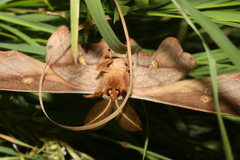
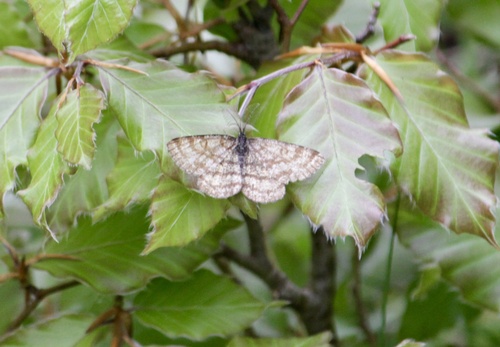
Japanese Silk Moth

Japanese Silk Moth

Antheraea yamamai

Daily sighting probability ~10% · With luck
at Fertő-Hanság National Park

In 3 days ~20% in a week ~40%

7 Verified sightings at Fertő-Hanság National Park From 2019 to 2026
133 In all 5 parks
February Best month
☀️🌙 Day & Night When it's spotted

About the Japanese Silk Moth

Antheraea yamamai, the Japanese silk moth or Japanese oak silkmoth (Japanese: yamamayu(ga) (山繭(蛾)・ヤママユ(ガ)) or tensan (天蚕)) is a moth of the family Saturniidae. It is endemic to east Asia, but has been imported to Europe for tussar silk production and is now found in southeastern Europe, mainly in Austria, northeastern Italy, and the Balkans. It seems to be spreading north and a population has been reported near Deggendorf and Passau in Germany. The species was first described by Félix Édouard Guérin-Méneville in 1861. It has been hybridized artificially with Antheraea polyphemus of North America.

This moth has been cultivated in Japan for more than 1000 years. It produces a naturally white silk that is very strong and elastic, but does not dye well. It is now very rare and expensive. The wingspan is 110–150 millimetres (4.3–5.9 in). Adults are on wing from August to September in one generation depending on the location.

The larva mainly feed on Quercus species, but have also been reported on Fagus sylvatica, Castanea sativa, Carpinus, Rosa, and Crataegus. In order to look at the tensan silk genes in more detail a de novo genome and set of transcriptomes have been sequenced, producing a 700Mb reference with 15,481 genes. Wikipedia →

Global Distribution

Parks Where Found

# Park Country Daily sighting probability
1 Triglav National Park 🇸🇮 Slovenia
~40%
2 Plitvice Lakes National Park 🇭🇷 Croatia
~20%
3 Nikko National Park 🇯🇵 Japan
~20%
4 Bavarian Forest National Park 🇩🇪 Germany
~10%
5 Fertő-Hanság National Park 🇭🇺 Hungary
~10%

Cities Where Found

# City Country Daily sighting probability
1 Osaka 🇯🇵 Japan
~10%
2 Seoul 🇰🇷 South Korea
<5%
3 Tokyo 🇯🇵 Japan
<5%

Before you go

What are the chances of seeing a Japanese Silk Moth in Fertő-Hanság National Park?

With luck

About 10% of wildlife watchers report a Japanese Silk Moth sighting in Fertő-Hanság National Park on a given day, based on 7 verified sightings from GBIF citizen-science data from 2019 to 2026. It is the 199th most-seen of the 243 insects we can rate there. Over three days the chance rises to about 20%, and over a week to about 40%, if each day is a fresh chance.

When is the best time to see a Japanese Silk Moth in Fertő-Hanság National Park?

February and August

In those months about 20% of wildlife watchers report a Japanese Silk Moth in Fertő-Hanság National Park on a given day, against under 5% in March–June and September–January, the lowest months.

What time of day is best to see a Japanese Silk Moth?

Between 8 and 11 am

Across all the parks we cover, that three-hour window holds the most Japanese Silk Moth sightings with a recorded time, and about 7 in 10 of them come between 6 am and 6 pm: it is seen both by day and at night.

Is Fertő-Hanság National Park the best place to see a Japanese Silk Moth?

5th of 5

Of the 5 parks where we can rate Japanese Silk Moth sightings, Fertő-Hanság National Park ranks 5th at about 10%. The best odds are in Triglav National Park (Slovenia, about 40%), Plitvice Lakes National Park (Croatia, about 20%) and Nikko National Park (Japan, about 20%).

Where does the Japanese Silk Moth sighting chance come from?

GBIF citizen-science records

It is estimated from how often the Japanese Silk Moth is recorded against all the insects logged in Fertő-Hanság National Park (7 verified sightings from 2019 to 2026), calibrated against known sighting rates. Figures are rounded to the nearest 10% because citizen-science data supports honest approximations, not decimals, and months with records from fewer than five people show "—". How it works.

← Back to Fertő-Hanság National Park