
New Zealand Lesser Short-tailed Bat

New Zealand Lesser Short-tailed Bat

Mystacina tuberculata

Silhouette: T. Michael Keesey · PhyloPic

LCNTVUVulnerableENCR Endemic
Daily sighting probability ~10% · With luck
at Fiordland National Park

In 3 days ~20% in a week ~40%

7 Verified sightings at Fiordland National Park From 2019 to 2026
7 In 1 park
March Best month
🌙 Nocturnal When it's spotted

About the New Zealand Lesser Short-tailed Bat

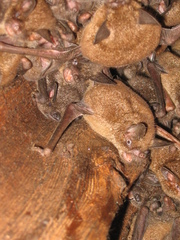
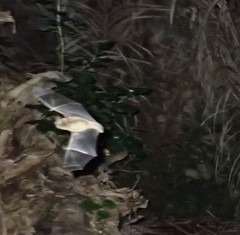
The New Zealand lesser short-tailed bat (Mystacina tuberculata) is a small-sized omnivorous mammal endemic to the islands of New Zealand. It is one of two extant and three overall terrestrial mammal species unique to New Zealand. Its closest relative, the New Zealand greater short-tailed bat (M. robusta), was last seen in 1965 and is presumed extinct due to intense predation from ship rats introduced in the last few centuries. These bats are also commonly referred to as pekapeka, their Māori-language name. Lesser short-tailed bats have unique adaptations that differentiate them from bats found in other parts of the world. For example, they are fully capable of moving along the ground to search for food, and the males sing to attract partners, taking turns to do so. Lesser short-tailed bats are a vulnerable species, so extensive conservation work and research are being done to prevent extinction.

Mystacina tuberculata are members of the suborder Yangochiroptera and have recently been placed in the superfamily Noctillionoidea. They are members of the family Mystacinidae, which contains the single genus Mystacina. Within Mystacina... Wikipedia →

Global Distribution

Parks Where Found

# Park Country Daily sighting probability
1 Fiordland National Park 🇳🇿 New Zealand
~10%

More parks will be added in future updates.

Before you go

What are the chances of seeing a New Zealand Lesser Short-tailed Bat in Fiordland National Park?

With luck

About 10% of wildlife watchers report a New Zealand Lesser Short-tailed Bat sighting in Fiordland National Park on a given day, based on 7 verified sightings from GBIF citizen-science data from 2019 to 2026. It is the 6th most-seen of the 12 mammals we can rate there. Over three days the chance rises to about 20%, and over a week to about 40%, if each day is a fresh chance.

When is the best time to see a New Zealand Lesser Short-tailed Bat in Fiordland National Park?

March

In that month about 20% of wildlife watchers report a New Zealand Lesser Short-tailed Bat in Fiordland National Park on a given day, against under 5% in April to December, the lowest months.

What time of day is best to see a New Zealand Lesser Short-tailed Bat?

Between 9 pm and midnight

Across all the parks we cover, that three-hour window holds the most New Zealand Lesser Short-tailed Bat sightings with a recorded time, and nearly all of them come between 6 pm and 6 am: it is mostly seen at night.

Where else can you see a New Zealand Lesser Short-tailed Bat?

Only Fiordland National Park, in our data

Fiordland National Park is the only park on Wallace's Line with enough records to rate New Zealand Lesser Short-tailed Bat sightings: about 10% of wildlife watchers there report one on a given day.

Where does the New Zealand Lesser Short-tailed Bat sighting chance come from?

GBIF citizen-science records

It is estimated from how often the New Zealand Lesser Short-tailed Bat is recorded against all the mammals logged in Fiordland National Park (7 verified sightings from 2019 to 2026), calibrated against known sighting rates. Figures are rounded to the nearest 10% because citizen-science data supports honest approximations, not decimals, and months with records from fewer than five people show "—". How it works.

← Back to Fiordland National Park