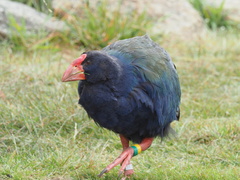
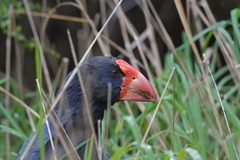
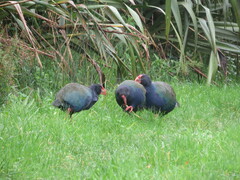

South Island Takahē

South Island Takahē

Porphyrio hochstetteri

Silhouette: Sheatherius · PhyloPic

LCNTVUENEndangeredCR Endemic
Daily sighting probability <5% · Rare
at Fiordland National Park

In 3 days <5%

15 Verified sightings at Fiordland National Park From 2019 to 2026
15 In 1 park
February Best month
☀️ Diurnal When it's spotted

About the South Island Takahē

The South Island takahē (Porphyrio hochstetteri) is a flightless swamphen indigenous to New Zealand and the largest living member of the rail family. It is often known by the abbreviated name takahē, which it shares with the recently (14th century) extinct North Island takahē. The two takahē species are also known as notornis.

Takahē were hunted extensively by both early European settlers and Māori, and takahē bones have been found in middens in the South Island. Fossil remains have also been found across the South Island. They were not named and described by Europeans until 1847, and then only from fossil bones. In 1850 a living bird was captured, and three more collected in the 19th century. After another bird was captured in 1898, and no more were to be found, the species was presumed extinct. Fifty years later, however, after a carefully planned search, South Island takahē were dramatically rediscovered in November 1948 by Geoffrey Orbell in an isolated valley in the South Island's Murchison Mountains. The species is now managed by the New Zealand Department of Conservation, whose Takahē Recovery Programme maintains populations on several offshore islands as well as Takahē Valley. Takahē has been reintroduced to numerous locations across the country. Although South Island takahē are still a threatened species, their NZTCS status was downgraded in 2016 from Nationally Critical to Nationally Vulnerable. As of 2023, the population is around 500 and is growing by 8 percent per year. Wikipedia →

Sounds

Call0:32

New Zealand · 2011

© Olivier SWIFT · XC500837 · CC BY-NC-SA 4.0

Song0:07

New Zealand · 2016

© Dan Lane · XC344381 · CC BY-NC-SA 4.0

Call0:56

New Zealand · 2015

© Johannes Fischer · XC214590 · CC BY-NC-SA 4.0

Global Distribution

Parks Where Found

# Park Country Daily sighting probability
1 Fiordland National Park 🇳🇿 New Zealand
<5%

More parks will be added in future updates.

Zoos & Centres Where Found

# Zoo / Centre Country
1 Pūkaha National Wildlife Centre 🇳🇿 New Zealand In captivity
2 Auckland Zoo 🇳🇿 New Zealand In captivity
3 Wellington Zoo 🇳🇿 New Zealand In captivity
4 Willowbank Wildlife Reserve 🇳🇿 New Zealand In captivity
5 Te Anau Bird Sanctuary 🇳🇿 New Zealand In captivity
6 Island Bay Marine Education Centre 🇳🇿 New Zealand In captivity

Before you go

What are the chances of seeing a South Island Takahē in Fiordland National Park?

Rare

Under 5% of wildlife watchers report a South Island Takahē sighting in Fiordland National Park on a given day, based on 15 verified sightings from GBIF citizen-science data from 2019 to 2026. It is the 92nd most-seen of the 94 birds we can rate there. Over three days the chance rises to under 5%, if each day is a fresh chance.

When is the best time to see a South Island Takahē in Fiordland National Park?

Any time of year

In every month with enough records, under 5% of wildlife watchers report a South Island Takahē in Fiordland National Park on a given day, so our monthly data shows no clear season.

What time of day is best to see a South Island Takahē?

Between 11 am and 2 pm

Across all the parks we cover, that three-hour window holds the most South Island Takahē sightings with a recorded time, and about 9 in 10 of them come between 6 am and 6 pm: it is a daytime animal.

Where else can you see a South Island Takahē?

Only Fiordland National Park, in our data

Fiordland National Park is the only park on Wallace's Line with enough records to rate South Island Takahē sightings: under 5% of wildlife watchers there report one on a given day.

Where does the South Island Takahē sighting chance come from?

GBIF citizen-science records

It is estimated from how often the South Island Takahē is recorded against all the birds logged in Fiordland National Park (15 verified sightings from 2019 to 2026), calibrated against known sighting rates. Figures are rounded to the nearest 10% because citizen-science data supports honest approximations, not decimals, and months with records from fewer than five people show "—". How it works.

← Back to Fiordland National Park