
Purple-gaped Honeyeater

Purple-gaped Honeyeater

Lichenostomus cratitius

Silhouette: Rachael Joakim · PhyloPic

LCLeast ConcernNTVUENCR Endemic
Daily sighting probability ~30% · Possible
at Flinders Chase

In 3 days ~60% in a week ~90%

51 Verified sightings at Flinders Chase From 2019 to 2026
51 In 1 park
June Best month
☀️ Diurnal When it's spotted

About the Purple-gaped Honeyeater

The purple-gaped honeyeater (Lichenostomus cratitius) is a species of bird in the family Meliphagidae. It is endemic to semi-arid southern Australia, where it inhabits mallee, tall heath and associated low eucalypt woodland.

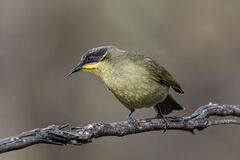
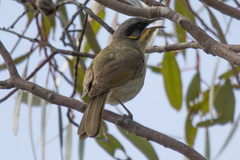
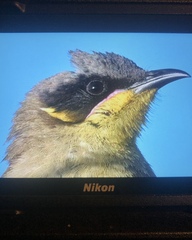
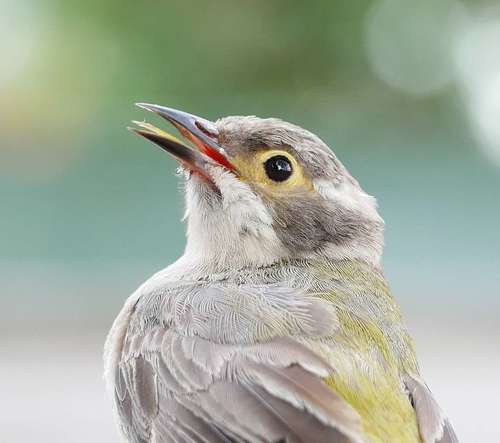
The purple-gaped honeyeater is a medium-sized (16-19 centimetres) honeyeater which is generally grey-olive above and buffish yellow below. They have a patterned head, with a black eyestripe against a grey background and purple gape above a yellow streak on the throat and pointed yellow ear coverts. Juveniles are similar, but with duller facial patterns, slightly browner plumage, and a yellow gape and gape line. The Kangaroo Island subspecies is considered to be larger and darker than the mainland subspecies.

Similar species include yellow-plumed honeyeater and singing honeyeater. The bird is also named Wattle-Cheeked Honeyeater in Birds of Australia vol 11 by Gregory Mathews The song is a clear toweet-toweet-toweet, followed by a high-pitched yep-yep-yep, often performed from a tall branch, including before dawn. They occur in disjunct populations across southern Australia, east from southern Western Australia, with... Wikipedia →

Sounds

Flight call0:13

Australia · 2025

© Khristos Nizamis · XC1068272 · CC BY-NC-ND 4.0

Call0:35

Australia · 2022

© Eddy Smith · XC750847 · CC BY-NC-SA 4.0

Call0:04

Australia · 2014

© nick talbot · XC203818 · CC BY-NC-SA 4.0

Global Distribution

Parks Where Found

# Park Country Daily sighting probability
1 Flinders Chase 🇦🇺 Australia
~30%

More parks will be added in future updates.

Before you go

What are the chances of seeing a Purple-gaped Honeyeater in Flinders Chase?

Possible

About 30% of wildlife watchers report a Purple-gaped Honeyeater sighting in Flinders Chase on a given day, based on 51 verified sightings from GBIF citizen-science data from 2019 to 2026. It is the 29th most-seen of the 68 birds we can rate there. Over three days the chance rises to about 60%, and over a week to about 90%, if each day is a fresh chance.

When is the best time to see a Purple-gaped Honeyeater in Flinders Chase?

June and July

In those months about 40% of wildlife watchers report a Purple-gaped Honeyeater in Flinders Chase on a given day, against about 20% in January–February and April, the lowest months. Those are among Flinders Chase's wettest months, with about 80 mm of rain a month against 25 mm in February. August has too few records to rate.

What time of day is best to see a Purple-gaped Honeyeater?

Between 9 am and noon

Across all the parks we cover, that three-hour window holds the most Purple-gaped Honeyeater sightings with a recorded time, and about 9 in 10 of them come between 6 am and 6 pm: it is a daytime animal.

Where else can you see a Purple-gaped Honeyeater?

Only Flinders Chase, in our data

Flinders Chase is the only park on Wallace's Line with enough records to rate Purple-gaped Honeyeater sightings: about 30% of wildlife watchers there report one on a given day.

Which relatives of the Purple-gaped Honeyeater live in Flinders Chase?

Same family: Meliphagidae

The closest relatives of the Purple-gaped Honeyeater that you can see in Flinders Chase (family Meliphagidae, Honeyeaters) are New Holland Honeyeater (about 60%), Red Wattlebird (about 60%) and Crescent Honeyeater (about 40%), with each one's daily chance of a sighting.

Where does the Purple-gaped Honeyeater sighting chance come from?

GBIF citizen-science records

It is estimated from how often the Purple-gaped Honeyeater is recorded against all the birds logged in Flinders Chase (51 verified sightings from 2019 to 2026), calibrated against known sighting rates. Figures are rounded to the nearest 10% because citizen-science data supports honest approximations, not decimals, and months with records from fewer than five people show "—". How it works.

← Back to Flinders Chase