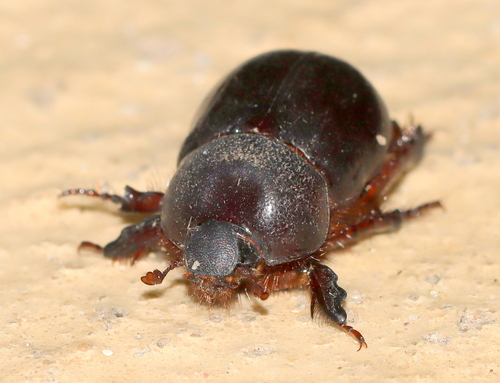
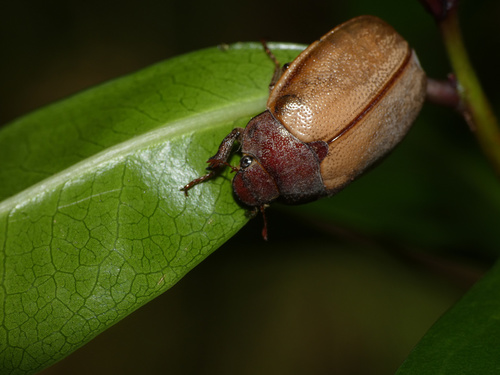
Boas Rhinoceros Beetle

Boas Rhinoceros Beetle

Oryctes boas

Daily sighting probability ~10% · With luck
at Garden Route National Park

In 3 days ~20% in a week ~30%

11 Verified sightings at Garden Route National Park From 2019 to 2026
52 In all 3 parks
October Best month
🌅 Crepuscular When it's spotted

About the Boas Rhinoceros Beetle

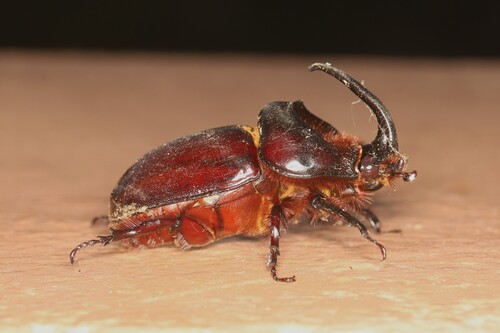
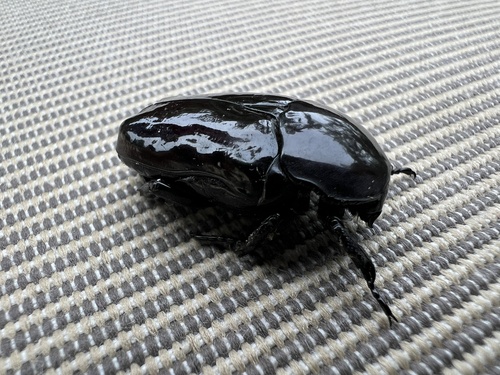
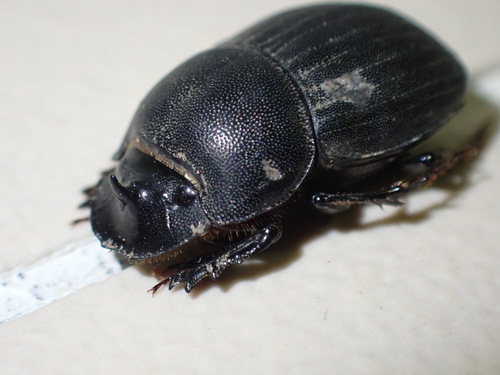
Oryctes boas is a species of rhinoceros beetles from the subfamily Dynastinae (family: Scarabaeidae) which is found in many parts of sub-Saharan Africa and in some neighboring parts of the Near East. It appears to be most common in south-eastern Africa. O. boas breeds mainly in compost heaps and is a pest of coconut palms. However, in West Africa it is usually less abundant and less destructive on coconut palms compared to Oryctes monoceros, a species with a similar distribution range and biology. Both species belong to the subgenus Rykanoryctes which is characterized by having 3 fixed (immovable) spikes at the tip of the hind tibia. The main morphological difference between both species is the size of the horn. In O. boas males, the horn is very long and curved backwards at the tip. O. boas is also smaller and heavier built compared to O. monoceros. The pronotum of O. boas males has a large depression (concavity) with two pointed teeth at its hind margin and dense hair in the anterior part. Females have a short horn and the depression on the pronotum is very small, round and usually with two knobs at the hind margin.

Oryctes boas was originally described by Fabricius... Wikipedia →

Global Distribution

Parks Where Found

# Park Country Daily sighting probability
1 Garden Route National Park 🇿🇦 South Africa
~10%
2 Kruger National Park 🇿🇦 South Africa
~10%
3 Table Mountain National Park 🇿🇦 South Africa
<5%

Cities Where Found

# City Country Daily sighting probability
1 Harare 🇿🇼 Zimbabwe
~10%
2 Lusaka 🇿🇲 Zambia
~10%
3 Nairobi 🇰🇪 Kenya
~10%
4 Johannesburg 🇿🇦 South Africa
~10%
5 Pretoria 🇿🇦 South Africa
~10%
6 Cape Town 🇿🇦 South Africa
<5%

Before you go

What are the chances of seeing a Boas Rhinoceros Beetle in Garden Route National Park?

With luck

About 10% of wildlife watchers report a Boas Rhinoceros Beetle sighting in Garden Route National Park on a given day, based on 11 verified sightings from GBIF citizen-science data from 2019 to 2026. It is the 153rd most-seen of the 298 insects we can rate there. Over three days the chance rises to about 20%, and over a week to about 30%, if each day is a fresh chance.

When is the best time to see a Boas Rhinoceros Beetle in Garden Route National Park?

February, May, August–October and December

In those months about 10% of wildlife watchers report a Boas Rhinoceros Beetle in Garden Route National Park on a given day, against under 5% in January, March–April, June–July and November, the lowest months.

What time of day is best to see a Boas Rhinoceros Beetle?

Between 6 and 9 pm

Across all the parks we cover, that three-hour window holds the most Boas Rhinoceros Beetle sightings with a recorded time, and about 6 in 10 of them come between 6 am and 6 pm: it is most active around dawn and dusk.

Is Garden Route National Park the best place to see a Boas Rhinoceros Beetle?

Yes

Of the 3 parks where we can rate Boas Rhinoceros Beetle sightings, Garden Route National Park has the highest daily chance: about 10%. Next come Kruger National Park (South Africa, about 10%) and Table Mountain National Park (South Africa, under 5%).

Where does the Boas Rhinoceros Beetle sighting chance come from?

GBIF citizen-science records

It is estimated from how often the Boas Rhinoceros Beetle is recorded against all the insects logged in Garden Route National Park (11 verified sightings from 2019 to 2026), calibrated against known sighting rates. Figures are rounded to the nearest 10% because citizen-science data supports honest approximations, not decimals, and months with records from fewer than five people show "—". How it works.

← Back to Garden Route National Park