Knysna Dwarf Chameleon

Knysna Dwarf Chameleon

Bradypodion damaranum

Silhouette: T. Michael Keesey (from a photograph by Frank Glaw, Jörn Köhler, Ted M. Townsend & Miguel Vences) · PhyloPic

LCLeast ConcernNTVUENCR
Daily sighting probability ~30% · Possible
at Garden Route National Park

In 3 days ~70% in a week ~90%

179 Verified sightings at Garden Route National Park From 2019 to 2026
179 In 1 park
March Best month
☀️ Diurnal When it's spotted

About the Knysna Dwarf Chameleon

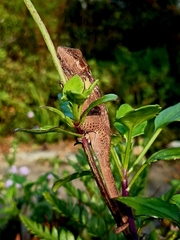
The Knysna dwarf chameleon (Bradypodion damaranum) is a species of dwarf chameleon in the Bradypodion ("slow footed") genus that is endemic to South Africa. It is a forest dweller, found only in a limited range in the afromontane forests near Knysna, South Africa, and in certain surrounding areas.

This species has the longest tail of all the Bradypodion species. As with most chameleons, its tongue is twice the length of its body and it can be shot out of its mouth using a special muscle in the jaw. This gives the chameleon the ability to catch insects some distance away. The Knysna dwarf chameleon has a prominent casque and has bright green to bluish skin, decorated with purple, yellow and pink hues. It is up to 180 mm (7.1 in) total length.

In the past, most South African dwarf chameleons were considered to be a subspecies of one Cape Bradypodion species This is now known to be wrong, however; B. damaranum does not appear to have any particularly close living relatives. Like the Cape dwarf chameleon, it seems to be a basal offshoot of the ancestral stock which gave rise to all Bradypodion chameleon species.

The Knysna dwarf chameleon... Wikipedia →

Global Distribution

Parks Where Found

# Park Country Daily sighting probability
1 Garden Route National Park 🇿🇦 South Africa
~30%

More parks will be added in future updates.

Closest Relatives at Garden Route National Park

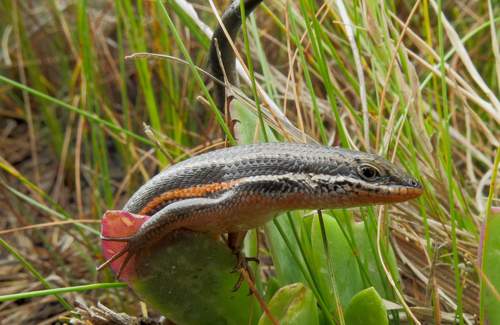
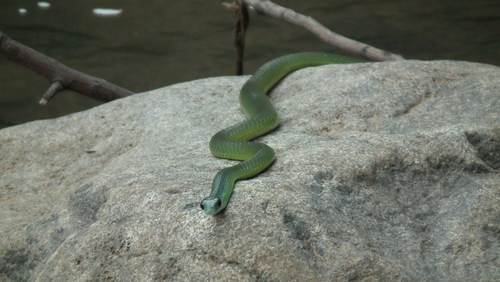
No species of the same family or order lives in Garden Route National Park, so these are its closest relatives here: other reptiles.

Before you go

What are the chances of seeing a Knysna Dwarf Chameleon in Garden Route National Park?

Possible

About 30% of wildlife watchers report a Knysna Dwarf Chameleon sighting in Garden Route National Park on a given day, based on 179 verified sightings from GBIF citizen-science data from 2019 to 2026. It is the 2nd most-seen of the 35 reptiles we can rate there. Over three days the chance rises to about 70%, and over a week to about 90%, if each day is a fresh chance.

When is the best time to see a Knysna Dwarf Chameleon in Garden Route National Park?

February and March

In those months about 40% of wildlife watchers report a Knysna Dwarf Chameleon in Garden Route National Park on a given day, against about 20% in May–June and September, the lowest months.

What time of day is best to see a Knysna Dwarf Chameleon?

Between 10 am and 1 pm

Across all the parks we cover, that three-hour window holds the most Knysna Dwarf Chameleon sightings with a recorded time, and about 8 in 10 of them come between 6 am and 6 pm: it is a daytime animal.

Where else can you see a Knysna Dwarf Chameleon?

Only Garden Route National Park, in our data

Garden Route National Park is the only park on Wallace's Line with enough records to rate Knysna Dwarf Chameleon sightings: about 30% of wildlife watchers there report one on a given day.

Where does the Knysna Dwarf Chameleon sighting chance come from?

GBIF citizen-science records

It is estimated from how often the Knysna Dwarf Chameleon is recorded against all the reptiles logged in Garden Route National Park (179 verified sightings from 2019 to 2026), calibrated against known sighting rates. Figures are rounded to the nearest 10% because citizen-science data supports honest approximations, not decimals, and months with records from fewer than five people show "—". How it works.

← Back to Garden Route National Park