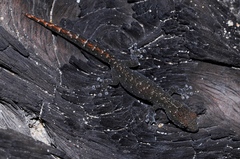

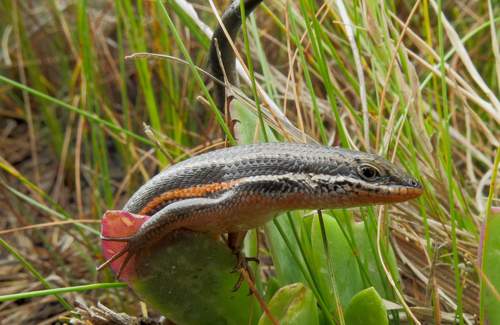
Marbled Leaf-toed Gecko

Marbled Leaf-toed Gecko

Afrogecko porphyreus

Silhouette: Jose Carlos Arenas-Monroy · PhyloPic

LCLeast ConcernNTVUENCR
Daily sighting probability ~20% · Possible
at Garden Route National Park

In 3 days ~50% in a week ~80%

86 Verified sightings at Garden Route National Park From 2019 to 2026
1,086 In all 4 parks
April Best month
🌅 Crepuscular When it's spotted

About the Marbled Leaf-toed Gecko

The marbled leaf-toed gecko (Afrogecko porphyreus) is a gecko found in southern and southwestern South Africa (including many offshore islands) and in Namibia. It is a flat, medium-sized gecko. Afrogecko porphyreus has a mottled, greyish body, a long tail and sometimes a pale stripe along its back. However, its colouration varies from almost black-and-buff patterning to smudged shades of buff. It is an adaptable little forager, hiding under debris, beneath bark, among rocks, and even in city houses.

These geckos eat large numbers of small insects, so a population of them living on one's property serves as a natural form of pest-control. Their diet is an array of invertebrates, including feeder insects. Domestic cats commonly kill large numbers of these lizards, sometimes exterminating them in a local area. They also are preyed upon by species of spiders in the genus Palystes, which may be more effective gecko predators than cats.

As in many similar gecko species, one of their major defences is autotomy of their tails. In some populations nearly all mature specimens have tails that have either regenerated or are in the process of regeneration. This... Wikipedia →

Global Distribution

Parks Where Found

# Park Country Daily sighting probability
1 Table Mountain National Park 🇿🇦 South Africa
~30%
2 De Hoop Nature Reserve 🇿🇦 South Africa
~20%
3 Garden Route National Park 🇿🇦 South Africa
~20%
4 West Coast National Park 🇿🇦 South Africa
~20%

Cities Where Found

# City Country Daily sighting probability
1 Cape Town 🇿🇦 South Africa
~40%

Before you go

What are the chances of seeing a Marbled Leaf-toed Gecko in Garden Route National Park?

Possible

About 20% of wildlife watchers report a Marbled Leaf-toed Gecko sighting in Garden Route National Park on a given day, based on 86 verified sightings from GBIF citizen-science data from 2019 to 2026. It is the 10th most-seen of the 35 reptiles we can rate there. Over three days the chance rises to about 50%, and over a week to about 80%, if each day is a fresh chance.

When is the best time to see a Marbled Leaf-toed Gecko in Garden Route National Park?

February and April

In those months about 30% of wildlife watchers report a Marbled Leaf-toed Gecko in Garden Route National Park on a given day, against under 5% in August, the lowest month.

What time of day is best to see a Marbled Leaf-toed Gecko?

Between 6 and 9 pm

Across all the parks we cover, that three-hour window holds the most Marbled Leaf-toed Gecko sightings with a recorded time, and about half of them come between 6 am and 6 pm: it is most active around dawn and dusk.

Is Garden Route National Park the best place to see a Marbled Leaf-toed Gecko?

3rd of 4

Of the 4 parks where we can rate Marbled Leaf-toed Gecko sightings, Garden Route National Park ranks 3rd at about 20%. The best odds are in Table Mountain National Park (South Africa, about 30%) and De Hoop Nature Reserve (South Africa, about 20%).

Which relatives of the Marbled Leaf-toed Gecko live in Garden Route National Park?

Same family: Gekkonidae

The closest relatives of the Marbled Leaf-toed Gecko that you can see in Garden Route National Park (family Gekkonidae, Typical Geckos) are Cape Dwarf Gecko (about 30%) and Tropical House Gecko (about 10%), with each one's daily chance of a sighting.

Where does the Marbled Leaf-toed Gecko sighting chance come from?

GBIF citizen-science records

It is estimated from how often the Marbled Leaf-toed Gecko is recorded against all the reptiles logged in Garden Route National Park (86 verified sightings from 2019 to 2026), calibrated against known sighting rates. Figures are rounded to the nearest 10% because citizen-science data supports honest approximations, not decimals, and months with records from fewer than five people show "—". How it works.

← Back to Garden Route National Park