Lily Borer

Lily Borer

Brithys crini

Daily sighting probability <5% · Rare
at Garden Route National Park

In 3 days ~10% in a week ~30%

9 Verified sightings at Garden Route National Park From 2019 to 2026
95 In all 2 parks
August Best month
☀️ Diurnal When it's spotted

About the Lily Borer

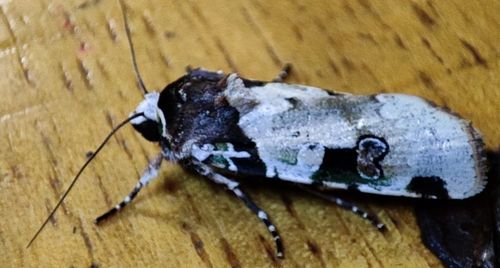
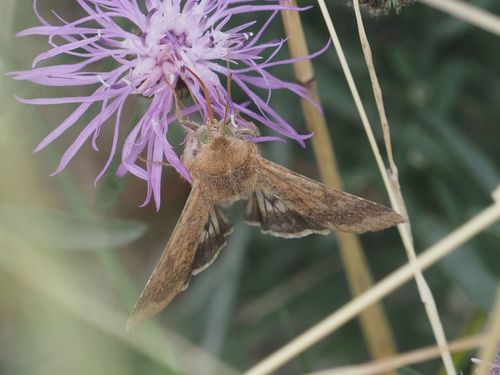
Brithys crini, the amaryllis borer, crinum borer, lily borer or Kew arches, is a moth of the family Noctuidae. It is a garden pest in parts of its range, as their larvae damage the stems and leaves of lilies, especially lilies of the family Amaryllidaceae.

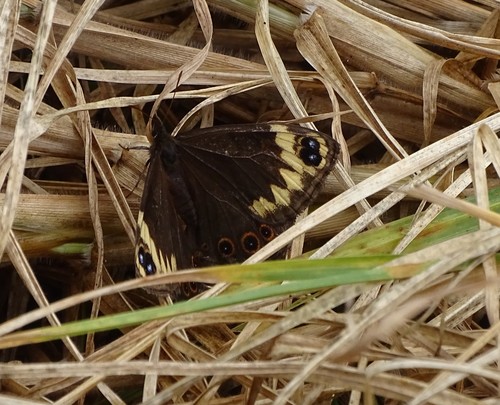
It is found in the coastal areas of Southern Europe and North Africa, south to South Africa. Furthermore, it is found in Japan and in Queensland and Northern Territory in Australia towards India and Sri Lanka. The wingspan of the moth is about 40 mm. Its head, thorax and forewings are very dark brown, but paler toward the wingtips. Sub-basal, median and postmedial indistinct waved lines are black. A curved submarginal ochreous line with ferrous colored lunules found on each side of it. There is a marginal black lunule series. The hindwings are practically white. Tarsi bear black and white stripes. In Europe the adults are on the wing in July.

There are several generations per year, though development slows down in cooler seasons, when the larvae sometimes overwinter by boring into the bulbs of the host plants. The moth lays clusters of a few dozen eggs on the host plant leaves. The... Wikipedia →

Global Distribution

Parks Where Found

# Park Country Daily sighting probability
1 Table Mountain National Park 🇿🇦 South Africa
~10%
2 Garden Route National Park 🇿🇦 South Africa
<5%

Cities Where Found

# City Country Daily sighting probability
1 Pretoria 🇿🇦 South Africa
~10%
2 Johannesburg 🇿🇦 South Africa
~10%
3 Cape Town 🇿🇦 South Africa
~10%
4 Durban 🇿🇦 South Africa
~10%
5 Harare 🇿🇼 Zimbabwe
~10%
6 Porto 🇵🇹 Portugal
<5%
7 Chennai 🇮🇳 India
<5%
8 Brisbane 🇦🇺 Australia
<5%
9 Tokyo 🇯🇵 Japan
<5%

Before you go

What are the chances of seeing a Lily Borer in Garden Route National Park?

Rare

Under 5% of wildlife watchers report a Lily Borer sighting in Garden Route National Park on a given day, based on 9 verified sightings from GBIF citizen-science data from 2019 to 2026. It is the 183rd most-seen of the 298 insects we can rate there. Over three days the chance rises to about 10%, and over a week to about 30%, if each day is a fresh chance.

When is the best time to see a Lily Borer in Garden Route National Park?

March, May, August–September and December–January

In those months about 10% of wildlife watchers report a Lily Borer in Garden Route National Park on a given day, against under 5% in February, April, June–July and October–November, the lowest months.

What time of day is best to see a Lily Borer?

Between 9 am and noon

Across all the parks we cover, that three-hour window holds the most Lily Borer sightings with a recorded time, and about 9 in 10 of them come between 6 am and 6 pm: it is a daytime animal.

Is Garden Route National Park the best place to see a Lily Borer?

2nd of 2

Of the 2 parks where we can rate Lily Borer sightings, Garden Route National Park ranks 2nd at under 5%. The best odds are in Table Mountain National Park (South Africa, about 10%).

Where does the Lily Borer sighting chance come from?

GBIF citizen-science records

It is estimated from how often the Lily Borer is recorded against all the insects logged in Garden Route National Park (9 verified sightings from 2019 to 2026), calibrated against known sighting rates. Figures are rounded to the nearest 10% because citizen-science data supports honest approximations, not decimals, and months with records from fewer than five people show "—". How it works.

← Back to Garden Route National Park