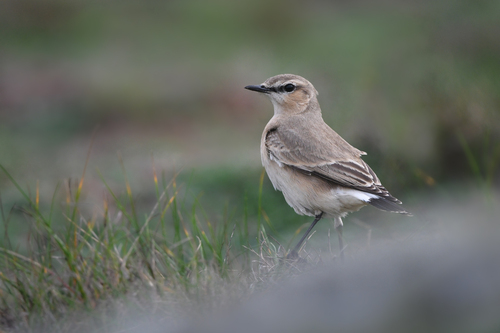
Asian Desert Warbler

Asian Desert Warbler

Sylvia nana

Silhouette: Martin Bulla, based on John Cox's illustration · PhyloPic

Daily sighting probability ~20% · Possible
at Gobi Gurvansaikhan National Park

In 3 days ~50% in a week ~80%

75 Verified sightings at Gobi Gurvansaikhan National Park From 2019 to 2026
75 In 1 park
July Best month
☀️ Diurnal When it's spotted

About the Asian Desert Warbler

The Asian desert warbler (Curruca nana) is an Old World warbler which breeds in the deserts of central and western Asia and the extreme east of Europe (Volga Delta area east to western Inner Mongolia in China), and migrating to similar habitats in southwestern Asia (Arabia to northwestern India) and the far northeast of Africa (Red Sea coastal regions) in winter. Until recently it was considered conspecific with the African desert warbler (and called just "desert warbler"), but is now given specific status. The two are still each other's closest living relatives, and their relationships to other typical warblers are not clear. They may be fairly close to the common whitethroat; particularly, female whitethroats look much like a richly coloured Asian desert warbler. But it seems that all these three taxa are fairly basal members of the genus.

It is a small bird (the second-smallest in the genus after African desert warbler), 11.5–12.5 cm long. The sexes are almost identical in colour, pale grey-brown above with browner wings and tail, and whitish below; the bill and legs are yellowish, and the eye has a yellow iris. Like its relatives, it is insectivorous, but will also take small berries; unlike most warblers, it commonly feeds on the ground. The song is a distinctive jingle often given in an advertisement flight, with a mix of clear and harsher notes. It breeds in semi-desert and dry steppe environments, as long as some bushes for nesting occur. The nest is built in low shrub, and 4–6 eggs are laid.

It has occurred as a rare vagrant as far west as Great Britain. The specific nana is Latin for "dwarf", from earlier Ancient Greek nanos. Wikipedia →

Sounds

Recording0:20

Mongolia · 2025

© Donna Pomeroy · iNaturalist · CC BY-NC 4.0

Global Distribution

Parks Where Found

# Park Country Daily sighting probability
1 Gobi Gurvansaikhan National Park 🇲🇳 Mongolia
~20%

More parks will be added in future updates.

Cities Where Found

# City Country Daily sighting probability
1 Abu Dhabi 🇦🇪 United Arab Emirates
<5%
2 Doha 🇶🇦 Qatar
<5%
3 Beijing 🇨🇳 China
<5%

Before you go

What are the chances of seeing an Asian Desert Warbler in Gobi Gurvansaikhan National Park?

Possible

About 20% of wildlife watchers report an Asian Desert Warbler sighting in Gobi Gurvansaikhan National Park on a given day, based on 75 verified sightings from GBIF citizen-science data from 2019 to 2026. It is the 37th most-seen of the 122 birds we can rate there. Over three days the chance rises to about 50%, and over a week to about 80%, if each day is a fresh chance.

When is the best time to see an Asian Desert Warbler in Gobi Gurvansaikhan National Park?

May and July

In those months about 30% of wildlife watchers report an Asian Desert Warbler in Gobi Gurvansaikhan National Park on a given day, against about 10% in September and December, the lowest months. January–April and October–November have too few records to rate.

What time of day is best to see an Asian Desert Warbler?

Between 7 and 10 am

Across all the parks we cover, that three-hour window holds the most Asian Desert Warbler sightings with a recorded time, and about 9 in 10 of them come between 6 am and 6 pm: it is a daytime animal.

Where else can you see an Asian Desert Warbler?

Only Gobi Gurvansaikhan National Park, in our data

Gobi Gurvansaikhan National Park is the only park on Wallace's Line with enough records to rate Asian Desert Warbler sightings: about 20% of wildlife watchers there report one on a given day.

Which relatives of the Asian Desert Warbler live in Gobi Gurvansaikhan National Park?

Same genus: Sylvia

The closest relatives of the Asian Desert Warbler that you can see in Gobi Gurvansaikhan National Park (genus Sylvia, Sylvia Warblers) are Whitethroat (about 30%), Barred Warbler (about 20%) and Lesser Whitethroat (about 10%), with each one's daily chance of a sighting.

Where does the Asian Desert Warbler sighting chance come from?

GBIF citizen-science records

It is estimated from how often the Asian Desert Warbler is recorded against all the birds logged in Gobi Gurvansaikhan National Park (75 verified sightings from 2019 to 2026), calibrated against known sighting rates. Figures are rounded to the nearest 10% because citizen-science data supports honest approximations, not decimals, and months with records from fewer than five people show "—". How it works.

← Back to Gobi Gurvansaikhan National Park