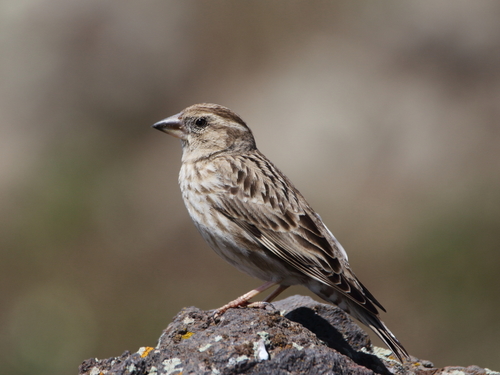
Mongolian Ground-Jay

Mongolian Ground-Jay

Podoces hendersoni

Silhouette: Sheatherius · PhyloPic

LCLeast ConcernNTVUENCR
Daily sighting probability ~20% · Possible
at Gobi Gurvansaikhan National Park

In 3 days ~50% in a week ~80%

75 Verified sightings at Gobi Gurvansaikhan National Park From 2019 to 2026
75 In 1 park
September Best month
☀️ Diurnal When it's spotted

About the Mongolian Ground-Jay

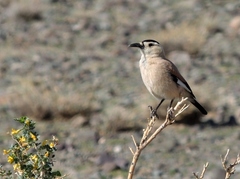
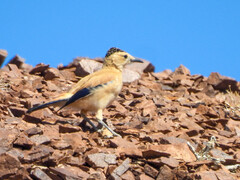
The Mongolian ground jay (Podoces hendersoni) or Henderson's ground jay is a species of bird in the family Corvidae, found in Central Asia. The bird is 28 cm (11 in) in length, with sandy-beige upperparts, off-white breast, and iridescent dark blue on the secondary feathers, and on the tips of the primary feathers. It has a long, decurved beak and a black stripe on its forehead.

It is found in arid areas of Central Asia (Mongolia, northern China and adjacent areas of Russia and Kazakhstan). It is threatened by habitat loss and fragmentation. It tends to live on areas with gravel surfaces. Eggs are typically laid and hatched in April-May. They nest in Prunus pedunculata. Females spend more time foraging and the males spend more time brooding the chicks at the start of the nesting period.

They are most active in the morning. Among ground jays, they have a relatively short trill call. The main diet of the nestling Mongolian ground jay consists of common lizards, toad-headed agama, and invertebrates. It is proposed that Mongolian ground jays feed their chicks based on the availability of their food rather than in relation... Wikipedia →
Sounds

Call1:02

China · 2019

© Peter Boesman · XC491475 · CC BY-NC-ND 4.0

Song0:29

Mongolia · 2019

© Frank Lambert · XC481532 · CC BY-NC-ND 4.0

Nocturnal flight call0:23

Mongolia · 2017

© James Lidster · XC527225 · CC BY-NC-SA 4.0

Global Distribution

Parks Where Found

# Park Country Daily sighting probability
1 Gobi Gurvansaikhan National Park 🇲🇳 Mongolia
~20%

More parks will be added in future updates.

Before you go

What are the chances of seeing a Mongolian Ground-Jay in Gobi Gurvansaikhan National Park?

Possible

About 20% of wildlife watchers report a Mongolian Ground-Jay sighting in Gobi Gurvansaikhan National Park on a given day, based on 75 verified sightings from GBIF citizen-science data from 2019 to 2026. It is the 40th most-seen of the 122 birds we can rate there. Over three days the chance rises to about 50%, and over a week to about 80%, if each day is a fresh chance.

When is the best time to see a Mongolian Ground-Jay in Gobi Gurvansaikhan National Park?

May and September

In those months about 30% of wildlife watchers report a Mongolian Ground-Jay in Gobi Gurvansaikhan National Park on a given day, against about 10% in December, the lowest month. January–April and October–November have too few records to rate.

What time of day is best to see a Mongolian Ground-Jay?

Between 8 and 11 am

Across all the parks we cover, that three-hour window holds the most Mongolian Ground-Jay sightings with a recorded time, and about 8 in 10 of them come between 6 am and 6 pm: it is a daytime animal.

Where else can you see a Mongolian Ground-Jay?

Only Gobi Gurvansaikhan National Park, in our data

Gobi Gurvansaikhan National Park is the only park on Wallace's Line with enough records to rate Mongolian Ground-Jay sightings: about 20% of wildlife watchers there report one on a given day.

Which relatives of the Mongolian Ground-Jay live in Gobi Gurvansaikhan National Park?

Same family: Corvidae

The closest relatives of the Mongolian Ground-Jay that you can see in Gobi Gurvansaikhan National Park (family Corvidae, Crows, Jays, and Magpies) are Common Raven (about 50%) and Red-billed Chough (about 40%), with each one's daily chance of a sighting.

Where does the Mongolian Ground-Jay sighting chance come from?

GBIF citizen-science records

It is estimated from how often the Mongolian Ground-Jay is recorded against all the birds logged in Gobi Gurvansaikhan National Park (75 verified sightings from 2019 to 2026), calibrated against known sighting rates. Figures are rounded to the nearest 10% because citizen-science data supports honest approximations, not decimals, and months with records from fewer than five people show "—". How it works.

← Back to Gobi Gurvansaikhan National Park