Pallas's Sandgrouse

Pallas's Sandgrouse

Syrrhaptes paradoxus

Silhouette: Andy Wilson · PhyloPic

LCLeast ConcernNTVUENCR
Daily sighting probability ~30% · Possible
at Gobi Gurvansaikhan National Park

In 3 days ~70% in a week ~90%

148 Verified sightings at Gobi Gurvansaikhan National Park From 2019 to 2026
148 In 1 park
December Best month
🌅 Crepuscular When it's spotted

About the Pallas's Sandgrouse

Pallas's sandgrouse (Syrrhaptes paradoxus) is a medium to large bird in the sandgrouse family. Marco Polo mentions a bird called Bargherlac (from Turkmen bağırlak) in The Travels of Marco Polo, published around 1300. This is probably Syrrhaptes paradoxus (S. pallasii).

Pallas's sandgrouse is named after the German zoologist Peter Simon Pallas. The scientific name is from Ancient Greek. The genus Syrrhaptes is from surrhaptos, meaning "sewn together" (the feathered toes of both species in the genus are fused together) and paradoxus is from paradoxos, meaning "strange".

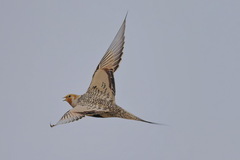
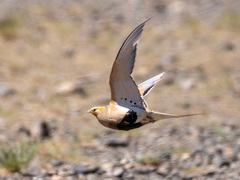
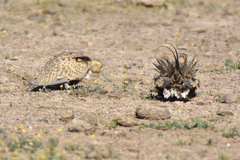
Pallas's sandgrouse is 30–41 cm (12–16 in) long with small, pigeon-like head and neck, but sturdy compact body. It has long pointed wings and tail and legs and toes are feathered. Its plumage is buff-coloured, barred above with a black belly patch and pale underwings. The black belly and pale underwing distinguish this species from the related Tibetan sandgrouse. The male Pallas's sandgrouse is distinguished by its grey head and breast, orange face and grey breast band. The female has duller plumage and lacks the breast band though it has more barring on the upperparts.

The small feet... Wikipedia →

Sounds

Call0:55

Kazakhstan · 2023

© Peter Boesman · XC813665 · CC BY-NC-ND 4.0

Flight call0:14

Mongolia · 2022

© Stanislas Wroza · XC765929 · CC BY-NC-SA 4.0

Call0:13

Mongolia · 2017

© Frank Lambert · XC468788 · CC BY-NC-ND 4.0

Global Distribution

Parks Where Found

# Park Country Daily sighting probability
1 Gobi Gurvansaikhan National Park 🇲🇳 Mongolia
~30%

More parks will be added in future updates.

Cities Where Found

# City Country Daily sighting probability
1 Bishkek 🇰🇬 Kyrgyzstan
<5%

Before you go

What are the chances of seeing a Pallas's Sandgrouse in Gobi Gurvansaikhan National Park?

Possible

About 30% of wildlife watchers report a Pallas's Sandgrouse sighting in Gobi Gurvansaikhan National Park on a given day, based on 148 verified sightings from GBIF citizen-science data from 2019 to 2026. It is the 31st most-seen of the 122 birds we can rate there. Over three days the chance rises to about 70%, and over a week to about 90%, if each day is a fresh chance.

When is the best time to see a Pallas's Sandgrouse in Gobi Gurvansaikhan National Park?

December

In that month about 60% of wildlife watchers report a Pallas's Sandgrouse in Gobi Gurvansaikhan National Park on a given day, against about 10% in September, the lowest month. January–April and October–November have too few records to rate.

What time of day is best to see a Pallas's Sandgrouse?

Between 4 and 7 am

Across all the parks we cover, that three-hour window holds the most Pallas's Sandgrouse sightings with a recorded time, and about half of them come between 6 pm and 6 am: it is most active around dawn and dusk.

Where else can you see a Pallas's Sandgrouse?

Only Gobi Gurvansaikhan National Park, in our data

Gobi Gurvansaikhan National Park is the only park on Wallace's Line with enough records to rate Pallas's Sandgrouse sightings: about 30% of wildlife watchers there report one on a given day.

Where does the Pallas's Sandgrouse sighting chance come from?

GBIF citizen-science records

It is estimated from how often the Pallas's Sandgrouse is recorded against all the birds logged in Gobi Gurvansaikhan National Park (148 verified sightings from 2019 to 2026), calibrated against known sighting rates. Figures are rounded to the nearest 10% because citizen-science data supports honest approximations, not decimals, and months with records from fewer than five people show "—". How it works.

← Back to Gobi Gurvansaikhan National Park