Saxaul Sparrow

Saxaul Sparrow

Passer ammodendri

Silhouette: Andrew Butko (modified) · PhyloPic

LCLeast ConcernNTVUENCR
Daily sighting probability ~20% · Possible
at Gobi Gurvansaikhan National Park

In 3 days ~50% in a week ~80%

104 Verified sightings at Gobi Gurvansaikhan National Park From 2019 to 2026
104 In 1 park
July Best month
☀️ Diurnal When it's spotted

About the Saxaul Sparrow

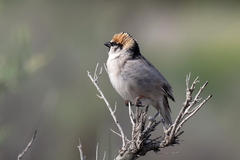
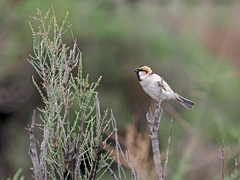
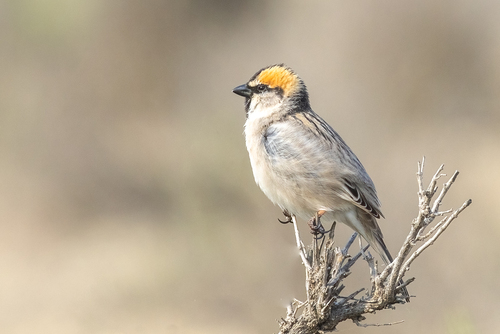
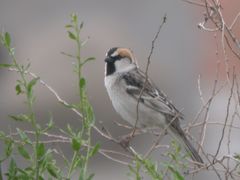
The saxaul sparrow (Passer ammodendri) is a passerine bird of the sparrow family (Passeridae), found in parts of Central Asia. At 14–16 centimetres (5.5–6.3 in) and 25–32 grams (0.88–1.13 oz), it is among the larger range of sparrows. Both sexes have plumage ranging from dull grey to sandy brown, and pale brown legs. Females have less boldly coloured plumage and bills, lacking the pattern of black stripes on the male's head. The head markings of both sexes make the saxaul sparrow distinctive and unlikely to be confused with any other bird. Vocalisations include a comparatively soft and musical chirping call, a song, and a flight call.

Three subspecies are recognised, differing in the overall tone of their plumage and in the head striping of the female. The subspecies ammodendri occurs in the west of the saxaul sparrow's range, while stoliczkae and nigricans occur in the east. This distribution falls into six probably disjunct areas across Central Asia, from central Turkmenistan to northern Gansu in China. A bird of deserts, the saxaul sparrow favours areas with shrubs such as the saxaul (Haloxylon), near rivers and oases. Though it has lost parts of its range to habitat destruction caused by agriculture, it is not seriously threatened by human activities.

Little is known of the saxaul sparrow's behaviour. Often hidden in foliage, it forages in trees and on the ground. It feeds mostly on seeds, such as from saxaul, as well as insects while breeding and as a nestling. When not breeding, it forms wandering flocks, but it is less social than other sparrows while breeding, often nesting in isolated pairs. Nests are round bundles of dry plant material lined with soft materials such as feathers. They are built in holes in tree cavities, earth banks, rocky slopes, and within man-made structures or the nests of birds of prey. Two clutches of five or six eggs are typically laid in a season. Both parents construct the nest and care for their eggs and young. Wikipedia →
Sounds

Alarm call0:52

Kazakhstan · 2023

© Ding Li Yong · XC814274 · CC BY-NC-ND 4.0

Call0:51

Kazakhstan · 2023

© Peter Boesman · XC813563 · CC BY-NC-ND 4.0

Song0:53

Kazakhstan · 2014

© R. Martin · XC236702 · CC BY-NC-ND 4.0

Global Distribution

Parks Where Found

# Park Country Daily sighting probability
1 Gobi Gurvansaikhan National Park 🇲🇳 Mongolia
~20%

More parks will be added in future updates.

Before you go

What are the chances of seeing a Saxaul Sparrow in Gobi Gurvansaikhan National Park?

Possible

About 20% of wildlife watchers report a Saxaul Sparrow sighting in Gobi Gurvansaikhan National Park on a given day, based on 104 verified sightings from GBIF citizen-science data from 2019 to 2026. It is the 38th most-seen of the 122 birds we can rate there. Over three days the chance rises to about 50%, and over a week to about 80%, if each day is a fresh chance.

When is the best time to see a Saxaul Sparrow in Gobi Gurvansaikhan National Park?

June and July

In those months about 30% of wildlife watchers report a Saxaul Sparrow in Gobi Gurvansaikhan National Park on a given day, against about 10% in August–September and December, the lowest months. January–April and October–November have too few records to rate.

What time of day is best to see a Saxaul Sparrow?

Between noon and 3 pm

Across all the parks we cover, that three-hour window holds the most Saxaul Sparrow sightings with a recorded time, and about 9 in 10 of them come between 6 am and 6 pm: it is a daytime animal.

Where else can you see a Saxaul Sparrow?

Only Gobi Gurvansaikhan National Park, in our data

Gobi Gurvansaikhan National Park is the only park on Wallace's Line with enough records to rate Saxaul Sparrow sightings: about 20% of wildlife watchers there report one on a given day.

Where does the Saxaul Sparrow sighting chance come from?

GBIF citizen-science records

It is estimated from how often the Saxaul Sparrow is recorded against all the birds logged in Gobi Gurvansaikhan National Park (104 verified sightings from 2019 to 2026), calibrated against known sighting rates. Figures are rounded to the nearest 10% because citizen-science data supports honest approximations, not decimals, and months with records from fewer than five people show "—". How it works.

← Back to Gobi Gurvansaikhan National Park