Black Wildebeest

Black Wildebeest

Connochaetes gnou

Silhouette: Deon de Jager based on this photo by Bernard Dupont: http://bit.ly/3KD3Ejt · PhyloPic

LCLeast ConcernNTVUENCR
Daily sighting probability ~80% · Very likely
at Golden Gate Highlands National Park

In 3 days >90%

73 Verified sightings at Golden Gate Highlands National Park From 2019 to 2026
73 In 1 park
May Best month
☀️ Diurnal When it's spotted

About the Black Wildebeest

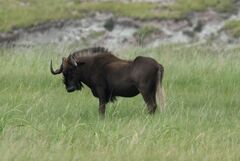
The black wildebeest or white-tailed gnu (Connochaetes gnou) is one of the two closely related wildebeest species. It is a member of the genus Connochaetes and family Bovidae. It was first described in 1780 by Eberhard August Wilhelm von Zimmermann. The black wildebeest is typically 1.7–2.2 m (5 ft 7 in – 7 ft 3 in) in head-and-body length, and the typical weight is 110–180 kg (240–400 lb). Males stand about 1.11–1.21 m (3 ft 8 in – 4 ft 0 in) at the shoulder, while the height of the females is 1.06–1.16 m (3 ft 6 in – 3 ft 10 in). The black wildebeest is characterised by its white, long, horse-like tail. It also has a dark brown to black coat and long, dark-coloured hair between its forelegs and under its belly.

The black wildebeest is an herbivore, and almost the whole diet consists of grasses. Water is an essential requirement. The three distinct social groups are the female herds, the bachelor herds, and the territorial bulls. They are fast runners and communicate using a variety of visual and vocal communications. The primary breeding season for the black wildebeest is from February to April. A single calf is usually born after a gestational period of about 8.5 months. The calf remains with its mother until her next calf is born a year later. The black wildebeest inhabits open plains, grasslands, and karoo shrublands.

The natural populations of black wildebeest, endemic in the southern part of Africa, were almost completely exterminated in the 19th century, due to their reputation as pests and the value of their hides and meat, but the species has been reintroduced widely from captive specimens, both in private areas and nature reserves throughout most of Lesotho, Eswatini, and South Africa. The species has also been introduced outside its natural range in Namibia and Kenya. Wikipedia →

Global Distribution

Parks Where Found

# Park Country Daily sighting probability
1 Golden Gate Highlands National Park 🇿🇦 South Africa
~80%

More parks will be added in future updates.

Zoos & Centres Where Found

# Zoo / Centre Country
1 Moscow Zoo 🇷🇺 Russia In captivity
2 Réserve africaine de Sigean 🇫🇷 France In captivity
3 Badoca Safari Park 🇵🇹 Portugal In captivity
4 Wow Safari Thoiry 🇫🇷 France In captivity
5 Réserve africaine de Thoiry 🇫🇷 France In captivity
6 Selwo Aventura 🇪🇸 Spain In captivity
7 Yerevan Zoo 🇦🇲 Armenia In captivity
8 Zoo Aquarium de Madrid 🇪🇸 Spain In captivity
9 Chapultepec Zoo 🇲🇽 Mexico In captivity
10 Zoo Santo Inácio 🇵🇹 Portugal In captivity
11 Réserve américaine de Thoiry 🇫🇷 France In captivity
12 Reserva Zoológica Oasys MiniHollywood 🇪🇸 Spain In captivity

Before you go

What are the chances of seeing a Black Wildebeest in Golden Gate Highlands National Park?

Very likely

About 80% of wildlife watchers report a Black Wildebeest sighting in Golden Gate Highlands National Park on a given day, based on 73 verified sightings from GBIF citizen-science data from 2019 to 2026. It is the most-seen of the 8 mammals we can rate there. Over three days the chance rises to over 90%, if each day is a fresh chance.

When is the best time to see a Black Wildebeest in Golden Gate Highlands National Park?

May

In that month about 90% of wildlife watchers report a Black Wildebeest in Golden Gate Highlands National Park on a given day, against about 30% in July, the lowest month. That is one of Golden Gate Highlands National Park's driest months, with about 20 mm of rain against 130 mm in January.

What time of day is best to see a Black Wildebeest?

Between 8 and 11 am

Across all the parks we cover, that three-hour window holds the most Black Wildebeest sightings with a recorded time, and nearly all of them come between 6 am and 6 pm: it is a daytime animal.

Where else can you see a Black Wildebeest?

Only Golden Gate Highlands National Park, in our data

Golden Gate Highlands National Park is the only park on Wallace's Line with enough records to rate Black Wildebeest sightings: about 80% of wildlife watchers there report one on a given day.

Which relatives of the Black Wildebeest live in Golden Gate Highlands National Park?

Same family: Bovidae

The closest relatives of the Black Wildebeest that you can see in Golden Gate Highlands National Park (family Bovidae, Bovids) are Bontebok/Blesbok (about 60%), Common Rhebok (about 40%) and Common Eland (about 40%), with each one's daily chance of a sighting.

Where does the Black Wildebeest sighting chance come from?

GBIF citizen-science records

It is estimated from how often the Black Wildebeest is recorded against all the mammals logged in Golden Gate Highlands National Park (73 verified sightings from 2019 to 2026), calibrated against known sighting rates. Figures are rounded to the nearest 10% because citizen-science data supports honest approximations, not decimals, and months with records from fewer than five people show "—". How it works.

← Back to Golden Gate Highlands National Park