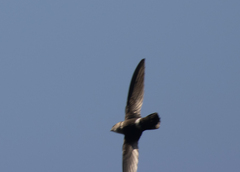
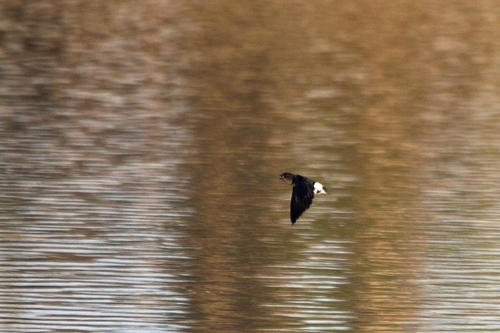
Mottled Spinetail

Mottled Spinetail

Telacanthura ussheri

Silhouette: Aviceda (vectorized by T. Michael Keesey) · PhyloPic

LCLeast ConcernNTVUENCR
Daily sighting probability <5% · Rare
at Gonarezhou National Park

In 3 days ~10% in a week ~30%

7 Verified sightings at Gonarezhou National Park From 2019 to 2026
479 In all 9 parks
May Best month
☀️ Diurnal When it's spotted

About the Mottled Spinetail

The mottled spinetail (Telacanthura ussheri) is a species of swift in the family Apodidae. It is found in Angola, Benin, Burkina Faso, Cameroon, Central African Republic, Republic of the Congo, Democratic Republic of the Congo, Ivory Coast, Equatorial Guinea, Gabon, Gambia, Ghana, Guinea, Guinea-Bissau, Kenya, Liberia, Malawi, Mali, Mozambique, Niger, Nigeria, Senegal, Sierra Leone, Somalia, South Africa, Tanzania, Togo, Uganda, Zambia, and Zimbabwe.

The mottled spinetail was formally described in 1870 by the English ornithologist Richard Bowdler Sharpe based on a specimen collected near Fort Victoria, Cape Coast, in present-day Ghana, by the British colonial administrator Herbert Taylor Ussher. Ussher would later become Governor of the Gold Coast. Sharpe coined the binomial name Chaetura ussheri where the specific epithet was named after the collector. The mottled spinetail is now placed together with the black spinetail in the genus Telacanthura that was introduced in 1918 by the Australian-born ornithologist Gregory Mathews.

Four subspecies are recognised: Wikipedia →

Sounds

Call0:17

Kenya · 2024

© Peter Boesman · XC948496 · CC BY-NC-ND 4.0

Call0:05

Tanzania · 2003

© Louis A. Hansen · XC124661 · CC BY-NC-SA 3.0

Global Distribution

Parks Where Found

# Park Country Daily sighting probability
1 Tarangire National Park 🇹🇿 Tanzania
~20%
2 Niokolo-Koba National Park 🇸🇳 Senegal
~20%
3 Mana Pools National Park 🇿🇼 Zimbabwe
~10%
4 Ruaha National Park 🇹🇿 Tanzania
~10%
5 Lower Zambezi National Park 🇿🇲 Zambia
~10%
6 Gonarezhou National Park 🇿🇼 Zimbabwe
<5%
7 Kibale National Park 🇺🇬 Uganda
<5%
8 Arusha National Park 🇹🇿 Tanzania
<5%
9 Kruger National Park 🇿🇦 South Africa
<5%

Cities Where Found

# City Country Daily sighting probability
1 Lagos 🇳🇬 Nigeria
~10%
2 Accra 🇬🇭 Ghana
<5%
3 Serrekunda 🇬🇲 Gambia
<5%

Before you go

What are the chances of seeing a Mottled Spinetail in Gonarezhou National Park?

Rare

Under 5% of wildlife watchers report a Mottled Spinetail sighting in Gonarezhou National Park on a given day, based on 7 verified sightings from GBIF citizen-science data from 2019 to 2026. It is the 224th most-seen of the 233 birds we can rate there. Over three days the chance rises to about 10%, and over a week to about 30%, if each day is a fresh chance.

When is the best time to see a Mottled Spinetail in Gonarezhou National Park?

May and October

In those months about 10% of wildlife watchers report a Mottled Spinetail in Gonarezhou National Park on a given day, against under 5% in February, July–September and November, the lowest months. Those are among Gonarezhou National Park's driest months, with about 15 mm of rain a month against 150 mm in January. March–April, June and December–January have too few records to rate.

What time of day is best to see a Mottled Spinetail?

Between 8 and 11 am

Across all the parks we cover, that three-hour window holds the most Mottled Spinetail sightings with a recorded time, and about 9 in 10 of them come between 6 am and 6 pm: it is a daytime animal.

Which relatives of the Mottled Spinetail live in Gonarezhou National Park?

Same family: Apodidae

The closest relatives of the Mottled Spinetail that you can see in Gonarezhou National Park (family Apodidae, Swifts) are African Palm-Swift (about 30%), Little Swift (about 30%) and White-rumped Swift (about 10%), with each one's daily chance of a sighting.

Where does the Mottled Spinetail sighting chance come from?

GBIF citizen-science records

It is estimated from how often the Mottled Spinetail is recorded against all the birds logged in Gonarezhou National Park (7 verified sightings from 2019 to 2026), calibrated against known sighting rates. Figures are rounded to the nearest 10% because citizen-science data supports honest approximations, not decimals, and months with records from fewer than five people show "—". How it works.

← Back to Gonarezhou National Park