Fasciated Snake Eagle

Fasciated Snake Eagle

Circaetus fasciolatus

Silhouette: Sheatherius · PhyloPic

LCNTNear ThreatenedVUENCR
Daily sighting probability <5% · Rare
at Gorongosa National Park

In 3 days ~10% in a week ~20%

14 Verified sightings at Gorongosa National Park From 2019 to 2026
264 In all 3 parks
February Best month
☀️ Diurnal When it's spotted

About the Fasciated Snake Eagle

The southern banded snake eagle (Circaetus fasciolatus), also known as the East African snake eagle or fasciated snake eagle, is a species of snake eagle in the family Accipitridae which is found in eastern Sub-Saharan Africa.

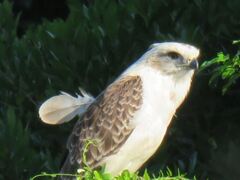
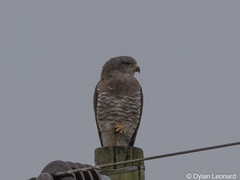
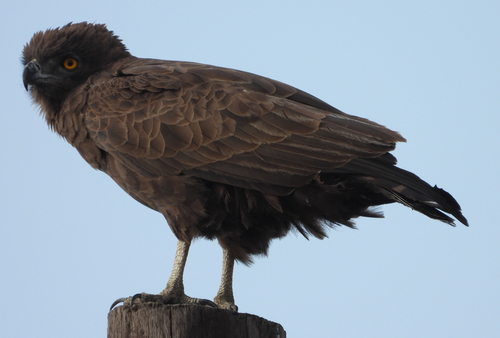
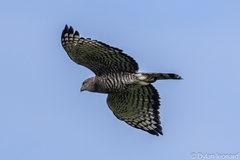
The southern banded snake eagle is a rather small, stocky snake eagle with a large, rounded head which has a hooded beak. It has a grey-brown head contrasting slightly with the mainly blackish-brown upperparts and whitish underparts. The tail has a white tip and shows three distinct dark bands on the underside. The large eyes are pale yellow eyes, the feet and cere are yellow and the bill us black. The juvenile lacks the grey head, has mainly dark upperparts and the whitish pale underparts are marked with dark streaks on the face, throat and upper breast. The total length varies from 55 to 60 cm with females larger than males.

The southern banded snake eagle is unobtrusive and is normally found due to its noisy, high-pitched call, "ko-ko-ko-kaw", repeatedly made either from a perch or while in flight. The southern banded snake eagle occurs in a narrow band along the east African coast from southern Somalia to the... Wikipedia →

Sounds

Call0:15

Kenya · 2022

© Magnus Wadstein · XC775493 · CC BY-NC-SA 4.0

Recording0:15

South Africa · 2021

© magdastlucia · iNaturalist · CC BY-NC 4.0

Global Distribution

Parks Where Found

# Park Country Daily sighting probability
1 iSimangaliso Wetland Park 🇿🇦 South Africa
~10%
2 Gorongosa National Park 🇲🇿 Mozambique
<5%
3 uMkhuze Game Reserve 🇿🇦 South Africa
<5%

Before you go

What are the chances of seeing a Fasciated Snake Eagle in Gorongosa National Park?

Rare

Under 5% of wildlife watchers report a Fasciated Snake Eagle sighting in Gorongosa National Park on a given day, based on 14 verified sightings from GBIF citizen-science data from 2019 to 2026. It is the 202nd most-seen of the 250 birds we can rate there. Over three days the chance rises to about 10%, and over a week to about 20%, if each day is a fresh chance.

When is the best time to see a Fasciated Snake Eagle in Gorongosa National Park?

February and September–October

In those months about 10% of wildlife watchers report a Fasciated Snake Eagle in Gorongosa National Park on a given day, against under 5% in April–August and November, the lowest months. March and December–January have too few records to rate.

What time of day is best to see a Fasciated Snake Eagle?

Between 7 and 10 am

Across all the parks we cover, that three-hour window holds the most Fasciated Snake Eagle sightings with a recorded time, and about 9 in 10 of them come between 6 am and 6 pm: it is a daytime animal.

Is Gorongosa National Park the best place to see a Fasciated Snake Eagle?

2nd of 3

Of the 3 parks where we can rate Fasciated Snake Eagle sightings, Gorongosa National Park ranks 2nd at under 5%. The best odds are in iSimangaliso Wetland Park (South Africa, about 10%).

Which relatives of the Fasciated Snake Eagle live in Gorongosa National Park?

Same genus: Circaetus

The closest relatives of the Fasciated Snake Eagle that you can see in Gorongosa National Park (genus Circaetus, Snake-Eagles) are Brown Snake Eagle (about 10%) and Black-breasted Snake Eagle (about 10%), with each one's daily chance of a sighting.

Where does the Fasciated Snake Eagle sighting chance come from?

GBIF citizen-science records

It is estimated from how often the Fasciated Snake Eagle is recorded against all the birds logged in Gorongosa National Park (14 verified sightings from 2019 to 2026), calibrated against known sighting rates. Figures are rounded to the nearest 10% because citizen-science data supports honest approximations, not decimals, and months with records from fewer than five people show "—". How it works.

← Back to Gorongosa National Park