Greater Sage Grouse

Greater Sage Grouse

Centrocercus urophasianus

Silhouette: Richard Rich · PhyloPic

LCNTVUVulnerableENCR
Daily sighting probability <5% · Rare
at Grand Teton National Park

In 3 days <5% in a week ~10%

110 Verified sightings at Grand Teton National Park From 2019 to 2026
110 In 1 park
January Best month
☀️ Diurnal When it's spotted

About the Greater Sage Grouse

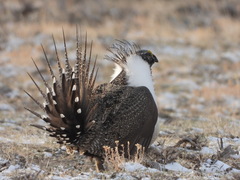
The greater sage-grouse (Centrocercus urophasianus), also known as the sagehen, is the largest grouse in North America. Its range is sagebrush country in the western United States and southern Alberta and Saskatchewan, Canada. It was known as simply the sage grouse until the Gunnison sage-grouse was recognized as a separate species in 2000. The Mono Basin population of sage grouse may also be distinct.

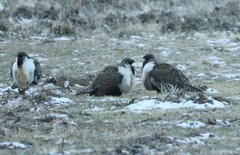
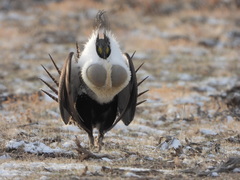
The greater sage-grouse is a permanent resident in its breeding grounds but may move short distances to lower elevations during winter. It makes use of a complex lek system in mating and nests on the ground under sagebrush or grass patches. It forages on the ground, mainly eating sagebrush but also other plants and insects. Greater sage-grouse do not have a muscular crop and are not able to digest hard seeds like other grouse.

The species is in decline across its range due to habitat loss, and has been recognized as threatened or near threatened by several national and international organizations. Adult greater sage-grouse have a long, pointed tail and legs with feathers to the toes. The adult male has a yellow patch over each eye, is grayish on top with a white breast... Wikipedia →

Sounds

Lekking1:06

United States · 2021

© Scott Olmstead · XC634662 · CC BY-NC-SA 4.0

Drumming1:01

United States · 1982

© Peter Ward and Ken Hall · XC603749 · CC BY-NC-SA 4.0

Song1:10

United States · 2017

© Sue Riffe · XC368674 · CC BY-NC-SA 4.0

Global Distribution

Parks Where Found

# Park Country Daily sighting probability
1 Grand Teton National Park 🇺🇸 United States
<5%

More parks will be added in future updates.

Before you go

What are the chances of seeing a Greater Sage Grouse in Grand Teton National Park?

Rare

Under 5% of wildlife watchers report a Greater Sage Grouse sighting in Grand Teton National Park on a given day, based on 110 verified sightings from GBIF citizen-science data from 2019 to 2026. It is the 128th most-seen of the 185 birds we can rate there. Over three days the chance rises to under 5%, and over a week to about 10%, if each day is a fresh chance.

When is the best time to see a Greater Sage Grouse in Grand Teton National Park?

January and March–April

In those months about 10% of wildlife watchers report a Greater Sage Grouse in Grand Teton National Park on a given day, against under 5% in February and May–December, the lowest months.

What time of day is best to see a Greater Sage Grouse?

Between 6 and 9 am

Across all the parks we cover, that three-hour window holds the most Greater Sage Grouse sightings with a recorded time, and about 8 in 10 of them come between 6 am and 6 pm: it is a daytime animal.

Where else can you see a Greater Sage Grouse?

Only Grand Teton National Park, in our data

Grand Teton National Park is the only park on Wallace's Line with enough records to rate Greater Sage Grouse sightings: under 5% of wildlife watchers there report one on a given day.

Where does the Greater Sage Grouse sighting chance come from?

GBIF citizen-science records

It is estimated from how often the Greater Sage Grouse is recorded against all the birds logged in Grand Teton National Park (110 verified sightings from 2019 to 2026), calibrated against known sighting rates. Figures are rounded to the nearest 10% because citizen-science data supports honest approximations, not decimals, and months with records from fewer than five people show "—". How it works.

← Back to Grand Teton National Park